Nicholas Economides
Harvard Correspondent
Hockey coach Rob Rassey returns to Harvard — this time at the helm
/ Read time: 3 minutes
Harvard Correspondent
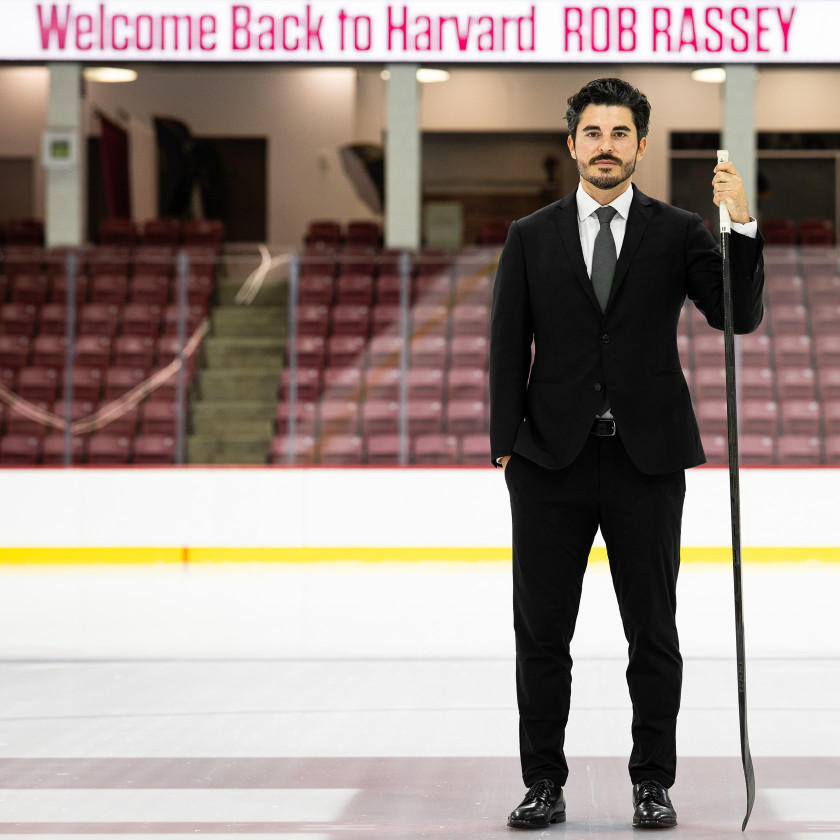
This Thursday, under the lights at The Bright-Landry Hockey Center, Rob Rassey, M.A. ’19, Robert D. Ziff ’88 Head Coach for Harvard Men’s Ice Hockey, will step into the rink and begin his tenure as the 12th Crimson coach in the program’s long and illustrious history.
Rassey first coached ice hockey at Harvard as an assistant coach from 2013 to 2019. He returned to Cambridge this summer after four years at the University of Michigan — and four straight NCAA tournament semifinal appearances — largely as an associate head coach. Rassey sat down with The FAS Current ahead of his opening game. He talked about his coaching journey, how he leads, and what he missed about Cambridge. This interview was edited for length and clarity.
What made a return to Harvard the best next step in your coaching journey?
The simple answer to that question is that it’s Harvard. The opportunity to start my head coaching career here was a no-brainer. It’s a place that I have a great connection to and where I coached a lot of amazing student-athletes and incredible teams. The most amazing thing about Harvard is the people and the pride they take in it.
What drew you to the coaching profession?
My dad coached youth hockey in the Detroit area for more than 20 years. Seeing the impact he had and hearing how people talked to me about him left a great impression. I coach to make an impact. When I was working as a scout for the Detroit Red Wings (2019–2021) in the NHL, it took me six months to realize where I was meant to be was working with people. I needed to work with players and help them grow, and to create an environment to help them develop. That’s what gets me going at the end of the day.
How would you describe your leadership style?
I am someone who brings a lot of energy, and I want the student-athletes to always feel comfortable coming to me and having a conversation. I’m going to hold them accountable to a standard, and I want to inspire confidence and help these kids reach their potential. Anthony Noreen was my first head coach as an assistant in the United States Hockey League. He gave me an opportunity to learn how to manage people, and I was always taken away by his energy and enthusiasm he brings every day. Having my dad coach me growing up was also very influential.
On the ice, how would you describe your brand of hockey?
People are going to see a team that is fast, both with and without the puck. Without the puck, we want to be extremely hard to play against and attack teams. With the puck, I use the term “connected and predictable.” We want to keep the puck on our stick as long as possible, and we are a team with predictable routing that should be fun to watch offensively.
You brought in two new assistant coaches, John Ronan and Tommy Davis. What do they bring to the staff?
I was lucky to build my staff with guys that I trust, individuals who are really good people and are really good at what they do. John was at Union College for a long time and what he did there from a recruiting and coaching side of things will help us. He will work with our forwards. Tommy is going to work with our defense. I coached Tommy in my first job in junior hockey for the Youngstown Phantoms, I’ve known him for a long time. He’s a great human being, and a worker.
How are you handling preseason preparation as you head toward the opener against UMass Amherst?
I feel like I have a good sense of how the schedule works after being an assistant here, I know training camp can be long. We don’t want to introduce too much too early. We are establishing habits and fundamentals, slowly building structure from there.
How has Harvard changed since you were here?
In the best way possible, it’s exactly the same. Everything that I love and remember about this place is still there. Pinocchio’s, El Jefe’s, Toscano, and Russell House Tavern are all my favorite spots in Harvard Square. Coming back, I’ve seen how special and unique this place is.
The project is unique “because all data, methods, and other procedures are public — something that is not true for any other public forecast we know of,” said co-creator Gary King.
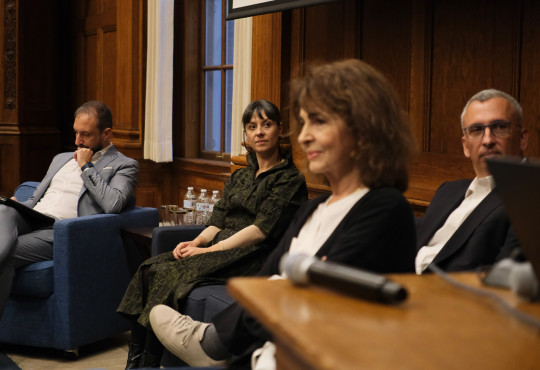
The multidisciplinary conversations Aristotle had with students at his Lyceum thousands of years ago might be useful today in thinking about humanity’s relationship with AI. At least, so says annual conference in Greece that brings together scientists, technologists, humanists, and civic leaders.

The First Proof consortium has repeatedly challenged AI systems to crack 10 tough research math problems. In the latest round of results, AI systems collectively solved all 10 but still lagged in the ability to clearly communicate and document their results.