Kermit Pattison
Harvard Staff Writer

Evolutionary biologist Erin Hecht on the ancient breed that can fine-tune according to surrounding sound
Harvard Staff Writer
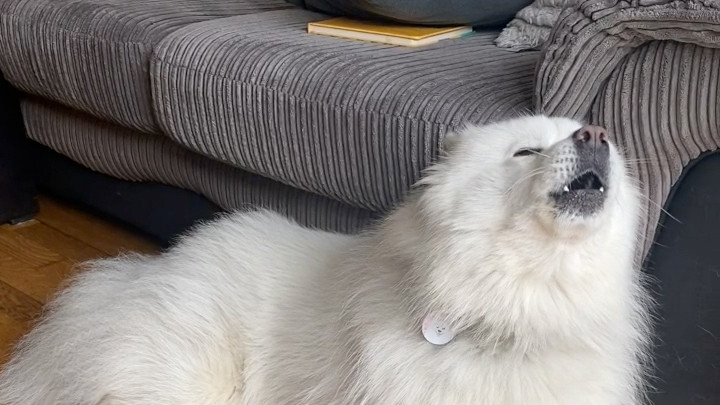
Forget howling at the moon. Lady Gaga and Imagine Dragons provide some dogs with the inspiration to yowl. As many dog owners can attest, everyday music can easily trigger the vocalizing — a phenomenon that has generated countless online videos and even a four-legged star on “America’s Got Talent.”
Some canines also manage to howl in tune. A new study co-authored by Harvard evolutionary biologists sheds light on how an ancient breed of dogs can adjust their pitch in response to the music they hear. In an article in Current Biology, Associate Professor of Human Evolutionary Biology Erin Hecht and colleagues describe fluffy white Samoyeds tuning their howls by up to four semitones (the equivalent of four keys on a piano).
In an interview, edited for length and clarity, Hecht discussed the study’s findings and shed light on the evolutionary origins of canine howling.
What inspired you to study howling?
This was a collaboration with Aniruddh D. Patel, a professor at Tufts University. He’s been studying vocal motor matching in various species and how animals might be able to modify their body movements or voices in order to match what they hear.
We have thought humans are pretty unique in the animal kingdom in their ability to modify the pitch of our voices, on the fly, to match what we’re hearing. That, of course, is a big part of singing along with a chorus of people. It’s thought that group singing probably played a big part in group social cohesion through human evolution.
Patel approached me about studying it since my lab studies dogs. This project came about during the pandemic when we were all stuck in our homes and trying to figure out what we could do that would be interesting and fun and address open research questions.
The question was whether dogs could howl along to sounds that they hear in the environment, and whether they're actively modulating the pitch of their voices to go along with that sound.
If you’re a dog or wolf, why do you howl?
In wolves, howling can regroup a social group — bring them all back together by letting individuals know where others are. It also can advertise the position of one group to another group, so they can be aware of each other’s territory. It’s a way to defend territory and to let another group know, “This is my space. Don't come over here.”
Dogs descend from wolves. If your dog is howling, is that the inner wolf coming out?
Yes! It’s an ancestral form of communication.
In the study, dogs howled to Handel, Perry Como, Lady Gaga, and Bradley Cooper. Who picked the songs?
The dogs got to pick. We just asked owners about what their dogs liked to howl to. They would tell us the most reliable triggers.
You tested the dogs by moving the pitch up or down on the same songs. One example was Luna, the Samoyed who howled along to “Shallow” by Lady Gaga and Bradley Cooper. If you’re a dog, why would you retune your howling?
We don't really know. It may or may not be a volitional thing on the part of the dog; it could be totally unconscious and automatic.
In this study, it was more common for them to adjust their pitch to match. I'm not really sure what's going on there. It could be that there's some sort of group cohesion purpose to matching up with your group members, in a similar way to humans. But that's just speculation. We did have one dog in this study that was altering pitch consistently away from what they were hearing, to be discordant.
Some dogs howl when they hear sirens — including one in this study. For canines, is music indistinguishable from an ambulance?
According to the humans who enrolled their dogs in the studies, some dogs howl to sirens but not music, and some to music but not sirens. Why? We don’t know yet! But this does suggest they can tell the difference.
What are the biggest learnings or insights from this study?
For a long time, humans have been interested in what makes our species unique, and we’ve been drawing these boxes around what makes us special — things that we can do that other animals can’t. Gradually, that pile of things that makes us special keeps getting whittled down. There are more similarities between us and other members of the animal kingdom than we like to think. Maybe this is one of those examples.

Two Harvard scientists describe a way to engineer the evolutionary landscape that viruses experience, pushing them away from dangerous variants and into evolutionary dead ends.

Amid the rhythms of the back-to-campus bustle, new faculty find themselves experiencing the same first-day excitement — and jitters. We dropped in on three, on the first day of their first classes.

As the sun sinks below the horizon, two scientists perch quietly beside a darkening field and wait for flashes of light. They have traveled far outside the city in search of research sites, because they study a group of creatures that have been driven to the margins of human settlements: fireflies.