Yahya Chaudhry
Harvard Staff Writer
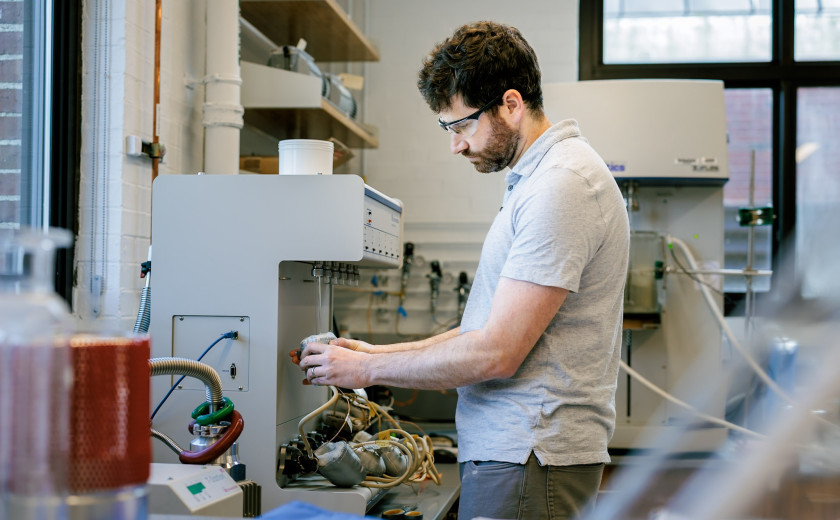
Gas-carrying technology from Jarad Mason’s lab reaches industry through the startup FluxBio
Harvard Staff Writer
In the race to build a biomanufacturing economy, one of the most stubborn obstacles is surprisingly mundane: getting enough gas into a tank of liquid.
From pharmaceuticals to alternative proteins, many technologies depend on microbes that need to breathe oxygen or consume other gases such as carbon dioxide and hydrogen. As fermenters scale up, the physics of gas-liquid mass transfer becomes a serious bottleneck. Operators respond with bigger compressors, higher pressures, and more powerful agitators, which add significant cost and complexity without solving the underlying problem.
A new Harvard‑linked startup, FluxBio, is betting that the solution lies not in bigger machines, but in re-engineering the liquid itself.
FluxBio traces its lab-to-market path back to Jarad Mason, Professor of Chemistry and Chemical Biology in the Department of Chemistry and Chemical Biology and associate faculty member at the Wyss Institute at Harvard University. Mason’s group designs porous materials and phase‑change solids for a variety of different applications. Microporous water — dispersions of tiny, gas-soaking crystals in water — grew out of that broader effort.
“We became aware of challenges associated with efficiently transporting gases through aqueous environments, which are ubiquitous across a wide range of biomedical and energy technologies,” Mason said. “We familiarized ourselves with technologies that had been developed to address these challenges, and none of them had really caught on because they did not work well enough.”
Microporous solids, with nanometer‑scale pores and enormous internal surface areas offered a different route. If those crystals could be dispersed and stabilized in water — without water flooding their pores — Mason theorized they might act as powerful, reusable gas carriers.
“You can think of microporous water as a kind of gas buffer; not a one-way storage vehicle, but more like a transport agent,” Mason said. “The particles increase the intrinsic gas‑carrying capacity of the aqueous media and play two roles: they enhance the rate at which gas is transferred from the bulk gas phase into solution, and they facilitate distribution of that gas throughout the entire solution.”
For Marika Ziesack Ph.D. ’18, a senior scientist at the Wyss Institute, the appeal was immediate and personal. She co‑founded Circe Bioscience, a climate‑tech company converting CO₂ into fats and oils and led its scale‑up.
“Circe brought its process from milliliters to thousands of liters, and that’s when I really saw what it takes to get biology from lab scale to industrial scale,” she said. “Both in traditional aerobic fermentation and in our custom reactor, the infrastructure just seemed not scalable to me, which was a mechanical problem.”
Today’s plants attack gas‑transfer limits with hardware solutions only. By raising the intrinsic gas-carrying capacity of the liquid itself, FluxBio takes a different path to increasing gas transfer, which, according to Ziesack, has no commercial equivalent to date.
“As an industry, we keep building power-hungry compressors, pushing more gas, stirring with powerful agitators, and then building larger reactors requiring more steel,” Ziesack, FluxBio founder and CEO, said. “This is what the industry has been doing for decades — no real change. All of it adds cost and complexity, and it’s just not working.”
Crucially, FluxBio’s approach is a drop-in that can be added directly to existing bioreactors without changing the equipment.
“There are nanobubble systems, hollow-fiber membranes, and new reactor designs, but all of them are still capex plays — you have to add or change equipment,” Ziesack said. “We’re the only scalable solution I know of that’s a true drop‑in additive for existing tanks, which makes it much easier to test and deploy.”
Backed by bioengineering veterans Professor Daniel Nocera and Professor Pamela Silver, who aided in the translation and validation of the Mason Lab’s technology, and funding from the Sustainable Futures Initiative as well as outside government funding from Defense Advanced Research Projects Agency, Office of Naval Research, Department of Energy, and the National Science Foundation, the team validated the technology across bioprocesses and de-risked product-market fit through intensive customer interviews and feasibility studies.
The early data astounded Ziesack.
“In our first gas‑fed experiments, we saw about a four‑fold improvement in biomass,” she said. “I’ve never seen that kind of jump in all my biomanufacturing experience. If we had this technology at my last company, it would have made a pivotal difference. That’s not an incremental optimization — that’s a game changer.”
When the team at CCB and the Wyss moved into a 2‑liter bioreactor, they again saw biomass roughly double, alongside reduced energy consumption. That prompted an analysis suggesting fewer failed batches, less compressed gas, lower stirring energy, and higher yields from existing steel in the ground.
“The technology can significantly reduce the amount of compressed gas that has to be fed into the bioreactor and reduce the energy that needs to be put into the reactor to keep it well stirred,” Mason said, “so you get operating‑expense savings and, more importantly, capital‑expense savings by boosting the space-time yield from your bioreactor.”
Behind FluxBio is a network of Harvard support aimed at turning lab insights into impact.
Mason’s project first drew the attention of the Blavatnik Biomedical Accelerator (BBA) starting in 2021.
“By providing relatively modest amounts of money — often a few hundred thousand dollars, up to about half a million — we can move Harvard’s biomedical technologies to a stage where they’re ready for industry investment,” said Curtis Keith, chief scientific officer of the BBA. “The overarching goal of the accelerator is to increase the chances that we can launch startup companies or, in some cases, license technologies to existing biotech and pharma.”
Biomedical research at Harvard has the potential to improve countless lives, revolutionize industries, and create immense social and economic value. Translating this early-stage research into compelling, validated technologies requires careful planning, focused resources, and a tireless pursuit of results.
The Blavatnik Biomedical Accelerator guides Harvard scientists toward translational impact by providing strategic, monetary, and advisory support for well-defined research projects. Our work is expressly aimed at hastening the pace of scientific progress, developing a shared vision with partners in industry, and ensuring that lifesaving technologies born at Harvard will become new products that impact the world for the better.
Learn more
As accelerator funding ended, work on cell compatibility and material removal moved into a collaboration with Landmark Bio, supported by Harvard’s Advanced Therapies Fund, a unique fund established by the Office of the Vice Provost for Research. The university’s Office of Technology Development (OTD) then helped structure the path to a spinout and recruit leadership.
“Our job isn’t just turning a handle and cranking out the same model for every company,” said Christopher Petty, director of business development for the physical sciences at OTD. “It’s really understanding what [founders] are trying to do and supporting that. Find the resources, find people like Marika. Find investors who are going to support that mission.”
He also emphasized that the relationship doesn’t end with a license.
“We’re not only focused on the patents or licensing patents. We are trying to help with the whole business picture,” Petty said. “I’m often working with startup companies for years before and after licensing a technology, supporting them in ways that help the company succeed and create meaningful impact.”
FluxBio’s near-term focus is clear: to help biomanufacturers get more out of the reactors they already own. The same gains in gas transfer that boost existing tanks also unlock smaller, simpler bioreactor designs, enabling a more decentralized approach to biomanufacturing that isn’t possible today.
Mason’s lab continues to explore in vivo uses of microporous materials — as artificial blood substitutes, as treatments for decompression sickness in collaboration with Boston Children’s Hospital and the U.S. Navy, and in other climate-relevant systems that rely on gas-hungry microbes.
This research was partially funded by U.S. Office of Naval Research, grant number N00014-19-1-2148.

Two Harvard scientists describe a way to engineer the evolutionary landscape that viruses experience, pushing them away from dangerous variants and into evolutionary dead ends.

Amid the rhythms of the back-to-campus bustle, new faculty find themselves experiencing the same first-day excitement — and jitters. We dropped in on three, on the first day of their first classes.

As the sun sinks below the horizon, two scientists perch quietly beside a darkening field and wait for flashes of light. They have traveled far outside the city in search of research sites, because they study a group of creatures that have been driven to the margins of human settlements: fireflies.