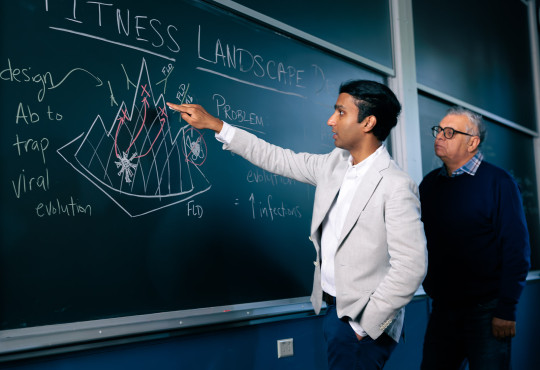
How to build an evolutionary trap for viruses
Two Harvard scientists describe a way to engineer the evolutionary landscape that viruses experience, pushing them away from dangerous variants and into evolutionary dead ends.
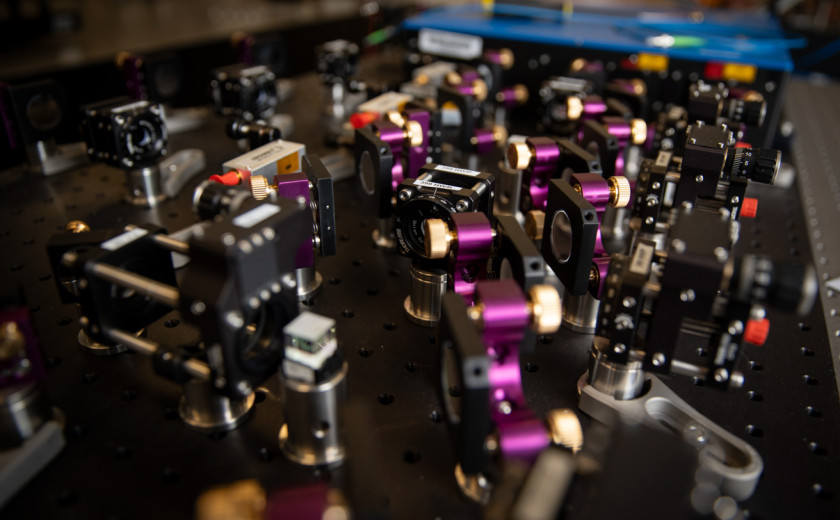
Yao, Hu, and academic peers will collaborate with government labs and industry while training the next generation of researchers
Harvard quantum scientists led by physics professor Norman Yao and close collaborators at other universities will receive more than $37 million from the National Science Foundation for a newly established Quantum Leap Challenge Institute (QLCI) on Fault-Tolerant Quantum Systems, Architectures and Applications.
The Harvard-led institute, a collaboration with Massachusetts Institute of Technology; University of California, Los Angeles; and Boston University, among others, is one of three newly funded QLCIs announced as part of a $290 million NSF investment. The three new institutes will complement five existing QLCIs across the United States.
The institute brings together 39 researchers across fields including mathematics, computer science, engineering, physics, and chemistry. Its four co-principal investigators are Evelyn Hu, Tarr-Coyne Professor of Applied Physics and of Electrical Engineering at the Harvard John A. Paulson School of Engineering and Applied Sciences (SEAS); Jason Cong (UCLA); Paola Cappellaro (MIT); and Aram Harrow (MIT).
The research group will address one of the central challenges in translating quantum science into applications: developing new methods to make quantum technologies more robust and resistant to the inherent fragility of quantum information.
“Revolutionary progress has been made in quantum science over the last decade, but the extreme vulnerability of quantum information to noise and unintended interactions remains a fundamental challenge,” Yao said. “There is no single route to making quantum systems robust. Some strategies encode quantum information so that errors can be detected and corrected; others harness interactions between particles to produce emergent forms of protection, in which robustness is built into the collective behavior of the system itself. Many of these ideas have now been demonstrated at the proof-of-principle level. The next challenge is to integrate them across the entire quantum stack — from materials and hardware to control, architecture, algorithms, and applications — so that we can build fault-tolerant quantum systems at a practically useful scale.”
The award of this grant is a recognition of the long-term, foundational investments made at Harvard in diverse areas of quantum science and engineering, ranging from theoretical foundations to the development of quantum sensors, quantum networks, and quantum computers in different physical platforms. Of late, the Harvard Quantum Initiative has augmented expertise in faculty and distinctive programs for students at both the graduate and undergraduate levels.
In its announcement, the NSF noted: “Just as an electronic calculator can outperform an abacus, a functional quantum computer could theoretically outperform every supercomputer for certain types of tasks. Similarly, new types of quantum sensors could precisely measure properties far too subtle or even impossible for current technologies to detect.”
The federal agency’s aim is to accelerate the impact of quantum technologies through collaborative partnerships within and between QLCIs, and through strong academic and industrial collaborations, Hu said. A key emphasis of these centers will be education and training programs that embrace and engage a larger number of students in hands-on activities that enhance learning and understanding and disseminate critical knowledge of quantum technologies to wider audiences.
“For more than four decades, NSF has been laying the foundational groundwork of research and discovery that is powering today’s modern quantum computing, sensing, and communication," said NSF leader Brian Stone. “It’s time for focused activities to leverage that base of knowledge to drive us even farther forward to the benefit of all Americans. The NSF Quantum Leap Challenge Institutes are a next step for us in understanding the quantum world we live in.”
Two Harvard scientists describe a way to engineer the evolutionary landscape that viruses experience, pushing them away from dangerous variants and into evolutionary dead ends.

Amid the rhythms of the back-to-campus bustle, new faculty find themselves experiencing the same first-day excitement — and jitters. We dropped in on three, on the first day of their first classes.

As the sun sinks below the horizon, two scientists perch quietly beside a darkening field and wait for flashes of light. They have traveled far outside the city in search of research sites, because they study a group of creatures that have been driven to the margins of human settlements: fireflies.