Eileen O’Grady
Harvard Staff Writer
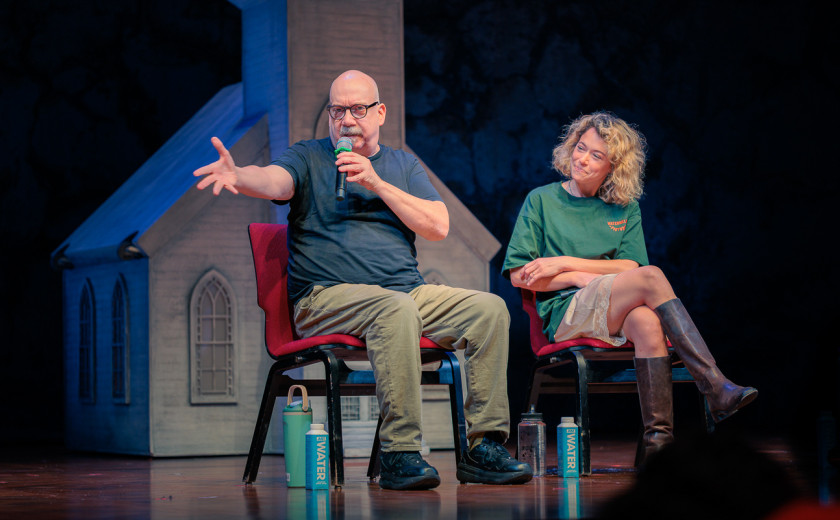
Cast of A.R.T. production shares trade secrets on getting into character
/ Read time: 5 minutes
Harvard Staff Writer
When Paul Giamatti was 7 years old, his mother, a high school English teacher, told him the story of the Eugène Ionesco play “Rhinoceros.” Giamatti was a monster enthusiast at the time, and something about the idea of a man turning into a rhinoceros lodged in his brain.
“It's a part I’ve always wanted to play because I get to do this animalistic thing,” Giamatti told a Loeb Drama Center audience September 17. “It was always out there, and I was like, ‘Someday, I’m going to get to turn into this monster.’”
At the panel hosted by the Office for the Arts at Harvard, Giamatti, who stars in “Rhinoceros” at the American Repertory Theater, talked with castmate Tatiana Maslany about the art of becoming and embodying character — human or otherwise. The conversation was moderated by the production’s director, Diane Paulus, Terrie & Bradley Bloom Artistic Director of the A.R.T.
Giamatti, known for movies like “Sideways” (2004), “American Splendor” (2003), and “The Holdovers” (2023), said that he experienced a moment of inspiration as a college sophomore after watching Dennis Hopper’s crazed villain performance in the 1986 David Lynch film “Blue Velvet.”
“Every time I acted, it brought me alive — because I could be a lunatic onstage, just do crazy things and get away with it,” Giamatti said. “Dennis Hopper’s performance, to me, exemplified the madness — what you could do.”
Maslany, who plays Daisy in “Rhinoceros,” said she was similarly inspired by seeing Gina Rowlands perform in John Cassavetes’ “A Woman Under the Influence” (1974).
“It totally blew my mind in terms of the capacity for what this art form could elicit in an audience,” said Maslany, known for the TV series “Orphan Black” (2013–2017). “The feeling I had watching Gina Rowlands was like, ‘Oh, this is limitless.’ The limit, the freedom that she explores in that, and the playfulness and the strangeness, I was like, ‘If I can touch one iota of that at any point during a process, that's enough for me.’”
In “Rhinoceros,” the 1959 absurdist French play running at the A.R.T. through September 27, a small-town clerk named Bérenger (John Turturro) has his life upended when his fellow citizens begin, one by one, to turn into raging, stampeding rhinoceroses. In the play, inspired by Ionesco’s experience watching the rise of fascism in Europe, Bérenger must choose whether to follow the herd.
Before his character’s noisy and feral transformation into an odd-toed ungulate at the end of Act II, Giamatti is often observed by his castmates sitting quietly in a chair backstage, appearing as if in a meditative state. When Paulus asked him about it, Giamatti confirmed that he uses a visualization technique to prepare for the scene.
“You hear about athletes running the race beforehand, and I’m doing that,” Giamatti explained. “I’m visualizing doing the thing. You see through it in some way before you do it, and I find it relaxing. It’s a preparation thing for that in particular.”
Giamatti, who said he has always been fascinated by “the monstrous and the grotesque,” loves a good physical challenge.
“To me, part of acting is pushing yourself bodily as far as you can go, and that’s especially true in theater,” he said. “What can I do in front of everybody that’s hyper real?” He credited Paulus with allowing him to act without restrictions. “She said, ‘That’s great, keep going, keep doing that.’”
Like Giamatti, Maslany loves collaborations with other creatives who take a “yes, and …” approach, giving each other the freedom to take risks without fear of criticism.
“It’s the improv mentality of it, where whatever you say to me is the best idea I’ve ever heard, and here’s some more going off that,” Maslany said. “The delight in it — it’s like the essence of play. It’s the essence of make-believe, in the most ‘little kid wants to turn into a monster’ way.”
Much to the audience’s delight, Turturro strolled onstage partway through the talk to surprise his castmates and join the conversation. Turturro, known for “The Big Lebowski” (1998), “O Brother, Where Art Thou?” (2000), and “Severance” (2022–2025), said aspiring actors will know early on if they have the ability to withstand the “circus” that is the entertainment industry.
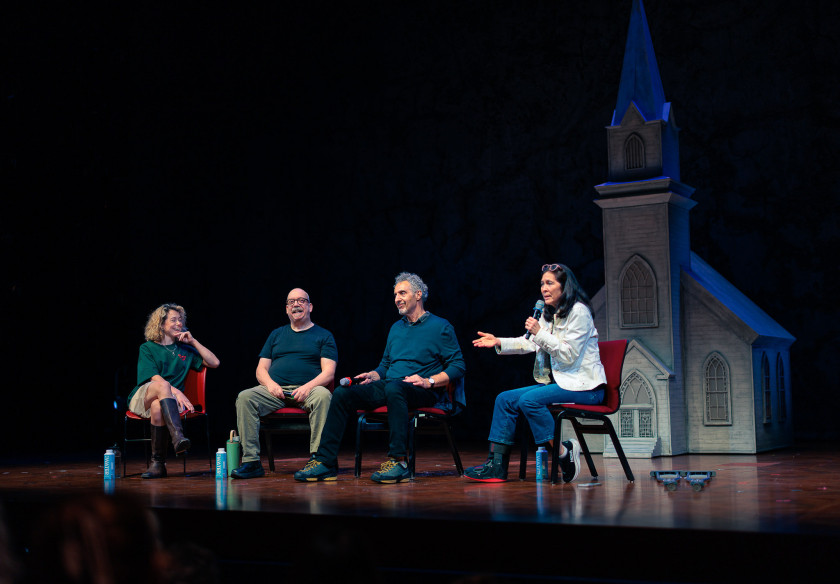
“You need a very thick skin and a very thin skin, and it’s hard to maintain both,” Turturro said. “I wouldn’t not encourage someone, but it’s not easy for a life. I know a lot of talented people who never got an opportunity, never got that one role to do it.”
Maslany advised aspiring actors to try not to limit themselves when it comes to the types of roles they can embody.
“I think the industry is very quick to decide for you who you are, based on what you look like or where you’re from, or how you sound,” Maslany said. “The joy of being an actor is embodying all elements of human behavior, animal behavior — whatever it is.”
Giamatti’s advice? Keep the brain fueled with inspiration.
“If you want to be an actor, don't stop studying people on the street,” Giamatti said. “Don’t stop talking to yourself and making characters and conversations with yourself at home. Read a lot. Listen to music. Do anything you can. Just keep feeding your imagination.”

Sixteen years ago, an invasive pest called the woolly adelgid arrived at Harvard Forest and slowly began to devastate its the eastern hemlocks — as they had done in forcce elsewhere. Since then, Harvard Forest scientists have begun to study how to manage the demise of its so-called foundation species.

The John L. Loeb Associate Professor of the Humanities and associate professor of African and African American Studies is one of eight U.S. visual arts writers to receive the award this year.

Piano Technical Services and the Office for the Arts worked with Vijay Iyer, Franklin D. and Florence Rosenblatt Professor of the Arts and Professor of African and African American Studies, to select the “unusually strong” instrument.