Christy DeSmith
Harvard Staff Writer

The professors, both naturalized U.S. citizens, were recognized as part of a July 4 tradition
/ Read time: 3 minutes
Harvard Staff Writer
Two FAS faculty members were honored this week as “Great Immigrants, Great Americans.”
For more than 20 years, the Andrew Carnegie Foundation has marked Independence Day by recognizing a group of naturalized U.S. citizens whose contributions have strengthened the nation. The 2026 class includes Mahzarin R. Banaji, Richard Clarke Cabot Professor of Social Ethics in the Department of Psychology, and Gregory Nagy, Francis Jones Professor of Classical Greek Literature and Professor of Comparative Literature.
Born to a family that belonged to the Parsi ethno-religious minority group, Banaji credits her cross-cultural upbringing in Secunderabad, India, with sparking her academic interests. She partnered with University of Washington psychologist Anthony Greenwald to pioneer the prediction of implicit biases, or attitudes that quietly shape human perceptions and decision-making. The collaborators posted their Implicit Association Test (IAT) to the World Wide Web in 1998. Banaji’s works include the book “Blindspot: Hidden Biases of Good People” (2013). The experimental psychologist has recently worked to advance understanding of machine psychology, documenting how human biases turn up in AI systems.
Nagy, born Böszörményi-Nagy Gergely, emigrated from Budapest, Hungary, with his family as a young child. He went on to become one of the world’s top authorities on archaic Greek literature and oral traditions, publishing extensively on the “Iliad” and the “Odyssey.” His best-known titles include “The Best of the Achaeans: Concepts of the Hero in Archaic Greek Poetry” (1979) and “The Ancient Greek Hero in 24 Hours” (2013). An early advocate of open-access learning, Nagy strives to make the classics broadly accessible. He has reached nearly 200,000 learners with an online course studying heroes in ancient Greek storytelling.
Also receiving the award was Harvard Medical School Professor Sanjiv Chopra, who was born in India. The Andrew Carnegie Foundation’s Class of 2026 “Great Immigrants, Great Americans” features a total of 25 honorees whose contributions span literature, fashion, music, and academia. In honor of the nation’s semiquincentennial, eight foreign-born signers of the Declaration of Independence were also acknowledged this year.
“As the United States celebrates 250 years of independence, our Great Immigrants tribute reminds us of the myriad ways immigrants have contributed to our society,” said Dame Louise Richardson, president of the Andrew Carnegie Foundation, a naturalized American citizen born in Ireland. “In honor of our founder, Andrew Carnegie, himself a Scottish immigrant, we applaud the 2026 Class of ‘Great Immigrants, Great Americans’ for their talent, skills, and achievements as naturalized citizens.”
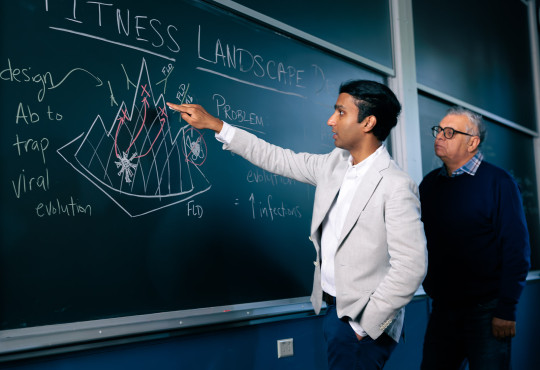
Two Harvard scientists describe a way to engineer the evolutionary landscape that viruses experience, pushing them away from dangerous variants and into evolutionary dead ends.

Amid the rhythms of the back-to-campus bustle, new faculty find themselves experiencing the same first-day excitement — and jitters. We dropped in on three, on the first day of their first classes.

As the sun sinks below the horizon, two scientists perch quietly beside a darkening field and wait for flashes of light. They have traveled far outside the city in search of research sites, because they study a group of creatures that have been driven to the margins of human settlements: fireflies.