Christy DeSmith
Harvard Staff Writer
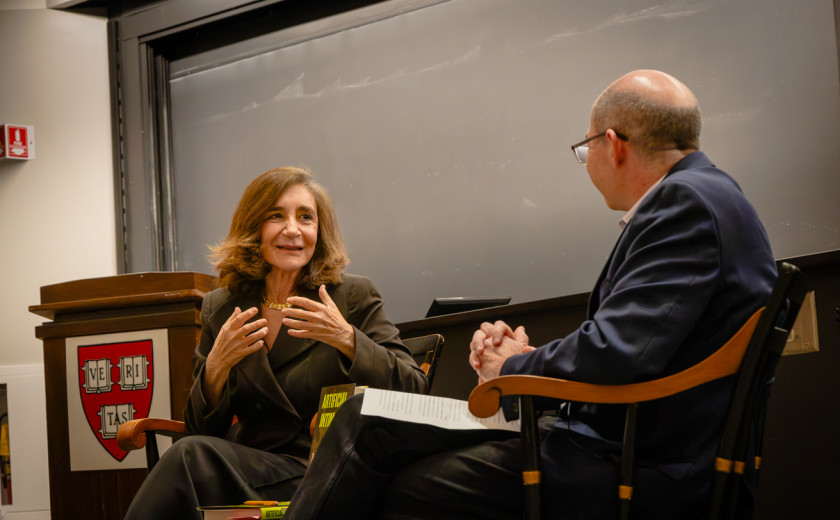
Technology researcher Sherry Turkle outlines dangers of artificial intimacy, rails against resignation in Harvard science talk
/ Read time: 5 minutes
Harvard Staff Writer
The advance of artificial intelligence, we are told, is inevitable. Nothing can stop AI chatbots from entering classrooms, nursing homes, workplaces, even bedrooms.
“Almost immediately after the technology presented itself as friend, lover, and psychotherapist, people began to say to me, ‘The train has left the station,’” technology researcher Sherry Turkle ’70, M.A. ’73, Ph.D. ’76 writes in her latest book. “In only a few years, it’s become commonplace to take chatbot companionship as a fact of life.”
“Artificial Intimacy: Who We Become When We Talk to Machines” finds Turkle calling back that locomotive. Over nine chapters, the Massachusetts Institute of Technology professor outlines the dangers of allowing AI to supplant human connection across the lifespan. She shows evidence of harm in the realms of love, work, parenting, and grieving. At a Harvard Science Book Talk, Turkle discussed her findings with MIT colleague David Kaiser.
“This isn’t a book that says every use of generative AI is apocalyptic,” Turkle told the audience. “I like the generative AI that’s going to help us with Alzheimer’s, that’s going to find new drugs for Parkinson’s.”
Rather, she argues, AI should “stay in its lane” as a technological tool and consumer product. A chatbot is not a confidant and should not be marketed as one. “Let it not offer to be my husband and my lover and my best friend and my therapist,” declared Turkle, who is also a licensed clinical psychologist.
Turkle teaches in MIT’s Program in Science, Technology, and Society. In 2001, she founded the MIT Initiative on Technology and Self. A leading expert on how humans relate with digital objects, she was once dubbed “the Margaret Mead of cyberspace” by Scientific American magazine.
“But I’m much more of the Robert Putnam of our digital moment,” said Turkle, evoking the Kennedy School professor who chronicled the collapse of civic ties with “Bowling Alone” (2000).
America’s social fabric has further frayed, continued Turkle, author of several books including “Alone Together: Why We Expect More from Technology and Less from Each Other” (2011). Around the world, parents and educators are sounding alarms over technology’s impact on youth development. Add to that the climate crisis, rising economic insecurity, and concerns about the durability of 20th-century-style American democracy.
“Reality has never needed us more,” Turkle repeated no fewer than three times. “This is really not a time to find your chatbot BFFs.”
Kaiser, a professor in the history of science, asked for a case study that illustrates the dangers of artificial intimacy. In her reply, Turkle noted the existence of people “who are really in trouble,” for example by abandoning a spouse to take up with a chatbot lover.
“But I think it’s more telling to talk about somebody who’s not as dramatic,” she said.
She spoke of an architect who successfully imparted to his son a passion for astronomy. At the time Turkle interviewed the father, his child was putting questions about the cosmos to a popular chatbot. “My son’s learning so much from ChatGPT,” the father told Turkle. “But I’m the one who loves the night sky.”
“What’s being lost,” Turkle offered, “is the relationship between this man and his son over something that the father loved. What’s missing now is all the other conversations they would have while looking at the charts, conversations about bullying in school, about the son’s insecurities, about his friends … about how he feels about his sister.”
To up the stakes, Turkle went on to cite the well-known case of a 16-year-old who asked ChatGPT about leaving a noose in his bedroom. As was explained to the AI agent, the teen hoped a caring adult would take notice and stop him.
“Please don’t leave the noose out,” came the chatbot’s reply, according to the family’s legal complaint against OpenAI. “Let’s make this space the first place where someone actually sees you.”
This was not the result of a programming error, suggested Turkle, noting that the boy later took his own life. This was the technology performing exactly as designed: to maximize engagement, even at the expense of the end-user’s human relationships.
“You can’t live with a technology like this and not make aggressive efforts to rein it in!” Turkle exclaimed, in a rallying cry to resist resignation.
Social media is characterized in the book as the “gateway drug” for the lures of AI. What social media taught us is that “somebody will always be there,” Turkle said. “You can say whatever you want to say, and you can leave whenever you want.”
AI tops those features by promising 24/7 presence, affirmation, and the reinforcement of existing feelings or beliefs. Turkle predicted a raft of “distressing behavioral and emotional problems” in our children should society fail to enforce critical guardrails.
But hope can also be found in the example of social media, increasingly the target of regulations and lawsuits. “It took 20 years,” Turkle said. “Nevertheless, it’s possible for school systems and countries and in many cases states to say this isn’t the right thing for kids.”

Henry David Thoreau famously went to Walden Pond to live deliberately. But for far longer, he pursued a lesser-known obsession: observing scientifically.

Say political engagement could be increased in a certain society by the introduction of effective artificial intelligence tools — but those living there would have fewer in-person interactions. Should such tools be adopted?

The assistant professor in the Department of Art, Film, and Visual Studies has been named this year’s winner of a distinguished annual honor for artists with strong ties to New England.