Eileen O’Grady
Harvard Staff Writer
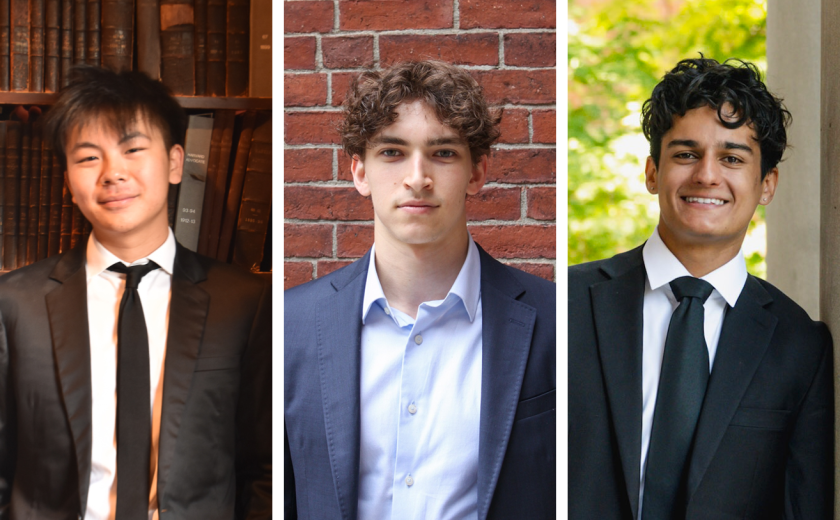
The honor is given annually to College seniors who demonstrate ‘intellectual adventure’
/ Read time: 4 minutes
Harvard Staff Writer
Harvard College seniors Frank Liu, Max Palys, and Raphael Tourette have been awarded the 2026 Taliesin Prize for Distinction in the Art of Learning.
The prize, given annually by the Division of Arts & Humanities, recognizes three graduating students who exhibit the spirit of “intellectual adventure.” The prize committee reviews undergraduate transcripts for evidence of intrinsic curiosity and other indications that the student deliberately chose an academic path reflecting courage, creativity, and exploration.
Liu completed a double concentration in English and molecular and cellular biology. He came to Harvard with an interest in health and medicine but quickly fell in love with literature after taking an introductory humanities class.
Understanding and valuing human life, Liu says, was the throughline connecting courses he took in global health, literature, economics, sociology, ethics, and statistics.
“Course selection provides a parallel to the statistical study of ‘sampling,’ in which we infer an infinitely interconnected horizon of knowledge with an inevitably limited sample,” he said. “Every course is a sample that refines my future projection.”
Palys, a double concentrator in mathematics and East Asian studies, sees his coursework as the study of different types of languages. He took Mandarin and Russian, dissected lyric poetry in English courses, and tackled Old Chinese in order to read Buddho-Daoist philosophy. He also explored the more symbolic and mechanical languages of mathematics, dynamical systems, and statistical mechanics.
“The study of languages of all types, fundamentally, is the study of people like me,” Palys said. “People that are slippery and mechanical, clean and complex, understandable and inscrutable.”
Tourette concentrated in applied mathematics, specializing in computer science, with a secondary in history of art and architecture. He describes his Harvard coursework as an exploration of the process of building — by and for humans.
Studying major human achievements like the construction of the Notre Dame Cathedral, or the invention of photography in his art history courses, seeded ideas about how these innovations advanced technological knowledge while also shaping culture.
Tourette views the mathematics behind AI as similarly transformative. “I study applied mathematics and computation because those are the materials of this moment, while I turn to art history to learn how to build toward human progress,” he said.
Two Harvard scientists describe a way to engineer the evolutionary landscape that viruses experience, pushing them away from dangerous variants and into evolutionary dead ends.

Amid the rhythms of the back-to-campus bustle, new faculty find themselves experiencing the same first-day excitement — and jitters. We dropped in on three, on the first day of their first classes.

As the sun sinks below the horizon, two scientists perch quietly beside a darkening field and wait for flashes of light. They have traveled far outside the city in search of research sites, because they study a group of creatures that have been driven to the margins of human settlements: fireflies.