Eric Moskowitz
Harvard Staff Writer


Inside the Bio Labs as the building turns 95
| 10 minutes
Harvard Staff Writer
Like the results of a satisfying experiment, the Biological Laboratories, known as the Bio Labs, hardly discloses itself at first glance, tucked at the end of the dead-end lane known as Divinity Avenue, where only a corner of the horseshoe-shaped complex is visible. But follow the narrow path beside the building and the courtyard opens, revealing the Bio Labs in full, from the animal friezes carved into the brick across the upper story to the three-ton bronze rhinos flanking the front doors.
It’s possible to spend years at Harvard without wandering across the building, but those who know, know: Over a few decades in the 20th century, 12 eventual Nobel laureates worked or trained here, mainly on the third floor. That makes the Bio Labs — which turned 95 this fall — one of a few historic “Nobel incubators” revered in the scientific community, rivaling the Medical Research Council Laboratory of Molecular Biology in Cambridge, England.
So it was natural for Hanan Noushad, a second-year Ph.D. student studying molecular and cellular biology (MCB) in the Kenneth C. Griffin Graduate School of Arts and Sciences, to pause for a selfie by the building’s sign in August when she was giving a tour of the area to the director of the Indian institute where she earned her bachelor’s and master’s degrees. It was a Sunday evening. A side door opened, and a 96-year-old man in linen pants and a scally cap stepped out, glasses dangling around his neck: Matt Meselson, a lion in molecular biology and genetics.
Like millions of other students in India bound for medicine or related sciences, Noushad spent two years preparing for the standardized National Eligibility cum Entrance Test (NEET). That meant that every few weeks she refreshed the most important lessons — including the field-defining 1958 Meselson–Stahl experiment demonstrating how DNA replicates, known as “the most beautiful experiment in biology,” highlighted in her textbook in multiple colors. When she posted the selfie, it quickly garnered 62,000 Instagram likes, most of them from India. “Everybody was like, ‘Oh my god, I’m studying about this now!’” she said.
Noushad first learned the legacy of the Bio Labs while visiting as a prospective student — a second-year grad student giving her a tour told all about the multitude of Nobel winners, not to mention those like Meselson whom many consider equally deserving for landmark contributions.
“It was very surreal,” said Noushad, who works in Carolyn Elya’s lab studying the “zombie” fungus that manipulates the behavior of infected fruit flies. “Growing up, these things were only in textbooks for us.”

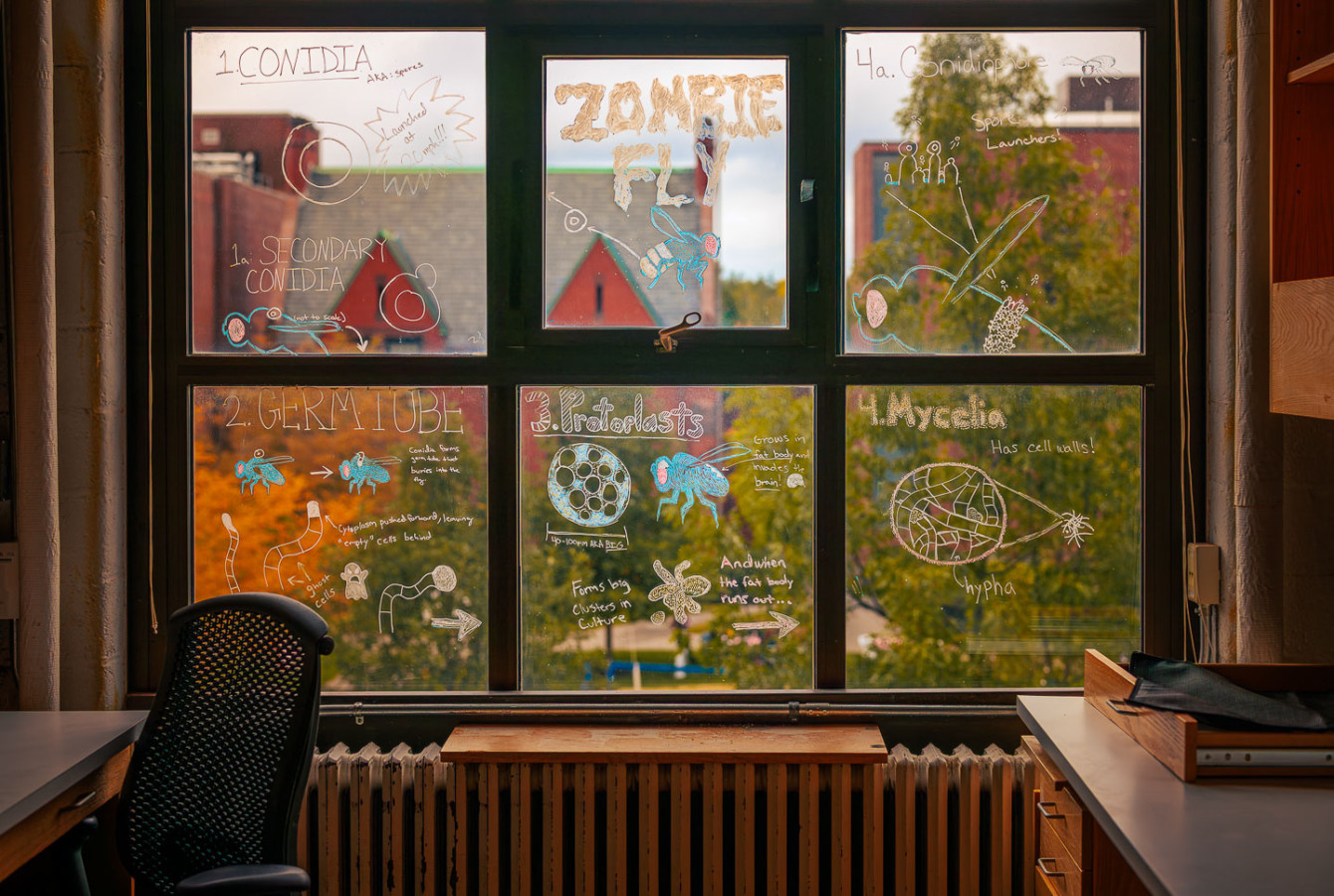
The history of the Bio Labs is as varied as the building itself — from the greenhouse on the roof to the octopus and zebrafish tanks in the basement. The late E.O. Wilson began his field-defining career in evolutionary biology there, but it is molecular biology that produced the bounty of Nobels and that makes the building a fixture of October conversation.
It’s where Nobel laureates George Wald and James Watson — as in DNA double-helix James Watson — built a culture that was alternately collaborative and competitive, and intense, said molecular biologist Rich Losick, a keeper of the building’s history. Nobel winner Walter Gilbert worked out the sequence for the genetic building blocks in DNA here and, with Watson, trained multiple future winners, including Mario Capecchi, who discovered a means for creating mice in which a specific gene is turned off, and Robert Horvitz, who went on to win for “seminal discoveries concerning genetic regulation of organ development and programmed cell death” in a species of nematode.
“I grew up with the story of how molecular biology was established, and many of the heroes of molecular biology were here,” said Sean Eddy, a computational biologist developing methods for analyzing genome sequences, whose lab today fills a corner of the first floor.
He’s among those in the building fascinated by a 1968 ABC documentary called “The Scientist,” set in the Bio Labs and narrated in stentorian tones by the actor George C. Scott, at a time when the field’s pioneers were wrestling with foundational questions. “This is the story of a battle. When the battle is won, it will be more important than the atom bomb,” Scott intones, as Wally Gilbert enters between the two rhinos into darkness.
Today, they occasionally screen the film — which centers on a Watson-stoked race between Gilbert and colleague Mark Ptashne to figure out how genes switch on and off — at Friday social gatherings in the first-floor “BioLounge.”
But the building is much more than a relic from that era. “One of the most interesting things about Bio Labs is that it’s a 100-year-old building that we’re still doing top-flight molecular biology in,” said Eddy, former MCB department chair. “Most of the places that I’ve worked, the university will decide they’re going to tear down a building of that age and replace it.”
Eddy, the Ellmore C. Patterson Professor of Molecular and Cellular Biology, came to Harvard in 2015 from the Janelia Research Campus of the Howard Hughes Medical Institute, an airy compound in Virginia designed by the award-winning modernist Rafael Viñoly. “Janelia was beautiful, but I was like, ‘OK, I’ve done my glass-and-steel era,’” he said. “‘I’m coming to Harvard. I’m coming to the College. I like the old brick, and the history aesthetic here.’”
The building’s time-tested construction is an asset, said Gary Goodwin, who came to the Bio Labs 27 years ago in a temporary role and has worked his way up to building manager, with an innate feel for every inch of its 200,000-plus square feet. “It’s all post and beams, and you can take down pretty much any interior wall,” he said. That makes it easier to custom-tailor lab space for new faculty than more modern science buildings. “It’s like a whiteboard, and we can keep knocking and rebuilding it to fit their needs.”


On a walk through the building, Goodwin and Fred Lindberg, area manager for multiple biology and biosciences buildings, noted the features that have and haven’t changed, from soapstone steps in the stairwells and an original janitorial closet to modern aquatic research facilities, specimen freezers, and a state-of-the-art energy-recovery system on the top floor to recapture hot and cold air, replacing a maze of ductwork, 150 exhaust fans, and five separate HVAC systems.
Still, it is not the whitewashed hallways that most often stir researchers and visitors but the exterior aesthetic, just as it drew Eddy. In August — four days after Noushad posted her Instagram selfie — the Journal of the History of Biology published a 33-page paper about the art and architecture of the storied building, focusing on the brick and bronze animal sculptures created by noted Boston-based artist Katharine Lane Weems, as well as the building’s conception and construction.
In the mid-1920s, Harvard’s research and teaching in zoology, botany, physiology, and genetics spanned five academic divisions and 10 museums and field stations from Jamaica Plain to the Panama Canal Zone, wrote Jenna Tonn, Ph.D. ’15, in that new paper, “Animals in Brick and Bronze.” Harvard President A. Lawrence Lowell wanted to “dissolve away the cell-walls” separating the natural sciences and promote this collaboration in a spacious new building.
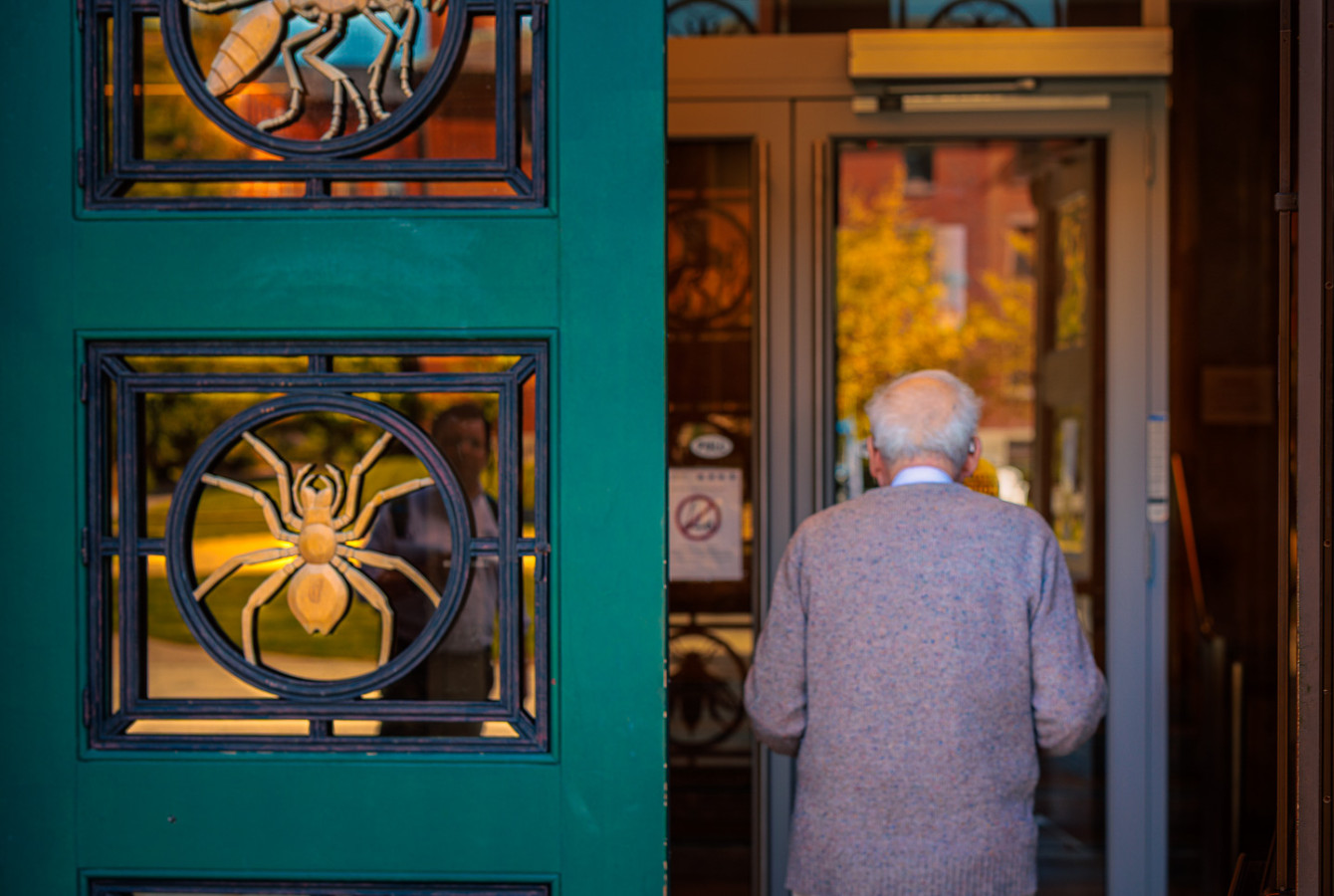
The decorated Boston firm Coolidge, Shepley, Bulfinch and Abbott designed the Bio Labs, and Weems contributed the friezes — 34 enormous animals carved directly into the brick at the top of the building by skilled workers with pneumatic drills, a novel approach — as well as three bronze door panels adorned with creatures from land, air, and sea, plus the two enormous rhino sculptures. Known as Bessie and Victoria, they’re decorated by graduate students every Halloween, and oversee the summer “Rhino League” volleyball games that have become a courtyard fixture.
The Rockefeller Foundation’s General Education Board provided $3 million in matching funds toward design, construction, and lab equipment. The original lobby plaque still acknowledges them — a fitting contribution, said Losick, because it was Rockefeller Foundation science administrator Warren Weaver who would coin the term “molecular biology” in 1938.
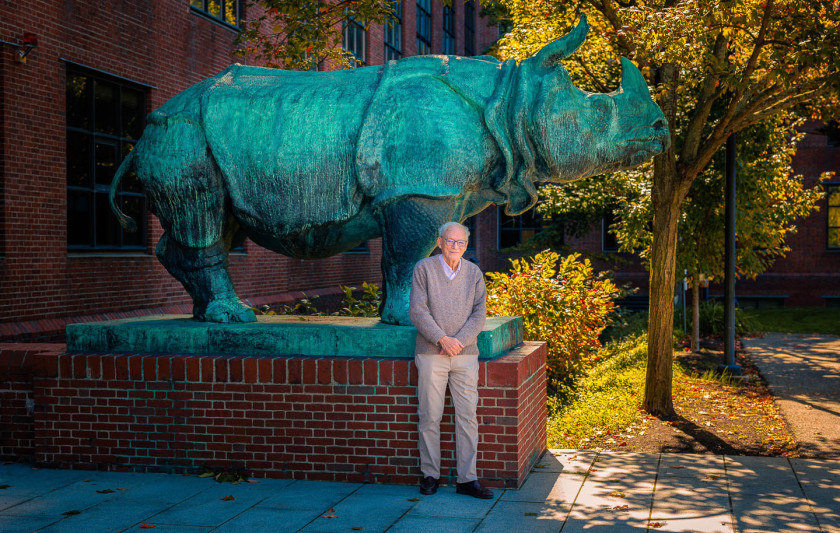
Losick, who has easily spent 100,000 hours at the Bio Labs, likes to quip that “John Harvard and I were classmates, and I’ve been here ever since,” though he first visited the building as a Princeton University undergrad in the early 1960s. He returned later in the decade, first as a junior fellow in the Society of Fellows and then a faculty member.
The Maria Moors Cabot Research Professor of Biology Emeritus, Losick closed his lab two years ago. He taught a popular intro course for half a century, and he has chronicled the story of the 12 laureates who worked in the building: Wald, Watson, Gilbert, Capecchi, Horvitz, Sir Richard Roberts, Roger Kornberg, Martin Chalfie, Craig Mello, Sidney Altman, Victor Ambros, and Gary Ruvkun.
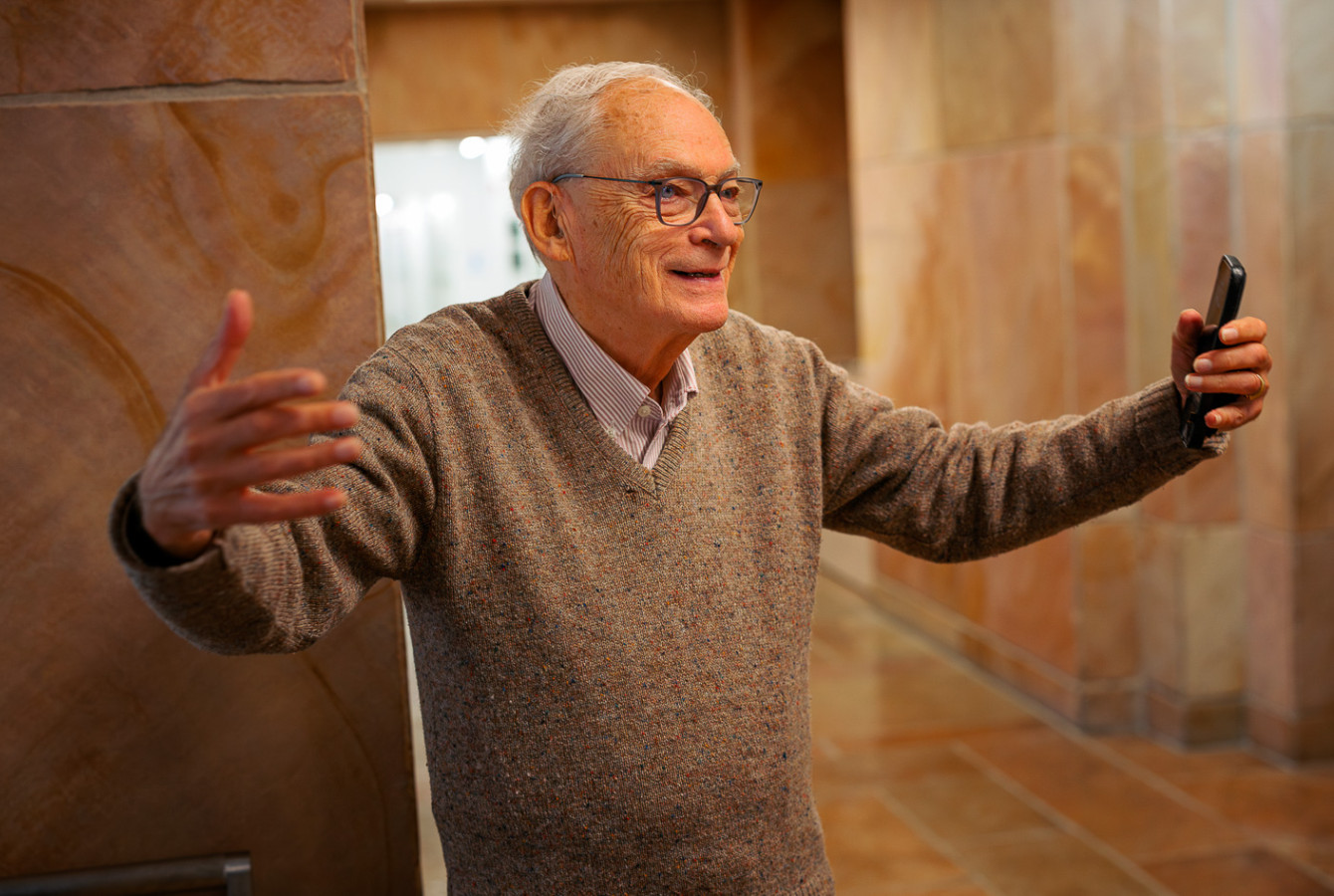
That led Losick to develop a class on the history of molecular biology, in which he intertwines the rise of the field and the faculty in the building, from the origins of molecular biology through the 1980s, when the central questions had been solved — the structure of DNA, how it’s duplicated, how it’s copied into messenger RNA and proteins, and how it’s regulated — and scientists could jump off in innumerable new directions. Students read the foundational papers, and Losick provides what he calls the contextual “gossip,” the stories of human intrigue, drive, collaboration, competition, frailties, and random chance that vaulted some to glory and relegated others to quieter corners of history.
Losick cites Meselson in calling those decades in molecular biology “a river that divides into thousands of branches.” Meselson, who is known for contributions related to multiple Nobel breakthroughs, as well as for years of advocacy against chemical and biological weapons, will share his own story with the students during a scheduled visit later this month, part of a syllabus that also includes upcoming lectures from three different Nobel laureates who have worked in the Bio Labs: Gilbert, Roberts, and Ambros.
The class meets in the building’s central lecture hall, just past the rhinos; it’s the same room where Gilbert gave one of his first talks on the sequence of a DNA. Losick recalls sitting there in disbelief half a century ago as Gilbert wrote the sequence as a corresponding string of over 40 chemical letters on the board — from memory.
After a recent lecture, seniors Caris Eaton and Mirika Jambudi marveled at the living history transmitted through the class.
“It’s amazing to hear from Professor Losick about his experiences, living through this period and knowing all of these famous molecular and cellular biologists and people who made revolutionary discoveries, and he gives us a nuanced perspective beyond the science,” said Jambudi, a double concentrator in MCB and the history of science.
Eaton, an MCB concentrator with a secondary in sociology, said she found the course through her adviser, who recommended making the most of her senior year with classes that could only be taken at Harvard. “Rich was alive when all of this was happening, and he can give perspective that a lot of people can’t give,” said Eaton. “Thinking that people didn’t even know that DNA had genetic value or the nature of its structure not that long ago is crazy.”
That renovated lecture hall has occupied the same space since 1931, but the BioLounge across from it was added in 2017. It became an instant meeting place for people from across the building — dissolving those “cell-walls” Lowell wrote about a century ago. Noushad, the grad student who posted the photo with Meselson, holds office her hours there for her introductory neurobiology section as a teaching fellow, when not doing her own research in Elya’s lab.
Elya, an assistant professor in MCB and self-described “zombiologist,” naturally appreciates the bronze bugs on the nearby front doors. She admits that when she came to Harvard in 2018 as a postdoctoral fellow in the Northwest Building, she hardly gave the Bio Labs a second thought, even on visits to use the imaging facility or procure fly food. Promoted to faculty in 2024, she was assigned temporary space on the building’s third floor — neighboring Losick — before moving down a flight.
“Hearing about the discovery of microRNA and some of the other things that have gone down here, and the people that have come through the space, it’s like, ‘Oh my god,’” she said.
It did — and didn’t — change the way she looked at her new academic home. “I mean, it was pretty intimidating,” she said. “But at the same time, it’s also just a place, right?”
Menstrual tracking apps have become all the rage, leading the growing field of “femtech” that claims to help women understand — and regulate — their bodies. But these apps may promise more than they deliver — and even be harmful to women.
The astrochemist traveled to Vatican City to accept the award in a September 24 ceremony.
The advance of artificial intelligence, we are told, is inevitable. Nothing can stop AI chatbots from entering classrooms, nursing homes, workplaces, even bedrooms.