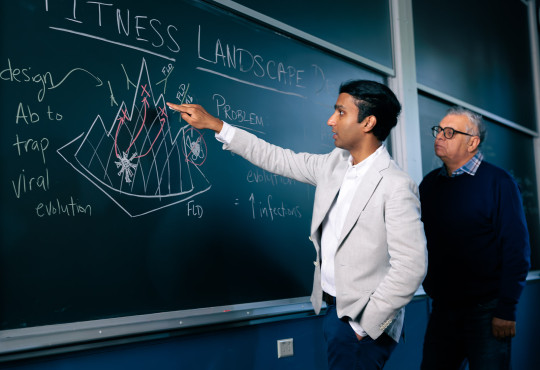
How to build an evolutionary trap for viruses
Two Harvard scientists describe a way to engineer the evolutionary landscape that viruses experience, pushing them away from dangerous variants and into evolutionary dead ends.

Also accomplished at the monthly convening was the establishment of a new climate concentration, discussion of a language pilot
The much-anticipated vote on undergraduate grading policy was postponed at Tuesday’s Meeting of the Faculty, though several amendments related to the proposal were debated and then added to the motion, which will be discussed for a final time at the May Faculty Meeting.
Edgerley Family Dean of the Faculty of Arts and Sciences Hopi Hoekstra took up the grading policy with a presentation on three amendments to the original grading proposal: an extension of the implementation timeline to the fall of 2027, the addition of SAT+ to the SAT/UNSAT grading option, and clarification that the cap on A grades will take into account all undergraduate students enrolled in a course. Faculty also approved a motion to divide the grading policy motion into three separate questions. At the March meeting, the faculty voted to hold a postal ballot on the proposed grading policy, allowing all voting faculty members to vote via email.
Faculty expressed both support for and concerns about the grading proposal, and Hoekstra noted that the discussion would continue at the May meeting.
She kicked off the April meeting, which was moved from the Faculty Room in University Hall to the Science Center to accommodate the large number of faculty engaged in discussion of the grading proposal, by celebrating three newly tenured faculty, Professor of Chemistry and Chemical Biology Jarad Mason, Gardner Cowles Associate Professor of the Humanities Vidyan Ravinthiran, and Professor of Statistics Lucas Janson. Newly elected members of the Faculty Council were also recognized: Professors David Atherton, Demba Ba, Cora Dvorkin, Sean Eddy, Joshua Greene, Emily Greenwood, and Gina Schouten.
Faculty overwhelmingly voted in favor of establishing a new cross-disciplinary concentration, Energy, Climate and the Environment (ENCE), with a vote of 215-3. In addition, Mark Elliott, Mark Schwartz Professor of Chinese and Inner Asian History and Vice Provost for International Affairs, introduced a proposal to pilot the Shared Language Initiative (SCI), a collaboration with Ivy League schools that provides access to instruction in Less Commonly Taught Languages. Languages offered through the two-year pilot at Harvard and Columbia University could include Uyghur, Chaghatay, Twi, Igbo, Amharic, Punjabi, Finnish, and Dutch. Faculty will vote on the SCI initiative, which would launch this July and be reviewed in two years, at the May Meeting of the Faculty.
Presenting the popular Research Minute, Raj Chetty, William A. Ackman Professor of Economics and Director of Opportunity Insights, shared an overview of his work which uses big data to study economic opportunity.
“Raj’s research focuses on economic mobility — how and why some children can move up the income ladder while others cannot,” said Hoekstra, introducing Chetty. “Through Opportunity Insights, Raj has worked to ensure that these findings don’t just live in journals but instead inform real-world decisions — helping to design policies and programs aimed at expanding opportunity.”
Chetty shared research on the Boston-based nonprofit Year Up, which provides job training and free tuition to young adults, noting that those who participated in Year Up earned from 2014 to 2022 an average of $9,000 more than peers who were not part of the program.
Last year, OI worked with 291 organizations in 43 states. Results have included federal housing vouchers (2023) and workforce development programs in Charlotte, N.C., and Philadelphia.
Earlier in the meeting, a Memorial Minute for the late William Paul, Mallinckrodt Professor of Applied Physics and Professor of Physics, Emeritus, was read by Frans Spaepen, John C. and Helen F. Franklin Professor of Applied Physics.
Two Harvard scientists describe a way to engineer the evolutionary landscape that viruses experience, pushing them away from dangerous variants and into evolutionary dead ends.

Amid the rhythms of the back-to-campus bustle, new faculty find themselves experiencing the same first-day excitement — and jitters. We dropped in on three, on the first day of their first classes.

As the sun sinks below the horizon, two scientists perch quietly beside a darkening field and wait for flashes of light. They have traveled far outside the city in search of research sites, because they study a group of creatures that have been driven to the margins of human settlements: fireflies.