Kermit Pattison
Harvard Staff Writer
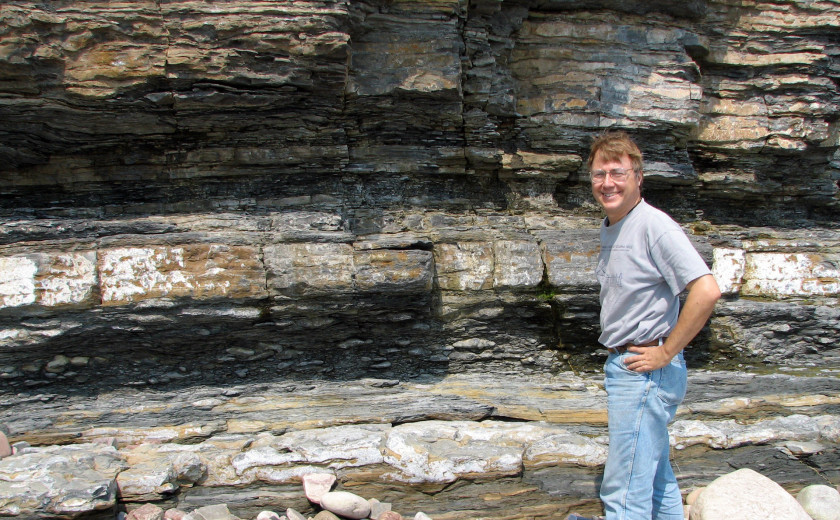
Andrew Knoll previews his new book on the 4-billion-year “conversation” between Earth and life — and recent interruptions by humans
/ Read time: 8 minutes
Harvard Staff Writer
Andrew Knoll has spent half a century following a very long conversation — the one between the physical Earth and its varied forms of life. It’s a dialogue that formed the air we breathe, the ground beneath our feet, and virtually every aspect of our planet on land and sea.
Knoll, who first came to Harvard as a Ph.D. student in the 1970s, joined the faculty in 1982 and now serves as the Fisher Research Professor of Natural History and Earth and Planetary Sciences, Emeritus, with appointments in the departments of Organismic and Evolutionary Biology and Earth and Planetary Sciences. As a geobiologist, his career coincided with what he calls the field’s transformation from a “fledgling enterprise to a thriving discipline.”
In an interview, edited for length and clarity, Knoll spoke about his new book, “Earth and Life: A Four Billion Year Conversation.” He described how life remade the face of our planet, how living forms evolved in response to environmental changes, and how it’s all being rocked by a new planetary force — humans.
You wrote another book on Earth history that was published in 2021. What prompted you to write the new one?
The last book was truly a history book. It starts in the beginning and works its way up to today. The new book is more about the processes that give rise to the world we see around us. As the title tries to make clear, we can’t understand the Earth just by looking at Earth science. We can’t understand biology just by looking at organisms, because so much of the world around us, from the composition of the atmosphere to the shapes of river channels, reflects the interactions between biological and physical processes.
That’s what I wanted to get across to a general readership for two reasons. One is that I think you’re better off if you know something about the planet you live on. And then there is the practical aspect that in the lifetimes of ourselves, our children, and our grandchildren, the Earth will be changing rapidly. If people want to understand that change in the context of how our planet works in general, it will help to have this background.
How did life reshape the planet? How was a biological Earth different than a purely geological Earth?
So many processes that we may take for granted actually involve this intricate conversation between Earth and life. Just to take one of my favorite examples, you're here because the atmosphere has 21 percent oxygen gas in it. You could not live on a planet with little or no oxygen, yet that was the state of our planet for about the first 2 billion years. There’s only one process that can generate oxygen at the rates and abundances capable of transforming the planet — and that is a biological process.
The trees outside your home, the algae in ponds and seas, and a group of bacteria called cyanobacteria use energy from the sun to extract the electrons needed to convert carbon dioxide to organic compounds from water, generating oxygen in the process. Photosynthesis, then, underpinned the transformation of Earth that made it possible to have complex multicellular organisms: evolution potentiated by a biological process playing out in the context of a physically dynamic planet.
Should we think of life — the aggregate of all living forms — as a geological force?
I would. There’s actually a book written around the 1990s by a very good Dutch scientist named Peter Westbroek and the title was, in fact, “Life as a Geological Force.” Peter was way ahead of the game. In biological processes, in particular metabolic processes, animals are pretty dull in that we basically respire and that’s it. Plants can photosynthesize.
But when you look at bacteria and their prokaryotic cousins, the archaea, they have this huge diversity of metabolic processes that allow them to utilize and transform many different elements. As I’m always fond of saying, bacteria don’t need people, but people certainly need bacteria.
You study major changes in Earth history over 4 billion years, such as the advent of life, plate tectonics, the great oxygenation event, mass extinctions, and planetary changes. How do the human-induced changes happening now compare to the speed and scale of earlier transformations?
There’s one very famous event in Earth history that I think does provide something of a distant mirror on the 21st century. Two hundred fifty-two million years ago, about 90 percent of all the species in the oceans disappeared in what is known as the end-Permian mass extinction. We now know the cause was massive volcanism, orders of magnitude larger than anything that humans have ever encountered. What that caused — and if you read the newspaper, some of these things will resonate — was global warming, because of putting CO2 into the atmosphere, ocean acidification, which is a drop in the pH of the oceans; because more and more CO2 is entering it, loss of oxygen in the deep oceans — all things that are happening today.
To me, the end Permian Extinction is a bit like Scrooge’s Ghost of Christmas Yet to Come. The ghost doesn’t tell Scrooge what's definitely going to happen, but he does give him a sense of what could happen if Scrooge doesn’t change his ways. Fortunately, we are endowed with intelligence so that we can deal with this accelerating problem. The rate at which temperature, climate, sea level are changing is unusual on a geologic timescale. Some people have suggested it’s more rapid than anything that’s happened in the past. I don’t know whether that’s true, but if the only thing that compares to it is volcanism a million times greater than anything we’ve ever seen, that’s something to take seriously.
At the end of your book, you actually strike a hopeful note. Given all the news about planet, what makes you optimistic?
There’s two responses to that one. If you talk to conservation biologists — and I know a lot of them — they figured out years ago that if the entire message is doom and gloom, people tend to say, “Ah, well, there’s nothing I can do about it. We’re sunk.” Whereas if you voice a hopeful note, people will be much more likely to be energized to take action.
Also, one of the nice things about humans is we have a lot of ingenuity in our population, and there are a lot of people all over the world, including at Harvard, working on ways of generating energy that do not involve fossil fuels, ways of reducing the amount of CO2 in the atmosphere, and changing ways of doing agriculture to make it more environmentally friendly.
There are a lot of good ideas out there, and hopefully we can mobilize the population to support those ideas and to live lives that are maximally conducive to our grandchildren having a good life. I’ve spoken to a wonderful institution called Long Now Boston. Their motto is that they’re trying to be good ancestors, and I think that’s a wonderful thing to aspire to.
Your book is about the conversation between Earth and life. I want to ask about other conversations — the ones with students and colleagues. How did your experience at Harvard shape the ideas in your book?
As an undergraduate, I learned that I really enjoyed geology and I really enjoyed biology, although they were taught in those days as though they were different universes. Sitting in my dorm room one night, it struck me that maybe they weren’t all that different. Maybe they were different sides of the same coin, and if I understood more about life, I could understand our planet better, and if I understood the planet better, I’d have a better platform for interpreting the history of life.
That got me going, and I had the very good fortune of being a graduate student here at Harvard and my advisor was Elso Barghoorn, the person who basically invented pre-Cambrian paleontology and showed that the Earth has a biological record that goes back billions of years before the origin of animals. Another member of my committee was a geochemist named Dick Holland, and he was one of the pioneers in establishing the idea that the Earth was oxygen-free for the first 2 billion years, and that changed 2.4 to 2.2 billion years ago. And then I had Steve Gould, when he was a young professor, on my committee and he helped me to think about biology.
One of the great things about Harvard was that as a student on a daily basis — something I appreciate much more now than I did then — I was able to talk to these people who were shaping a new way of thinking. That was just wonderful. That always resonates with me when I’m working with students, whether it’s a non-majors class on the history of the Earth or mentoring graduate students. Without sounding too self-absorbed, I can help them by sharing my story with them, just as my mentors did for me, listen to them, and help them think about their own ideas. My graduate students were a wonderful bunch over the years and I’ve learned as much from them as they learned from me. It is a collaborative exercise and my job, in essence, is to help students become themselves.
Two Harvard scientists describe a way to engineer the evolutionary landscape that viruses experience, pushing them away from dangerous variants and into evolutionary dead ends.

Amid the rhythms of the back-to-campus bustle, new faculty find themselves experiencing the same first-day excitement — and jitters. We dropped in on three, on the first day of their first classes.

As the sun sinks below the horizon, two scientists perch quietly beside a darkening field and wait for flashes of light. They have traveled far outside the city in search of research sites, because they study a group of creatures that have been driven to the margins of human settlements: fireflies.