Yahya Chaudhry
Harvard Staff Writer
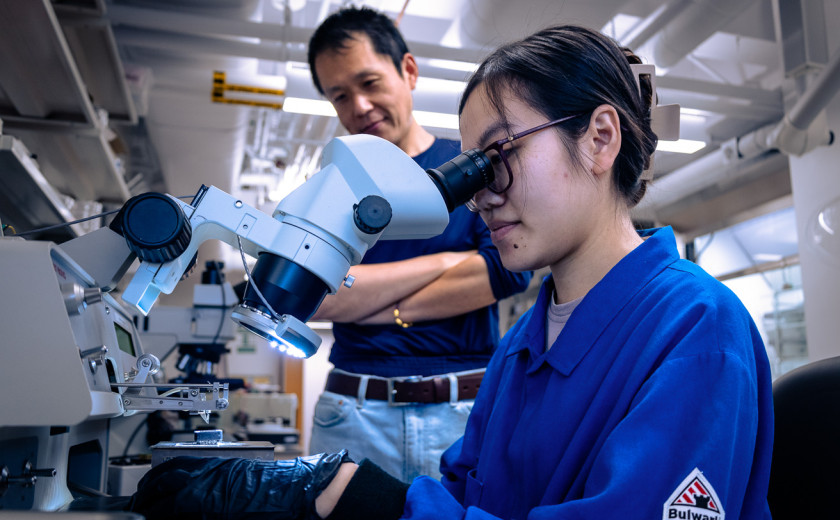
Discovered structure enables performance gains that could solve major energy bottlenecks facing modern data centers
/ Read time: 3 minutes
Harvard Staff Writer
The oxygen could have ruined the experiment.
Instead, the common element used to grow a crystal birthed a happy accident, a quantum structure that assembles its own pattern. While building quantum technologies typically requires stacking atomic layers with sub-nanometer precision in ultra-clean laboratories, this serendipitous chemical reaction revealed a bulk material that could spontaneously engineer its own complex, wave-like quantum structure.
Now, a new study in Nature led by Suyang Xu, John L. Loeb Asssociate Professor of the Natural Sciences, and other Harvard chemists has unraveled the physics behind this creation, discovering that the synthesized crystal — uranium oxide telluride (UOTe) — spontaneously warps into a wave-like spiral structure known as a chiral superlattice. These findings unlock a path to harnessing ultra-fast magnetic materials and cleaner, higher-speed computer memory and hardware.
“The semiconductor industry has invested a trillion dollars to lithographically write pattern in nanometer scale,” said Xu, senior author on the paper. “But here, we don't need to write that. We’ve grown the material, and it comes out as a given that it already has this pattern. It’s really the chemistry that is doing the magic.”
This self-organized pattern overcomes a long-standing obstacle in condensed-matter physics: making microscopic antiferromagnets — and their ability to cancel the opposing forces out — practical for spintronic devices. While traditional magnets possess magnetic fields that can interfere with neighboring components, antiferromagnets feature alternating atomic spins, making them immune to external magnetic disruption and capable of switching orders of magnitude faster. However, this internal balance has historically made their magnetic states nearly impossible to detect or control electrically.
“This chiral superlattice breaks all the necessary symmetry and makes this material — which might be otherwise described as very ‘boring’ — have more useful properties of a ferromagnet,” said co-author Thao H. Dinh, a co-advisee of Xu and Philip Kim and a Ph.D. student at the Harvard Kenneth C. Griffin Graduate School of Arts and Sciences.
Unlocking these complex quantum phenomena required a broad, multi-institutional effort that bridged chemistry, physics, and material science. The experimental work was led by Dinh and Xu, alongside collaborators including Sheng Ran (Washington University in St. Louis), as well as researchers from The Rowland Institute at Harvard and the labs of Hongkun Park in the Department of Chemistry and Philip Kim in the Department of Physics.
The researchers discovered that UOTe’s unique structure originates from an unexpected chemical tug-of-war. Inside the lattice, uranium binds simultaneously to tiny oxygen anions and significantly larger tellurium anions. This atomic-sized mismatch creates severe local strain, forcing the material to minimize its internal energy by warping into a permanent wave pattern.
“We figured it out via transmission electron microscopy that it spontaneously buckles, layer by layer, into this wave-like pattern, like a ripple frozen in the crystal,” Dinh said. “Having the material engineering itself into this interesting structure is just as powerful as the human-built superlattice.”
Using advanced measurement tools, the team observed electrons traveling through UOTe experience a powerful Berry curvature, an internal quantum force born from the crystal’s twisted geometry. This quantum force allows the material to generate strong spin-polarized currents without requiring an external magnetic field.
By demonstrating this spontaneous distortion, not only did the researchers establish a novel link between local chemical bonding and global electronic transport, but they also laid the groundwork for future spintronic hardware: The material provides a platform for memory architectures that operates much faster and more efficiently.
In computing and artificial intelligence, these performance gains could solve major energy bottlenecks facing modern data centers, where power consumption and processing heat remain severe challenges.
“In data centers, these bottlenecks are really either the processor or the memory,” Xu said. “Antiferromagnets are some of the most compelling solutions because, compared to current memory, it can be orders of magnitude faster.”
He noted that such materials could also advance next-generation computing architectures.
“They provide a possible solution to these neuromorphic devices where the property of the device can directly simulate how a neuron works,” Xu said.
Moving forward, the researchers plan to use ultrafast light pulses and mechanical pressure to dynamically toggle the material’s chiral state, while applying its underlying chemical design rules to discover nonradioactive candidate materials for future quantum technologies.
This research was partially supported by the Department of Energy Office of Science through the Ames National Laboratory, grant DE-AC0207CH11358, National Science Foundation, DMR-2143177, Air Force Office of Scientific Research, FA9550-23-1-0040, and the Army Research Office, W911NF2420195.

Harvard geoscientists reported that organic matter harvested from certain meteorites bears chemical traces of “primitive oxygen reservoirs” that have changed little since the birth of our solar system. The findings help trace the origins of organic matter that meteorites may have delivered to a young Earth, supplying the planet with ingredients essential for life.

Singer Mavis Staples, actress Angela Bassett, and soccer star Didier Drogba were among the honorees presented with W.E.B. Du Bois Medals Thursday at Sanders Theatre. The annual ceremony, hosted by the Hutchins Center for African & African American Research, recognizes outstanding contributions to Black history and culture.

“We will keep working at it until we get it right,” the FAS dean said.