Christy DeSmith
Harvard Staff Writer

Astrophysicist explains the apparent motion of these galaxies and introduces a way to locate their powerful flares
/ Read time: 5 minutes
Harvard Staff Writer
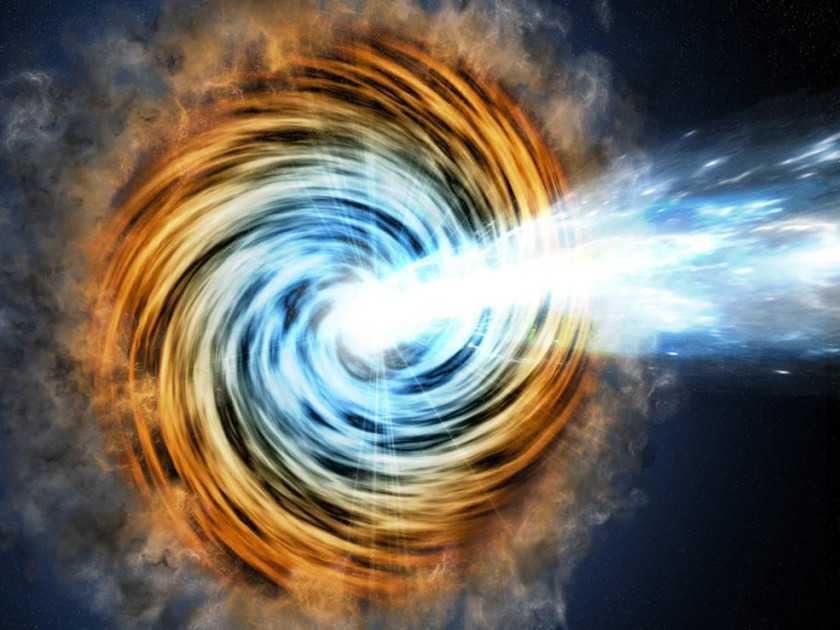
Blazars, or galaxies powered by supermassive black holes, act as anchor points in the sky.
They shine brightly in telescope observations, with glowing nuclei that send jets of particles and radiation directly toward Earth. But because they are so far away, they also appear almost perfectly fixed.
“From Earth, they look like some of the most stable objects in the universe,” explained Sasha Plavin, a postdoctoral fellow for the past three years with Harvard’s Black Hole Initiative. “Even GPS navigation is tied to observations of these black-hole-powered galaxies.”
This explains why astrophysicists like Plavin, who completed his doctorate at Moscow’s Lebedev Physical Institute in 2022, were so puzzled by data released by the European Space Agency. Its Gaia space telescope, which has collected more than 3 trillion observations, recorded shifts in the locations of about a hundred blazars.
“They appeared to be moving back and forth,” Plavin said.
In a recent paper published in the Astrophysical Journal Letters, Plavin reveals the source of this illusion. Powerful flares changed the distribution of a blazar’s light, shifting the position that Gaia measured. Plavin, who will start this fall as a Jansky Fellow at the National Radio Astronomy Observatory, then turns these shifts into a new tool for locating the flares.
In an interview with the FAS Current, edited for length and clarity, Plavin elaborated on his findings and discussed why researchers like him are drawn to blazars in the first place.
Let’s start with the basics. What is a blazar?
There are all kinds of galaxies in existence, but every one has a massive black hole at its center. Many galaxies, including our own Milky Way, are quiet, or inactive, meaning that most of their light comes from stars. In contrast, a blazar’s black hole outshines all the stars in that galaxy combined.
In fact, blazars are visible from across the universe because they are among the most luminous objects in the sky. Their luminosity and apparent stability make them useful for everything from studying high-energy physics to navigation here on Earth.
Why are scientists like you so drawn to blazars?
The main reason we astrophysicists study blazars is the extreme physical conditions around them. If we want to study the highest-energy particles, the most powerful particle outflows, or the strongest magnetic fields, we have to look beyond Earth. Even our largest particle accelerators fall far short of what happens around a black hole.
So, studying the environments around black holes is one of the few ways to test high-energy physics under conditions we cannot reproduce on Earth — and perhaps discover fundamental physics we have not yet encountered.
Your paper relies on measurements from the Gaia space telescope. What should we know about it?
This telescope, which observed the sky from 2014 to 2025, was very unusual. It wasn’t there to give us beautiful images; it was there to measure the positions of stars and galaxies as precisely as possible. Of course, it tracked the motions of stars in our own galaxy. But it also pinpointed the sky’s most distant objects with extraordinary precision.
Typically, we measure these distant objects with radio waves. But Gaia measured blazar positions very accurately using visible light, providing a basis for comparison and a new foundation for the global reference frame. The telescope may have stopped observing, but they’re still preparing the final data release.
Blazars generally appear fixed in telescope observations. Why, then, did Gaia record them as moving?
When blazars flare, they temporarily become brighter, shifting the position Gaia measures. Imagine two flashlights so far away that they blend into a single point. If one flashlight becomes brighter, the point appears to shift toward it, even though neither flashlight has moved. This is exactly what’s happening with blazars.
My analysis shows that these motions are not measurement errors; they are a real physical effect. Better measurements will let us study them more clearly, not make them disappear.
You introduce a way to localize these flares. What’s new about your method?
How far from the black hole do these flares happen? On which side of it? I would say the paper’s main contribution is locating where all this flaring activity occurs.
Localizing them is difficult. Typically, researchers compare flares at different frequencies. Those observed first are generally inferred to originate closer to the black hole, while those observed later are inferred to come from farther away. But that method is indirect, and it doesn’t always work.
Instead, I use the way a blazar’s position shifts as it brightens or fades to locate the flare geometrically. The results place the flares close to the black hole, near the base of the jet.
Can you walk us through your research process?
First, I identified blazars that showed significant motion in the aggregated data. Then I kept only those for which Gaia also provided brightness measurements.
I then asked a simple question: Do blazars that brighten appear to move in a different direction from those that fade? The correlation turned out to be surprisingly strong and remarkably consistent across the sample. When the blazars became brighter, the position Gaia measured moved closer to the black hole. When they became fainter, it moved away.
How surprising were these results?
For now, Gaia gives us aggregated measurements rather than full motion trajectories over the years. That made it unclear whether the available data would be enough to explain why the blazars appeared to move.
After a lot of thought, I came up with my simple approach. I thought the effect would be small, if it appeared at all. Instead, I found a clear pattern. It surprised me, and it has also surprised other researchers when I’ve presented it at conferences. Future Gaia data should provide full motion trajectories, allowing us to locate these flares even more precisely.

Harvard geoscientists reported that organic matter harvested from certain meteorites bears chemical traces of “primitive oxygen reservoirs” that have changed little since the birth of our solar system. The findings help trace the origins of organic matter that meteorites may have delivered to a young Earth, supplying the planet with ingredients essential for life.

Singer Mavis Staples, actress Angela Bassett, and soccer star Didier Drogba were among the honorees presented with W.E.B. Du Bois Medals Thursday at Sanders Theatre. The annual ceremony, hosted by the Hutchins Center for African & African American Research, recognizes outstanding contributions to Black history and culture.

“We will keep working at it until we get it right,” the FAS dean said.