Eileen O’Grady
Harvard Staff Writer

Brain scans reveal how selective breeding and individual training have forged canine communication skills
/ Read time: 6 minutes
Harvard Staff Writer
Most golden retrievers can understand the word “treat.” They can follow their owners’ pointing fingers, and they know when family members are feeling angry or excited. Selective breeding over generations has made these dogs remarkably attuned to human communication.
But can they fetch a pair of slippers? Or alert a child to the presence of peanut allergens at lunchtime? That depends on how well the dog has been trained.
A new paper from Erin Hecht’s Evolutionary Neuroscience Laboratory, recently published in the Journal of Neuroscience, analyzed how human influence, through both selective breeding across evolutionary time and training during individual lifetimes, has shaped the canine brain to make dogs better communicators.
“Dogs’ communicative skills are a big part of how they become part of our families,” said Hecht, Associate Professor of Human Evolutionary Biology and one of the paper’s three co-authors. “It’s also part of how they learn to perform important working functions like helping people with disabilities navigate the world and finding missing people after a disaster. We reasoned that as dogs evolved to live and work in the human world, their brains may have changed in ways that made communication with people more effective.”
The researchers confirmed that selective breeding has led to broad changes in the organization and asymmetry of dogs’ brain networks, making them more perceptive to human voices, faces, and gestures. At the same time, the researchers found that training can have a more targeted impact on individual brain systems, making the dog better at cue interpretation and response.
“The remarkable communication that happens between our two species isn’t just nature or nurture. It reflects both,” Hecht said. “Evolution builds the communication system, and experience fine-tunes it.”
The research team, led by Mélina Cordeau, a postdoctoral fellow in Hecht’s lab, set out to study 108 domestic dogs, categorizing them as either “modern” or “pre-modern” breeds. Also contributing was co-author Sophie Barton, another postdoc in Hecht’s lab.
The modern breeds, heavily shaped by artificial selection, include Labrador retrievers, border collies, and German shepherds. Representing ancient or less modified lineages are pre-modern breeds such as Samoyeds, Shiba Inus, and Siberian huskies.
The dogs’ brains were imaged using diffusion MRI tractography, a method that maps the brain’s white matter pathways. The researchers were looking for information about connections between brain regions and about “hemispheric asymmetry,” or whether connections are stronger on the left or right side of the brain.

“If you think of the brain as a city, typical MRI scans produce something like a map where you can see the location of different neighborhoods,” Hecht explained. “Diffusion MRI lets you see the roads that are connecting those neighborhoods.”
Results revealed differences in frontal and temporal association networks, which are involved in integrating auditory information with attention, decision-making, and action. Notably, the modern breeds showed stronger hemispheric asymmetry, which is thought to reflect specialization for certain types of mental processing tasks. The researchers specifically noticed that a certain pathway — which predicts the number of words a dog knows and can respond to — was larger in modern breeds, suggesting they are better at communication and processing human language.
“Thousands of years of human-directed selection appear to have changed how entire networks are organized and lateralized,” Hecht said.
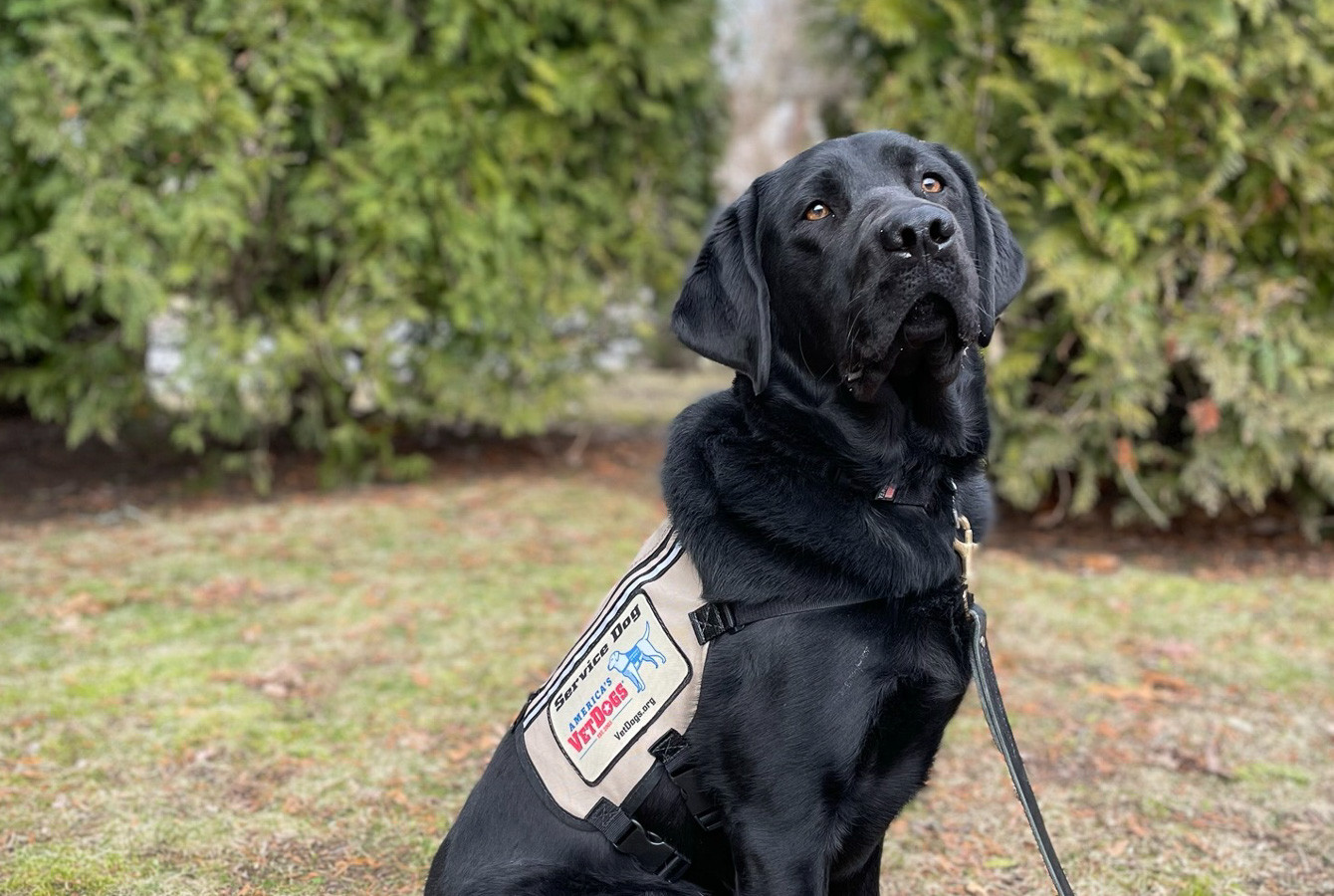
Cordeau and her team also compared trained service dogs to “released” service dogs, or canines initially bred and socialized to become service dogs before forgoing the training program and ultimately becoming pets.
Differences in the pathway that predicts vocabulary size had been found between trained service dogs and the rest of the sample. The left-sided pathway was stronger in service dogs, while the right-sided pathway was stronger in pet dogs. The findings suggest that service dog brains, after training, become better tuned to planning and carrying out actions.
“We also saw other differences between trained and released service dogs throughout the broader network of connections, but these differences were more focal and localized,” Hecht said. “We interpret that to mean that selection across generations can rewire brain networks, while experience within a lifetime fine-tunes them on a smaller scale.”
Hecht said this type of research helps pet owners understand more about their dogs — how capable they are of communicating and how well they can fit into a home and bond with a family.
But knowing more about how dogs learn skills can also help address shortages of working dogs badly needed for roles in healthcare, law enforcement, military, and other sectors across the U.S.
“The pipeline to produce specialized working dogs is so leaky; there can be multi-year waits to get a service dog or a guide dog, and there are acknowledged national shortages in detection dogs and search-and-rescue dogs,” Hecht said. “Our lab hopes to address these issues by better understanding the biology of skill-learning and providing tools for earlier prediction about which dogs will succeed.”

Harvard geoscientists reported that organic matter harvested from certain meteorites bears chemical traces of “primitive oxygen reservoirs” that have changed little since the birth of our solar system. The findings help trace the origins of organic matter that meteorites may have delivered to a young Earth, supplying the planet with ingredients essential for life.

Singer Mavis Staples, actress Angela Bassett, and soccer star Didier Drogba were among the honorees presented with W.E.B. Du Bois Medals Thursday at Sanders Theatre. The annual ceremony, hosted by the Hutchins Center for African & African American Research, recognizes outstanding contributions to Black history and culture.

“We will keep working at it until we get it right,” the FAS dean said.