Christy DeSmith
Harvard Staff Writer

Economics paper reveals common ground and tools with big potential to reduce harm
/ Read time: 5 minutes
Harvard Staff Writer
Gun ownership is among the most polarizing issues in American life. Many U.S. residents keep their homes stocked with multiple firearms. Others recoil at the thought of owning one.
But a new working paper reveals unexpected common ground, with members of both groups striving for the exact same thing.
“Everybody wants safety,” said co-author Stefanie Stantcheva, Nathaniel Ropes Professor of Political Economy. “People just disagree on what will create it.”
The economic analysis gets at the foundations of people’s beliefs about gun ownership as well as what drives that first firearms purchase. Given the well-documented risks of keeping guns in the home, Stantcheva and her co-authors also set out to test whether beliefs and behaviors can be shifted for those who derive a sense of safety from their weapons. Could they be persuaded to reduce the size of their arsenals? Are there changes they can make without sacrificing a sense of security?
Undertaking the research were three economists with distinct areas of focus. Stantcheva, founder of the Social Economics Lab, specializes in large-scale surveys that yield insights on how economic reasoning plays out with the general public. Co-author Marcella Alsan ’99, M.P.H. ’05, Ph.D. ’12, a professor at Stanford University, is a physician-economist with expertise in health inequalities. Co-author Joshua Schwartzstein, Ph.D. ’10, Cahners-Rabb Professor of Business Administration at Harvard Business School, is a behavioral economist.
Schwartzstein has a body of theoretical work exploring the emergence of disagreement — and why it often proves so stubborn. “Applying this lens to guns has been fascinating, especially here in the U.S. where there is such passionate and persistent disagreement,” he said.
The research team surveyed more than 5,400 adults on their beliefs about gun ownership. Results revealed safety as the primary motivator for both owners and nonowners: Nonowners associate guns with increased personal and social costs, including accidents involving children, whereas owners see lower probability of violent outcomes with increased protective benefits.
Also revealed was a third group, a subset of the nonowners who help drive consumer demand. Their responses indicated an interest in acquiring a first gun, with safety concerns still the key driver.
“Gun owners and people uninterested in guns felt similarly safe in light of their decision-making,” explained Schwartzstein, noting slight variances according to crime rates and other local factors. “People who do not own guns but show an interest seemed to feel much less safe.”
The gun-curious, comprising about 30 percent of nonowners, also saw lower risks in arming their households. “Their beliefs looked a little bit like those of people who own guns,” Schwartzstein observed.
The co-authors organized these patterns into a framework they call the safety possibilities frontier. “The idea is that every tool is associated with benefits and harms,” explained Stantcheva, recipient of the prestigious John Bates Clark Medal in 2025. “What’s the tool that will create the greatest benefit while minimizing the harms? People have very different views about how these trade-offs will work.”
Subsamples of survey respondents participated in three randomized experiments, designed to expose them to new information and harm-mitigating tools. Follow-up surveys tested whether the encounter succeeded in changing their beliefs about potential benefits and harms.
The first experiment offered basic facts about the risks of keeping firearms at home. A short video covered everything from potential legal liabilities to the increased risk of suicide, especially for young people and older men in the household.
The second and third experiments highlighted a nonlethal firearm. Some study participants encountered a video with straightforward information about the little-known consumer option. Others were given product information plus an endorsement by a conservative television personality.
“The idea was that this could expand the frontier by shifting people’s view of what’s possible,” Stantcheva said. “Because this is an alternative with potentially similar benefits to lethal firearms but much lower harms.”
Results showed gun owners unlikely to give up their weapons. More likely to move were their beliefs about safe storage and nonlethal firearms.
In fact, learning about the nonlethal product meaningfully increased gun owners’ stated willingness to keep traditional weapons securely stored. This change proved especially sticky with those who watched the TV celebrity endorsement.
“We have to work with the reality that we live in,” Stantcheva concluded. “Many gun owners are interested in acquiring more firearms. Making sure their next firearm is nonlethal and that lethal firearms are kept securely stored could have a really big impact.”

The topping-off ceremony, a construction rite rooted in ancient Scandinavian rituals, took place August 27 at the site of the future Pritzker Hall, which will house the Department of Economics. The building project was set in motion five years ago.
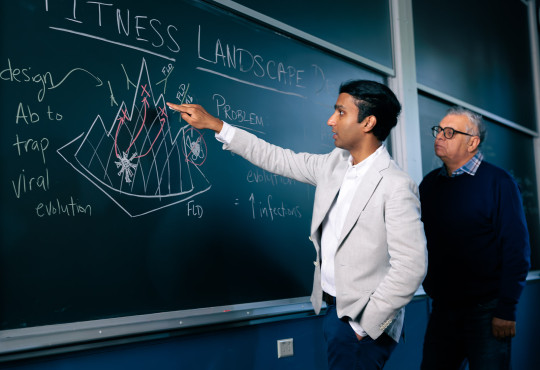
Two Harvard scientists describe a way to engineer the evolutionary landscape that viruses experience, pushing them away from dangerous variants and into evolutionary dead ends.

Amid the rhythms of the back-to-campus bustle, new faculty find themselves experiencing the same first-day excitement — and jitters. We dropped in on three, on the first day of their first classes.