Eric Moskowitz
Harvard Staff Writer
Inaugural Harvard conference elevated deep exchange of fields “not often discussed at the same time”
/ Read time: 7 minutes
Harvard Staff Writer
The Harvard Center for Jewish Studies and the Alwaleed Islamic Studies Program are both housed in Harvard’s Museum of the Ancient Near East and operate similarly as research hubs, bringing together faculty from a range of fields, departments, and schools across the University. But for the first 17 years after the AISP opened, the two never collaborated.
Then came October 7, 2023. In that highly charged atmosphere afterward, the leaders of both centers “came together and said, ‘We have to do something,’” said Harry Bastermajian, executive director of the AISP.
Bastermajian and his CJS counterpart, Rachel Rockenmacher, recognized both the centuries of entwined history of Muslims and Jews spanning the Middle East to Iberia — as well as the shared academic origins of the two fields of study in the modern academy. With the endorsement of their faculty directors, Khaled El-Rouayheb and Derek Penslar, they started a series on Jewish-Muslim interrelations, organizing a guest lecture in the spring of 2024, then three more over the next two years.
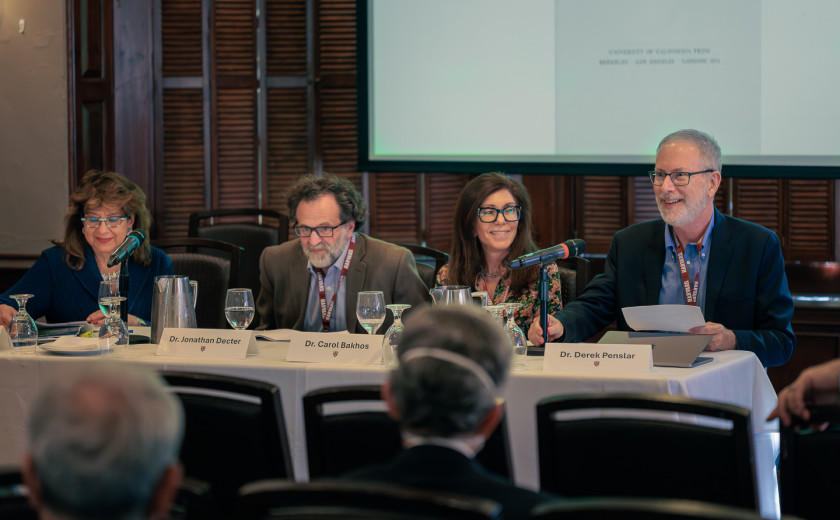
Those went so smoothly that the faculty directors, meeting over coffee, decided to hash out a plan for a full-fledged conference: “Legacies of Misreading: Anti-Jewish and Anti-Muslim Bias in Islamic and Jewish Civilizations,” held last week.
“Right from the start, Khaled and I wanted to ensure that the conference would consist of serious scholarly exchange rather than political debate or advocacy,” said Penslar, William Lee Frost Professor of Jewish History. “It’s important to us that the University should transcend rather than transmit bias, misunderstanding, and conflict.”
The all-day conference was split thematically, with a morning focus on Muslim perceptions of Jewish civilization, and an afternoon focus on the opposite. In some ways, it was just like any academic conference, with scholars delivering papers and talks that spanned the centuries and approached the theme in a variety of ways, and dozens of researchers breaking bread over lunch; but even in that manner, it was quietly revelatory.
“These fields are not often discussed at the same time, in the same room, and this conference asks each field to look critically and historically at its own traditions and to think together with specialists,” said Mark Elliott, Vice Provost for International Affairs as well as the Mark Schwartz Professor of Chinese and Inner Asian History, in opening remarks. “The aim here is to arrive at a more nuanced — a more historically informed — understanding of misunderstanding.”
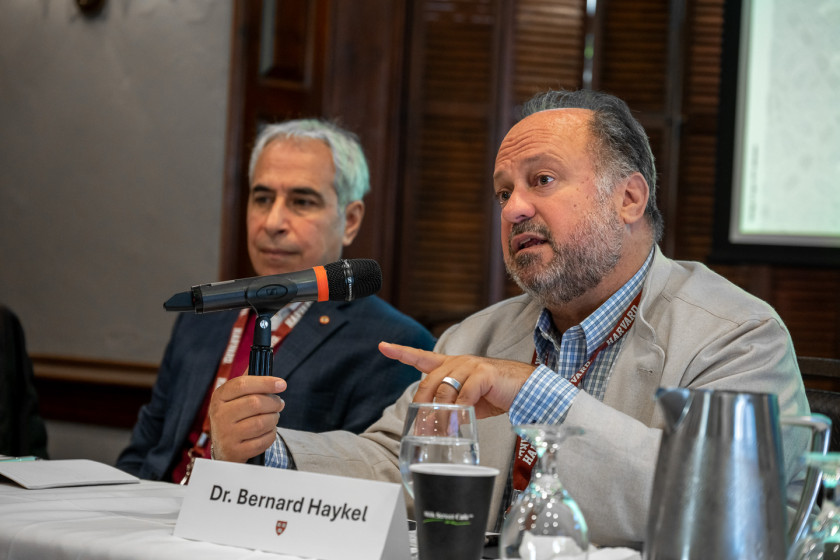
The morning session featured Princeton University professor Bernard Haykel (“The Polemics Surrounding the Treatment of Jews in Yemen’s History”) and Smith College professor Suleiman Mourad (“Muslim-Jewish Interactions during the Ayyubid and Mamluk Periods: Some Remarks”) along with Harvard’s Malika Zeghal, the Prince Alwaleed Bin Talal Professor in Contemporary Islamic Thought and Life.
Zeghal (“The Limits of Equality under a Muslim State: Jews and Muslims in North Africa”) examined Tunisia, which like most Middle Eastern countries enshrines Islam as the state-preferred religion — complicating a contemporary Tunisian narrative of egalitarianism and secularism.
Under premodern Sharia Law, Jews and Christians across the Islamic world were treated as dhimmi, a framework that acknowledged their special status in the Quran as “People of the Book” and granted certain religious and societal protections in exchange for a tax, though their autonomy varied widely in practice across time and from place to place.
With Tunisia, most histories of the Jews have been written “from the bottom up.” Looking top-down, Zeghal studied how the country’s elites in the post-dhimmi era — across various regimes since the 1850s — wrestled with the tension between equality and custodianship of Islam, yielding a story of “protection, cooperation, and discrimination.” (Penslar likened it to the Israeli judiciary’s efforts to reconcile a rights-based society with Jewish particularism, what in Israel is referred to as “a Jewish and democratic state.”)
Mourad recounted a story from the 1470s, when a storm destroyed a synagogue that abutted a mosque in Jerusalem’s Jewish quarter. Local Muslim authorities embraced it as an opportunity to improve access to the mosque, but the Jewish community appealed to the ruling Mamluk sultan in Cairo, who validated the Jews’ property rights and granted them permission to rebuild — setting off a prolonged tussle and showing the way dhimmi “rights were sometimes assiduously enforced and other times ignored, however unpopular they might have been with some Muslim groups.”
He also noted that the famed 12th-century Muslim scholar Ibn Asakir’s 80-volume opus on the history of Damascus barely mentioned Jews — and then mainly in relation to their seventh-century conquest: “That tells us about this willful ignorance of the ‘other’ that we find across Islamic history, that often obfuscates our own perception.”
Haykel was the rare conference speaker addressing bias in contemporary work from his own field, which he considered rife. “I’m going to sound like a scold,” he said. “Scholarship should be about knowledge production, and not about political activism, which has unfortunately taken over my field entirely, and many other fields in the humanities and social sciences.”
He cited a paper by a prominent Islamic studies scholar claiming that the Jews of Yemen historically enjoyed more acceptance and integration and less discrimination and violence than acknowledged by Jewish scholars, alleging selective storytelling to feed a narrative of “rescue from Arab oppression.” That author claimed his Jewish counterparts had neglected Arabic sources — even though he himself does not read Hebrew, and, Haykel said, Israeli researchers had thoroughly mined Arabic sources from Yemen. He didn’t want to belabor the bias of that one example — “it runs in both directions” — but wanted to encourage scholarship based on “nuanced reading without specifically pushing a political agenda and then more specifically denying facts.”
In the afternoon, Carol Bakhos of the University of California, Los Angeles, went back to rabbinic literature of late antiquity and the early medieval period in a presentation on “Ishmael and the Ishmaelites in Rabbinic Apocalyptic Imagination.” After oppression by the Roman and then Byzantine Christian empires, “some Jews experienced the emergence of the Arabian empire as a harbinger of a political or religious sea change,” Bakhos said. They saw it as liberation from suffering and even a sign of messianic deliverance, and it informed the ways that rabbis interpreted the biblical story of Ishmael — until the reality of life under Islamic rule showed them otherwise. “Once hailed as a liberator by Jews, Islam [came to be] seen as yet another oppressive empire,” she said.
Bakhos’ subjects were engaging with their own texts, not Islamic doctrine. Jonathan Decter of Brandeis University (“Doctrine and Ritual in Jewish Polemical Writing Against Islam”) delved into rabbis and Jewish authors who engaged with the Quran and other Islamic sources, while living under Muslim rule.
In classical antiquity, Jews were distinct in a world of idol worship and polytheism, but by late antiquity, “Judaism was effectively a species of a broader genus,” Decter said. Jewish authors comparing and contrasting monotheisms sometimes went on the offensive against Islam, but given the power differential between Jews and Muslims, they were necessarily cautious — writing between the lines figuratively or even literally, in the form of encoded acrostics. Others offered mixed evaluations, forming what could be seen as the beginnings of the academic discipline of comparative religion, though even that could be deadly; in 13th-century Baghdad, the Jewish philosopher Ibn Kammuna’s “Examination of the Three Faiths” caused rioting that forced him to flee the city in a coffin.
“We’re the inheritors of all these medieval legacies — the good, the bad, the ugly, and the interesting,” Decter said.
Susannah Heschel of Dartmouth College, currently a visiting professor at Harvard Divinity School, traced the rise of modern Jewish and Islamic studies to Central Europe in the 19th century, in “The Role of Islam in Modern Jewish Self-Definition.” Jewish scholars — initially barred from the academy — conducted much of that founding work when finally given an opportunity. For example, Gustav Weil, who wrote the first European biography of Muhammad that drew on early Arabic sources, spent decades as an assistant librarian before being granted a professorship in Heidelberg in his 50s.
At the time, the academic craft of research and writing was taking shape across the sciences and humanities. Jewish scholars saw the pursuit of knowledge — “Wissenschaft,” in German — as both therapeutic and socially useful. It was natural for them to turn the lens on themselves, and on Islam, too, finding it safer to scrutinize these faiths than the dominant religion of Central Europe. Moreover, the Arabic, Hebrew, and Aramaic languages had much in common, and portions of the Quran echo material and themes from the Hebrew Bible.
Some Jewish scholars applied a different kind of bias than their Christian colleagues, who tended to denigrate Judaism and Islam in relation to early Christianity. Jewish scholars — who eventually occupied a quarter of chaired professorships in Islamic studies in Germany before the Holocaust, despite being 1 percent of the population — were more sympathetic to Islam. But they also tended to amplify the medieval era in al-Andalus (the southernmost portion of Spain) as the ultimate “golden age” of Muslim civilization, in contrast with the persecution of Jews and Muslims that followed under Catholic rule.
Continuing with Iberia, Mark Meyerson of the University of Toronto delivered the keynote address (“Violent Muslims? Cowardly Jews? Christian Misreadings of the Behavior of Muslim and Jewish Minorities in Late Medieval and Early Modern Spain”). The Christian ruling class, Meyerson noted, viewed both peoples with bias. He found that the prevailing stereotypes of Jews and Muslims — and of conversos and Moriscos, or forcibly baptized Jews and Muslims, respectively — didn’t stand up to scrutiny. Muslim infighting wasn’t an act of random barbarism but followed recognized rules and structures. Jews projected passivity for self-preservation — “Jew” became a Valencian smear for “a man too fearful to take revenge” — but inside their own community they mimicked Christian displays of violence on matters of honor.
Penslar, in closing, said that “lived reality, which changes greatly across space and time, is ultimately the only accurate source for understanding the essence of Jewish-Muslim relations.” And he offered a word on polemics — against Judaism by Muslims, and vice versa — as “the antithesis of rigorous scholarly study embodied in this conference and in our collegial conversations.”

The Class of 2030 totals 1,648 and includes students from all 50 states and 86 countries.

After four years at the University of Michigan, former assistant coach Rob Rassey returns to Harvard as head coach of the men’s ice hockey team. Ahead of his first game on Thursday, he talked about his career journey, how he leads, and what he missed about Cambridge.
The project is unique “because all data, methods, and other procedures are public — something that is not true for any other public forecast we know of,” said co-creator Gary King.