Kermit Pattison
Harvard Staff Writer
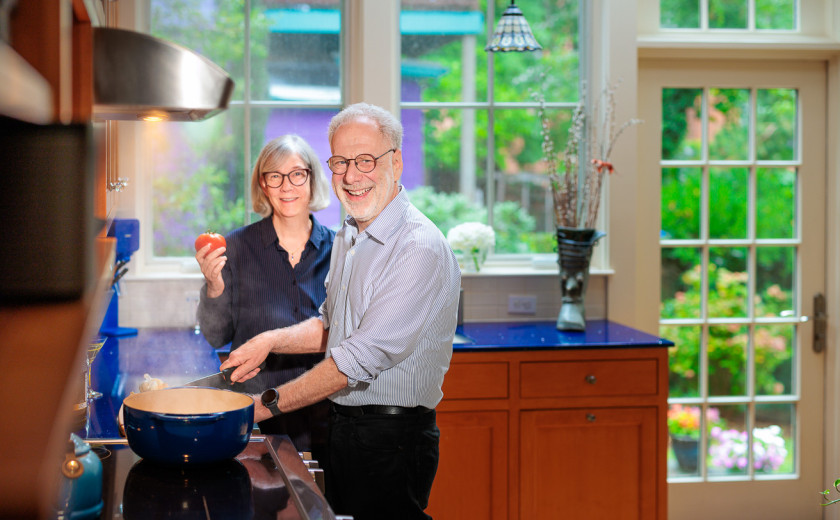
Daniel Lieberman’s new book anchored by culinary odyssey with his wife
/ Read time: 8 minutes
Harvard Staff Writer
For most of his life, Daniel Lieberman has dedicated his mind to studying the evolution of the human body. In his latest project, he also devoted his body — specifically his digestive tract — to science.
In “Fed Up: What Evolution Reveals About Food, Diet, Health, and Eating Well,” Lieberman recounts how humans ascended to global mastery largely because they became “the ultimate omnivores” who managed to find a meal almost anywhere. The new release also serves as a guidebook for our modern predicament: an overabundance of choices, conflicting messages about food and health, and constant evangelizing of diets that promise panaceas.
“People love overly simple, magic-bullet, quick-fix solutions, and I think that’s a major reason why there’s so much confusion about diet,” said Lieberman ’86, Ph.D. ’93, Edwin M. Lerner II Professor of Biological Sciences in the Department of Human Evolutionary Biology. “We have to stop oversimplifying what is, unfortunately, a complex problem.”
But Lieberman, who studies how our biology is often at odds with modern lifestyles, wanted to avoid a dry regurgitation of facts. So, he and his wife, Tonia Prescott ’86, embarked on an alimentary odyssey — a succession of two-week stints adhering to popular diets, from “paleo” fare to raw food to factory-synthesized “replacement” diets. Each kitchen adventure provided a narrative thread, allowing the professor to serve up digestible portions of hard science about human physiology, nutrition, and the history of what we eat and how we think about it.
Food is a central storyline in the evolution of humans — or any species. For most animals, the number one task is finding nourishment. Over millions of years, our ancestors became more versatile at that game, allowing them to settle diverse environments, evolve bigger brains, and produce more offspring. Ancient hunter-gatherers relied on intelligence to figure out how to hunt animals, what plants were safe to eat, and nourish themselves in different seasons.
Today, people need a different sort of acumen, because the modern environment presents us with a bewildering plethora of choices; the average supermarket stocks 33,000 items. We are tempted by unhealthy foods that appeal to primal cravings and hear contradictory information about what is good or bad for our health.
“Now we still need knowledge, not to get our food but to choose our food,” Lieberman said recently in his office above the Peabody Museum of Archaeology & Ethnology. “Why is it that we don’t teach that basic information, even to physicians? Why don’t we teach this in high school? Everybody should learn about what goes into their body and how to understand one of those nutrition facts labels. The point of the book is to teach what everybody ought to know to answer the question ‘What should I eat?’”
One low point in the couple’s culinary tour was the raw food diet.
For two weeks, they planned to follow the strictures of the anti-cooking camp and consume nothing that had been baked, boiled, or fried. They consulted recipe books (which could not properly be called cookbooks for obvious reasons).
“All of them make enthusiastic promises that ‘going raw’ will fill us with energy, improve our sleep, elevate our mood, and prevent almost every imaginable disease,” Lieberman recalled. “One of them even claims our poop will smell better.”
In the abundantly stocked grocery store, he and Prescott discovered a paucity of stuff they were actually allowed to eat, aside from fruits and vegetables. They prepared raw zucchini “pasta” spiralized in a special kitchen device and a dessert of “uncookies” — a mash of raw hazelnuts, dates, raw cocoa, dark unsweetened chocolate, and vanilla extract.
“I am sorry to confess that after 30 minutes I sneak down to the basement to find the coffee we removed from the kitchen,” Lieberman writes. “Tonia and I agree we don’t care what the raw foodists say, we are not going two weeks without coffee!”
Soon they made a similar exception for wine. Still, the diet wore on them. They spent many hours preparing food to be edible — grating cauliflower “rice” for example — yet constantly wished they were eating something else.
Normally an avid runner, Lieberman found he lost the energy to exercise. He felt hungry around the clock, constantly thought about food, and craved forbidden bowls of oatmeal, bread, and his beloved peanut butter. Masses of raw foods also played havoc with their digestion. (Here, Lieberman introduces the reader to the term borborygmus — the gassy rumbling in the small intestine).
Prescott sank into sadness.
“I’m naturally not a person who’s suffered from depression,” she recounted one recent morning in her kitchen. “I’ve never had that experience before and it was so overpowering. I went to open a window, and I just didn’t have the energy — and our windows aren’t that hard to open. I just looked out and I started to cry.”
She collapsed into bed in tears. Then came a sudden revelation — BAGEL! Prescott stormed out of the house, went to a café, and quietly restored herself with a forbidden baked good smeared with cream cheese.
She returned home and confessed she had cheated. “I regret nothing,” she said.
In short, the couple rediscovered what our ancestors found when mastering fire — cooking really matters. It makes food more digestible, nutritious, and enjoyable. In the book, Lieberman expounds on the extensive work of his colleague Richard Wrangham, author of “Catching Fire: How Cooking Made Us Human” (2009). As Lieberman concludes: “We evolved to be the planet’s most eclectic and successful omnivores to a large extent because we cook.”
Next on the agenda was the paleo diet, supposedly modeled on what our hunter-gatherer ancestors ate. It prescribed lean meats such as grass-fed beef, seafood, eggs, leafy vegetables, fruits, nuts, and seeds. Forbidden were all grains, potatoes, legumes, dairy, and processed foods.
Lieberman’s verdict: “The diet doesn’t feel remotely Paleolithic.”

Wednesday, October 7
6 p.m.
Zimmer Hall, Hall D
1 Oxford St.
Free tickets, RSVP required
During the pandemic, Lieberman’s research group surveyed published literature on the diets of traditional societies. “We found so much variation among hunter-gatherer diets that the paleo diet bears little resemblance to any of them,” he writes. “You name it, hunter-gatherers ate it.”
Ancient peoples ate much more than the big game depicted in cave paintings. On the coasts, they caught fish and shellfish. In deserts, they had a taste for cactus. In the Arctic, they consumed seals. They ate a great diversity of plants — including grains — well before farming.
As modern humans expanded over the planet, the dietary eureka was adaptability — not clinging to old diets or prohibitions, Lieberman said. Humans succeeded not by adhering to old staples, but by adding new ones.
And so it went as the couple noshed through one diet after another: blue zones (generally sensible, Lieberman concluded, but the dubious longevity claims are “more marketing than serious science”), factory food replacement diet (“my biggest complaint was sensory deprivation”), intermittent fasting (“not too bad — you just skip breakfast”), and the carnivore diet (“a dose of quackery”). In all, Lieberman analyzed 11 diets and tried eight. Prescott let him finish on his own after declaring: “I’m done with this nutso project.”
The book settles one big question: What is the optimal human diet? The answer is simple — there is no such thing. Once some basic nutritional requirements are fulfilled, there are many routes to healthy eating. The celebrated Mediterranean diet, for example, is just the European version of a common formula.
Indeed, Lieberman writes, cultures all over the world have shown the elements of a healthy diet: little added sugar, lots of fruits and vegetables, whole grains, mostly unsaturated fats from plants rather than saturated fat from animals (and zero trans fats). Also on that list are legumes, nuts, moderate amounts of seafood or red meats, no more than a pinch of salt here and there, and absolutely no “weird” chemical additives.
In the end, Lieberman condenses a career’s worth of findings into a few simple points of advice: avoid fad diets, minimize highly processed foods, try to prevent swings of weight gain and loss, and keep on exercising.
Now that the book is complete, Prescott looks forward to dinner conversations that do not revolve around food. “I will actively fight him at the dinner table to change the subject,” she said. “Sometimes I will in advance come up with some defensive mechanism — usually whatever book I'm reading.”
That elicited a laugh from her husband, who had just finished waxing about the gut microbiome and neurotransmitters. He understood what it meant to be fed up.

The assistant professor in the Department of Art, Film, and Visual Studies has been named this year’s winner of a distinguished annual honor for artists with strong ties to New England.
When Paul Giamatti was 7 years old, his mother told him the story of the Eugène Ionesco play “Rhinoceros.” Giamatti was a monster enthusiast at the time, and something about the idea of a man turning into a rhinoceros lodged in his brain.

Sixteen years ago, an invasive pest called the woolly adelgid arrived at Harvard Forest and slowly began to devastate its the eastern hemlocks — as they had done in forcce elsewhere. Since then, Harvard Forest scientists have begun to study how to manage the demise of its so-called foundation species.