Eric Moskowitz
Harvard Staff Writer
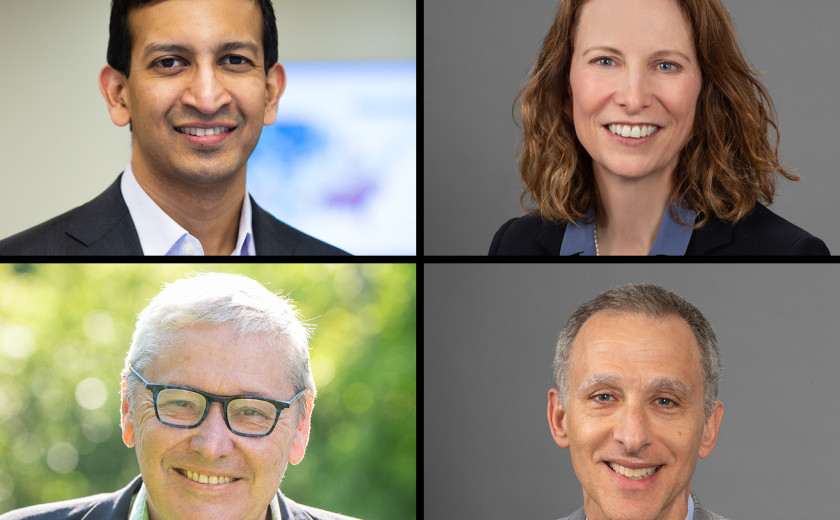
Academics will weigh in on inflation, data, balance sheets, and communications
Harvard Staff Writer
Four Harvard economics professors have been named by new Federal Reserve Chair Kevin Warsh to lead a set of task forces that will advise the central bank on monetary policy.
The five independent task forces, comprised of business leaders, academics, and former central bankers, are key to Warsh’s plan to revamp aspects of the Federal Reserve while trying to maximize employment and hold prices stable. Each consists of three subject-area experts charged with giving an aspect of the Fed’s operations a fresh look, with, according to the announcement, “a mandate to follow the evidence, provide candid feedback, and produce rigorous findings” to guide policymakers.
Karen Dynan Ph.D. ’92 and Jeremy Stein will serve on a task force focused on balance sheet policy, examining the costs, benefits, and implications of the independent agency’s $6.7 trillion portfolio of government bonds, notes, and mortgage-backed securities.
Raj Chetty ’00, Ph.D. ’03, will serve on a data task force, evaluating the signals the Fed receives from government figures and considering new sources of information and changes to improve the central bank’s data collection and analysis.
Greg Mankiw will serve on a task force on inflation, revisiting how the Fed understands and responds to what drives ongoing price increases in goods and services.
The other two task forces will focus on communications — how the Federal Reserve conveys its deliberations and decisions, especially in times of uncertainty — and on productivity and jobs, with the latter focusing on the role of artificial intelligence as an economic force.
In addition to the four Harvard faculty, the 11 other members of the task forces include Nobel Prize-winning economist Thomas Sargent, Ph.D. ’68; former Walmart CEO Doug McMillon; venture capitalist Marc Andreessen; and former heads of the central banks of England (Mervyn King), India (Raghuram Rajan), and Brazil (Armínio Fraga).
“The U.S. economy has changed significantly over the last generation, and never more so than right now,” Warsh said in a statement announcing the creation of the task forces July 9. “I am honored that the best minds from a range of disciplines have agreed to work with us to sharpen our performance as an institution. The goal is straightforward: to ensure the Fed is best positioned to achieve our objectives in this consequential time.”
Warsh did not announce a timeline, but the panels are expected to make recommendations by year’s end to the Federal Open Market Committee, the key decision-making body on monetary policy, which consists of the seven members of the Federal Reserve Board, the president of the New York Fed, and four regional Federal Reserve Bank presidents on rotating terms. Stein and Chetty said their task forces have started digging into the work already.
Dynan is a professor of the practice in the Department of Economics and at Harvard Kennedy School. She served as assistant secretary for economic policy and chief economist at the U.S. Department of the Treasury under President Barack Obama (2014–17) and spent nearly two decades on the staff of the Federal Reserve in the 1990s and early 2000s.
“There are a lot of important questions about the Federal Reserve’s balance sheet, and I’m looking forward to working with my fellow task force members and the Fed staff as we think through those issues,” Dynan wrote in an email. Her research focuses on fiscal and monetary policy, consumer behavior, and economic measurement.
Stein, Moise Y. Safra Professor of Economics, was a member of the Fed’s Board of Governors from 2012 to 2014 and served on the board of directors of the Harvard Management Company for nearly a decade. His research areas include behavioral finance and market efficiency, corporate investment and financing decisions, risk management, capital allocation, banking, and monetary policy.
“I’m honored to be a part of this process, and I look forward to working with my co-chairs and Fed staff on these important issues,” Stein said.
Chetty, William A. Ackman Professor of Public Economics, is the director of Opportunity Insights, which uses big data — from sources such as the IRS and Facebook — instead of survey results to better understand the barriers and levers affecting socioeconomic mobility and opportunity. He is a winner of the MacArthur Foundation “genius grant” and the John Bates Clark Medal for economists under 40 who have made the most significant contributions to the field.
“Through our work on the Economic Tracker, we’ve seen how large-scale, near-real-time macroeconomic data can deepen our understanding of economic trends and provide policymakers with more timely and actionable insights,” Chetty said. “I look forward to working with colleagues at the Federal Reserve and applying the lessons from that research to help inform policy decisions and improve economic outcomes.”
Mankiw, Robert M. Beren Professor of Economics, authored the textbooks “Principles of Economics,” now in its 11th edition, and “Macroeconomics,” now in its 12th edition. He has published research on inflation, price stickiness, consumer behavior, and economic fluctuations and growth, among other topics, and served as chairman of the White House Council of Economic Advisers under President George W. Bush, from 2003 to 2005.

Harvard geoscientists reported that organic matter harvested from certain meteorites bears chemical traces of “primitive oxygen reservoirs” that have changed little since the birth of our solar system. The findings help trace the origins of organic matter that meteorites may have delivered to a young Earth, supplying the planet with ingredients essential for life.

Singer Mavis Staples, actress Angela Bassett, and soccer star Didier Drogba were among the honorees presented with W.E.B. Du Bois Medals Thursday at Sanders Theatre. The annual ceremony, hosted by the Hutchins Center for African & African American Research, recognizes outstanding contributions to Black history and culture.

“We will keep working at it until we get it right,” the FAS dean said.