Eric Moskowitz
Harvard Staff Writer
Art, Film, and Visual Studies professor honored for body of work “that so thoroughly fuses and refracts language, place, and experience”
| 4 minutes

Sky Hopinka, a multidisciplinary artist and filmmaker and an assistant professor in the Department of Art, Film, and Visual Studies, has been named this year’s winner of the Rappaport Art Prize, a distinguished annual honor for artists with strong ties to New England.
Hopinka works in film and video as well as photography, collage, text, and poetry. His body of work — dreamlike and evocative, at once deeply personal and universal — touches on themes such as landscape and memory, filtered through Hopinka’sperspective as a diasporic member of the Ho-Chunk Nation and the Pechanga Band of Luiseño Indians.
The Rappaport Prize, given by the deCordova Sculpture Park and Museum in Lincoln, adds to the significant list of accolades Hopinka has received in the decade and a half since the former freelance filmmaker entered graduate school — including a 2023 Baloise Art Prize at Art Basel, a 2022 MacArthur Foundation “genius grant” fellowship, and a 2020 Guggenheim Fellowship.
“It’s very humbling, and it’s also been a really validating experience,” said Hopinka, reached by telephone in Brooklyn; he divides his time between Cambridge and New York, and is on sabbatical this year. “These awards have come at different parts of my career, where I’m trying new things. You want to build on what you’ve done in the past and make these different versions of yourself in conversation with one another.”
The award came as a surprise to Hopinka. The deCordova and the Phyllis and Jerome Lyle Rappaport Foundation, which funds the endowed prize, consult museum directors, curators, collectors, and artists from around the country to form a pool of nominations, before a formal jury selects a winner from a group of finalists. Hopinka did not know he had been nominated.
Jonathan Rappaport, who leads the foundation’s arts and culture committee, said the jury had “never before encountered art that so thoroughly fuses and refracts language, place, and experience.” In a statement, he marveled at Hopinka’s work, including “photographs stitched into poems, text assuming visual form, and films that unspool into meditations.”
Hopinka currently has a solo exhibition on view at the National Gallery of Art in Washington, D.C. — “Kicking the Clouds,” a mid-career survey — as well as a large-scale commission installed at the Barnes Foundation in Philadelphia (“Red Metal Dust”), featuring 11 monumental photographs overlaid with copper. His 2025 feature-length film “Powwow People” is still on the documentary circuit, with a Los Angeles screening next month.


The Rappaport Prize comes with a $50,000 award and a lecture at the deCordova, which Hopinka will deliver October 8. He has gallery shows slated for 2027 in both the U.S. (Broadway Gallery NYC) and Canada (Toronto’s Cooper Cole Gallery).
Hopinka’s parents met on the powwow circuit, where his mother (an enrolled member of the Pechanga, from California) was a dancer and his father (an enrolled member of the Ho-Chunk, from Wisconsin) a drummer. They settled in the Northwest, raising Hopinka near the Lummi Reservation in Ferndale, Wash. He said that upbringing — embraced by the Lummi, but not a tribal member — added an extra layer to the inherently diasporic experience of being Native in this country, given the long history of forced relocation and assimilation.
“There’s these different ways of understanding boundaries and also tribal sovereignty that are ingrained as you’re growing up and as you’re navigating the world and understanding your own complex identity,” he said.
“There’s no one way to be Native in this country, because there’s over 500 federally recognized tribes, and there’s a lot of complexity and nuance that goes into that. And it really shaped how I understand my own place — moving through these different landscapes and different places that I’ve lived.”
Hopinka first came to Harvard in 2018 as a fellow at the Radcliffe Institute for Advanced Study, while on the faculty at Canada’s Simon Fraser University. He fell in love with the Harvard community and was encouraged to apply for an assistant professorship in early 2024, after working at Bard College.
“There’s so many wonderful people here,” Hopinka said.
Some of Hopinka’s short films are multichannel (meant for immersive installation, with multiple projections) and some are single-channel. For those new to his work, he suggested two single-channel films that were installed at The Museum of Modern Art, when his career first began to gain traction: “Jáaji Approx.” (2015) — named for the near-translation of the word used for directly addressing a father in the Hocąk, or Ho-Chunk, language; it pairs audio interviews with Hopinka’s father and snippets of songs with varied imagery, touching on landscapes they have traversed together and separately — and “I’ll Remember You as You Were, Not as What You’ll Become” (2016), an elegy to the Native poet and artist Diane Burns.

Say political engagement could be increased in a certain society by the introduction of effective artificial intelligence tools — but those living there would have fewer in-person interactions. Should such tools be adopted?
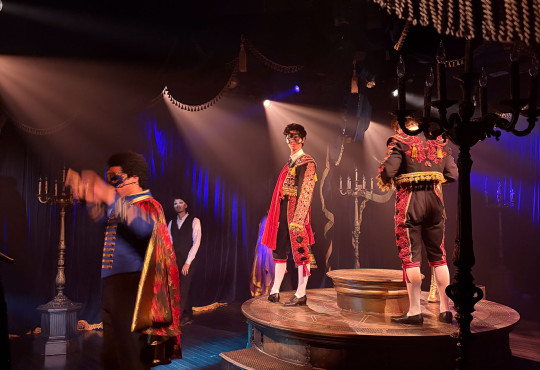
This past summer, three Harvard students helped transport Manhattan audiences to Parisian rooftops, opera house dressing rooms, and a subterranean labyrinth in “Masquerade,” an immersive adaptation of Andrew Lloyd Webber’s “The Phantom of the Opera.”
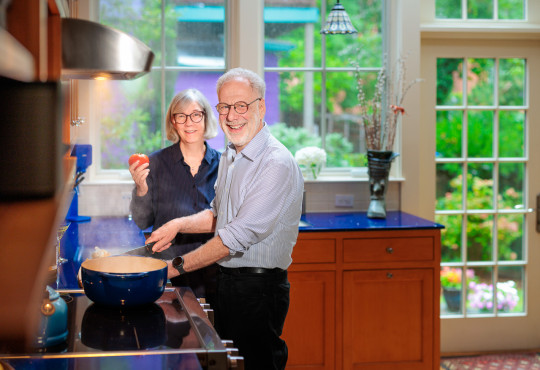
For most of his life, Daniel Lieberman has dedicated his mind to studying the evolution of the human body. In his latest project, he also devoted his body — specifically his digestive tract — to science.