Eileen O’Grady
Harvard Staff Writer
Greek conference, inspired by ancient philosopher’s Lyceum, offers model of dialogue between humanities and tech
/ Read time: 5 minutes
Harvard Staff Writer
The multidisciplinary conversations Aristotle had with students at his Lyceum thousands of years ago might be useful today in thinking about humanity’s relationship with AI.
At least, that’s the premise of an annual conference in Greece that brings together scientists, technologists, humanists, and civic leaders to discuss AI and philosophy.
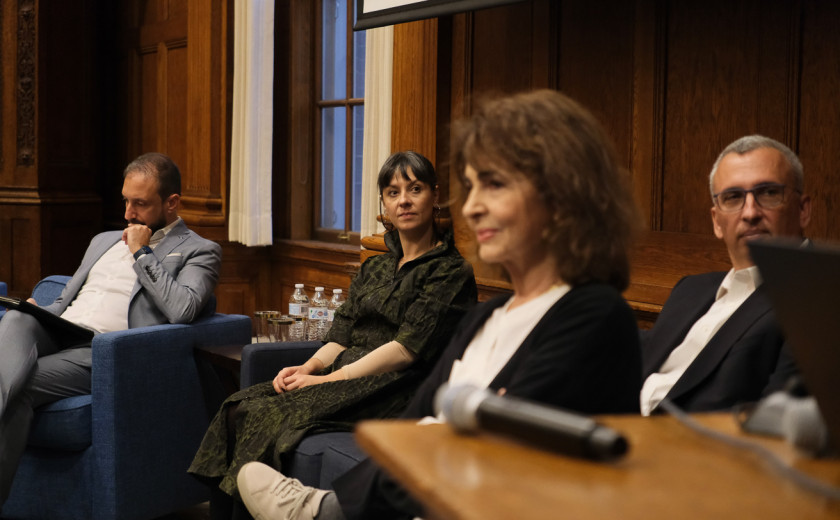
The Lyceum Project conference served as a model for a recent panel discussion, hosted by the Center for Hellenic Studies and Mahindra Humanities Center in honor of Worldwide Week at Harvard, on whether our AI future can serve human flourishing and the good life.
“How does AI reshape, if at all, the ways in which we conceive of excellence, the ways in which we conceive of our ‘ergon’ — of our functions, what it means to be human?” lecturer on government Sergio Imparato asked an audience packed into the Barker Center’s Thompson Room. “A related question, which we sometimes ask in a different tone, is ‘What is the end of AI?’ It is a tool, after all. What is its function? And who gets to decide it?”
Imparato, a Lyceum Project attendee since its founding in 2024, was one of four speakers to appear on the October 14 panel, which was moderated by Associate Senior Lecturer on Social Studies Nicolas Prevelakis. Joining them in conversation were representatives of the two organizations that host the Athens-based conference: Vangelis Karkaletsis and Maria Dagioglou from the National Centre for Scientific Research Demokritos (NCSR), and Alexandra Mitsotakis with the World Human Forum.
Dagioglou, a researcher specializing in AI methods, human behavior, and human-AI collaboration, explained that the conference takes inspiration from the ancient Greek concept of schole, often translated as “leisure,” which refers to time spent away from work dedicated to the contemplation and discussion of philosophy.
“This is so urgent,” said Karkaletsis, director and chairman of NCSR’s board. “We can see this today with all this discussion around artificial intelligence and the dilemmas that are discussed in Europe, in the U.S., and all [over] the globe. We have initiated all this in order to bring together people for discussions about values, about these dilemmas.”
While humanities scholars may take it as a given that philosophy should be used to guide AI design and development, Dagioglou said not everyone in the tech industry thinks this way.
“Unless you are trained to do so, it’s impossible to translate philosophical questions to technical requirements,” she said. “It’s impossible to realize that on some occasions, rounding a decimal number up to the second or the third even, might be actually a moral dilemma and not just a mathematical act.”
Dagioglou added that this type of conference offers exposure to different perspectives, to people from fields participants may not usually interact with.
“We have been experiencing this massive explosion of knowledge and overspecialization,” Dagioglou said. “This is why we need all these people to come together and discuss.”
Conversations held during the Lyceum Project have contributed to real policy changes, Karkaletsis said, such as Greece’s new law banning children aged 15 and under from using social media.

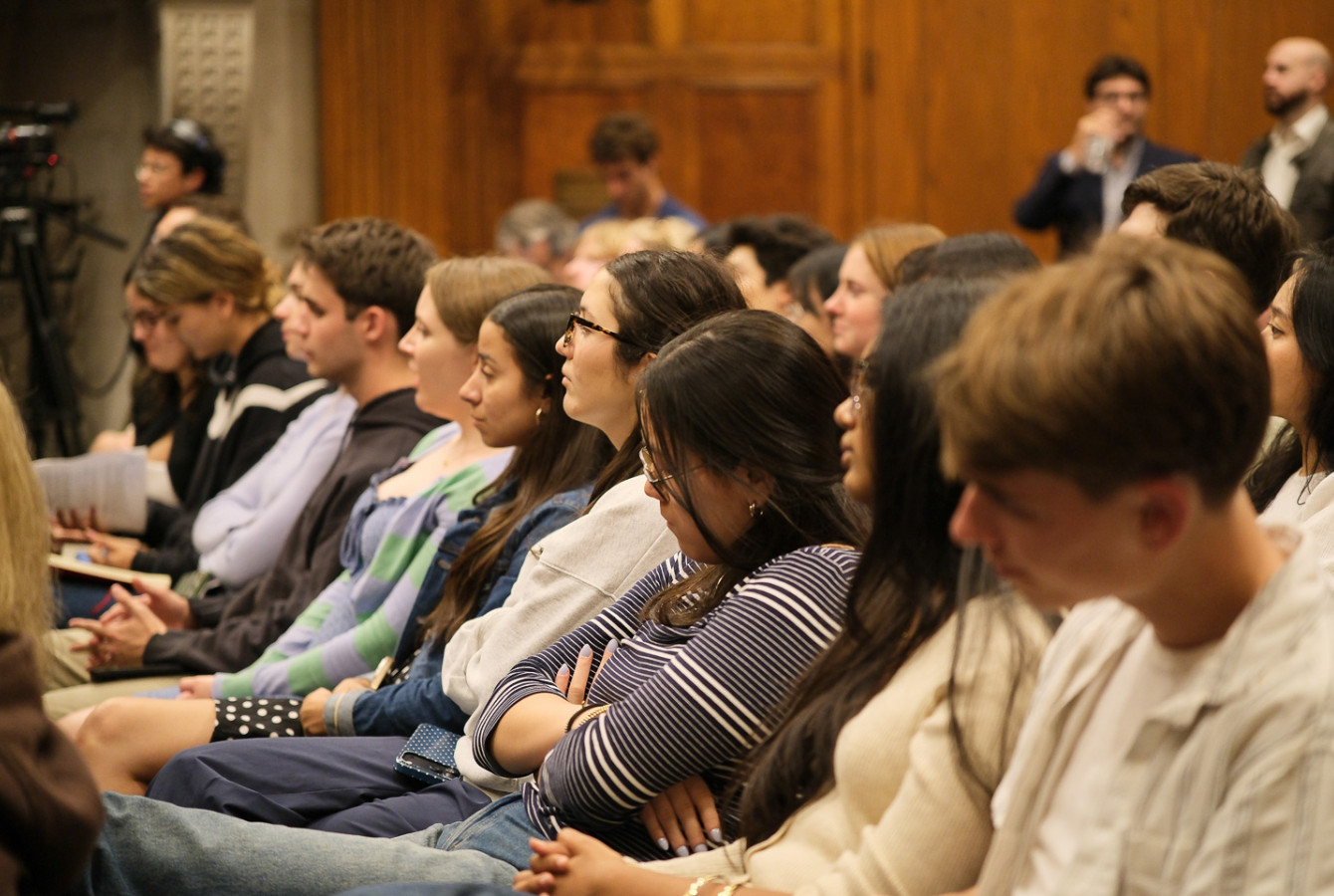
During the audience Q&A, several students asked about the role of major AI corporations like Anthropic and OpenAI. One undergraduate wondered how ordinary citizens can realistically plan for a “flourishing” future with AI, when the companies maintain total control over the technology’s development.
Karkaletsis suggested more focus on regulation, with protections found in the 2024 European Union Artificial Intelligence Act providing one useful framework. He added that the 1968 Nuclear Non-Proliferation Treaty set an important precedent for international collaboration on regulating technologies.
“We need to do something similar here, following the example of the European Union,” Karkaletsis said.
Mitsotaki’s organization is currently in the process of getting approval to build a pavilion on the historic site of Aristotle’s Lyceum, next door to the Athens Conservatoire where the conference occurs. The building project will create a space for both the Lyceum Project and for visitors to learn more about Aristotle’s philosophy.
“This space can play an important role. It can not only bring science, technology, philosophy together; it can make Aristotle relevant for people who, like me, have never studied philosophy in our life,” said Mitsotakis, a social entrepreneur.
Aristotle believed ethics and politics share the same purpose, or telos, Imparato explained. As the ancient philosopher saw it, both exist to serve eudaimonia, or “happiness,” which some define as “human flourishing,” but Imparato interprets as “activity of the soul in the pursuit of excellence.”
It’s an idea that can be used to think about the ethics and politics of AI.
“Can AI help us rethink what it means to be a citizen?” Imparato asked. “Can it help us deliberate over what is the telos of politics? Should it be happiness, or should we leave people free to determine what happiness is to them, and not come to a shared understanding of ‘the good life?’”

The First Proof consortium has repeatedly challenged AI systems to crack 10 tough research math problems. In the latest round of results, AI systems collectively solved all 10 but still lagged in the ability to clearly communicate and document their results.

I think it’s very important for us as classicists to take a work like Nolan’s ‘Odyssey’ as a work of adaptation that is aiming to produce new relations with antiquity and not to think about it in overly deferential terms, or in terms of fidelity or accuracy,” said classics professor Emily Greenwood.

The findings unlock a path to harnessing ultra-fast magnetic materials and cleaner computer memory and hardware — enabling performance gains that could solve major energy bottlenecks facing modern data centers.