Eileen O’Grady
Harvard Staff Writer
Humanities faculty innovating in curriculum, digital engagement traded ideas about the future of education in their fields
/ Read time: 5 minutes
Harvard Staff Writer
When humanistic education is at its best, students approach the classroom with enthusiasm, with the spirit of collective inquiry.
At worst, panelists told a Sever Hall audience, it can look like low enrollment, low enthusiasm, and low willingness to participate in class discussions.
“There’s nothing that we can do in the classroom that’s as entertaining as Instagram reels,” said Madeline Baker, College Fellow in the Department of the History of Science. “If we play this attention economy game, we’re going to lose.”
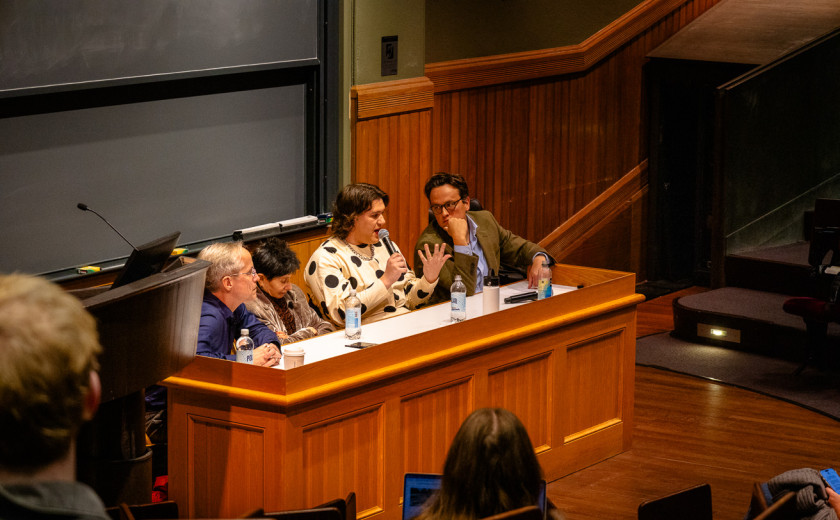
A talk on the future of learning in the humanities featured Baker in conversation with Doris Sommer, Ira and Jewell Williams Professor of Romance Languages and Literatures and of African and African American Studies, and Justin Smith-Ruiu, a professor of history and philosophy of science at Paris Cité University. The October 19 event was hosted by The Public Culture Project, an initiative of the Arts & Humanities Division, and moderated by Program Director Ian Corbin.
Amid the upheaval of switching to online learning during the COVID-19 pandemic, Baker recalled that faculty indulged students taking a more “spectatorial” approach to their classes. Most teachers would be happy if students didn’t turn off their cameras to go do laundry.
But after the return to classrooms, Baker noted, some habits stuck.
During her first year as a Harvard lecturer in 2022–23, Baker remembered receiving a lot of advice about what she called, “for lack of a better word ... showmanship.” “What was emphasized to me was a sense of performance, or even an ability to entertain," she said. "I characterize this as a ‘death spiral’ because increasingly I found students bringing that same set of expectations to the classroom.”
Smith-Ruiu agreed, calling the move to online learning an “extinction event” from which students never recovered. One solution, he suggested, is leaning into it.
“One of the possible strategies, when we realize we can’t win, is to try to figure out how to get in on the vertical [video] market ourselves, and to keep up with the new attention-fracking technologies,” Smith-Ruiu said.
The other option? Lean way out.
“Another strategy is to say, ‘We’re going to do exactly the opposite of that here,’” Smith-Ruiu continued. “We’re going to cultivate marathon powers of attention by doing something that people barely do anymore.”
Sommer preferred the second strategy, arguing that the humanities stand their best chance for success with increased student engagement and participation.
Sommer, who developed the Pre-Texts methodology to improve close reading skills, also believes humanities pedagogy needs to be overhauled in a big way.
“I think the problem is our need, culturally, to distinguish between right answers and wrong answers, the best and the worst, rather than enjoy difference,” Sommer said. “From a very young age, we are taught that there is one right answer and that everything else is in error. How do we deal with different perspectives, different experiences, when we make ourselves so intellectually meager as to insist on one right answer per question?”
She described a successful experience leading a Zoom course, as part of her Pre-Texts program, for a group from Nigeria over the summer. Nearly 20 participants were instructed to remain visible onscreen and participate in breakout group activities, invite one another to speak, and stay attentive.
“It was so exciting and, I think, productive,” Sommer said. “If instead of being performers, we identify everyone as a performer … we have a chance to keep people engaged.”
Smith-Ruiu spoke about his nonprofit, The Hinternet Foundation, which he started to experiment with ways to adapt and revive humanities education in an AI-driven era.
“Over the next few years, what I hope will happen is that more and more academic initiatives and more and more exploration will emerge to the point where we’ll start to see new ways for humanistic inquiry to thrive, even alongside new technologies that, on the face of it, are hostile to what we want to do as humanists,” Smith-Ruiu said.
Baker spoke about The Drift magazine, which in many ways leans into humanistic tradition while reviving it by involving newer writers and insisting on fresh, original ideas.
“We thought that there should be people in their 20s — even their early 20s — weighing in on these questions, instead of just people who’d been weighing in on these questions since the 20th century,” Baker said.
During the event’s Q&A portion, a student noted that people have been discussing the “crisis” of humanities education for decades. Is this a continuation of the same debate, they asked, or is the present moment uniquely bad?
According to Smith-Ruiu, the AI boom presents as big a disruption to knowledge-generation as the print revolution did in the early modern period. But he refuses to be entirely pessimistic about the humanities.
“A year or so ago, I was interpreting ‘crisis’ as a situation where only despondency is the appropriate reaction. Now I see it as just a critical moment that we have to get right,” Smith-Ruiu said. “Human beings are going to continue to want to cultivate their faculties of reason and imagination and do the same things we did back in the old days. We’re going to have to learn how to do it with new technological prostheses, but it is critical now to think about what that is going to be.”

The Class of 2030 totals 1,648 and includes students from all 50 states and 86 countries.
The all-day conference was split thematically, with a morning focus on Muslim perceptions of Jewish civilization, and an afternoon focus on the opposite.

After four years at the University of Michigan, former assistant coach Rob Rassey returns to Harvard as head coach of the men’s ice hockey team. Ahead of his first game on Thursday, he talked about his career journey, how he leads, and what he missed about Cambridge.