Eileen O’Grady
Harvard Staff Writer
Recent panel explored issues raised by AI-generated avatars and chatbots that simulate the dead
/ Read time: 5 minutes
Harvard Staff Writer

For the grieving, speaking with a loved one who has died can be a compelling prospect. But as AI becomes increasingly capable of creating chatbots or avatars simulating the voices, faces, and speech patterns of the dead, scholars are left confronting the legal and moral implications of what some call “digital resurrection.”
“I completely understand, as both a legal scholar and on a very deep human level, the drive that folks would have to do more than just hear their grandmother’s voice or their spouse’s voice or their child’s voice,” said Leah Plunkett, Meyer Research Lecturer on Law and Associate Dean of Learning Experience and Innovation at Harvard Law School “It is a growing industry now.”
At an October 27 event hosted by the Public Culture Project and Berkman Klein Center for Internet & Society, Plunkett spoke with Kathleen Coleman, James Loeb Professor of the Classics, and Stacey Wales, whose family created the world’s first AI-generated courtroom victim impact statement depicting her late brother. The three discussed how the digital presence of a deceased loved one might change the way people grieve, as well as the complexities of balancing the wishes of the deceased with the needs of the bereaved.
Plunkett referenced AI startups like “Seance AI” or “Re;memory” that can, for a fee, create an avatar or chatbot using a deceased loved one’s old photos, videos, social media posts, and emails. Some people are also using large language models to create their own “death bots” so loved ones can continue interacting after they’re gone, Plunkett said.
Wales, whose brother Christopher Pelkey was killed during a 2021 Arizona road rage incident, created an AI avatar to use during the 2025 sentencing hearing for the convicted shooter, Gabriel Paul Horcasitas.
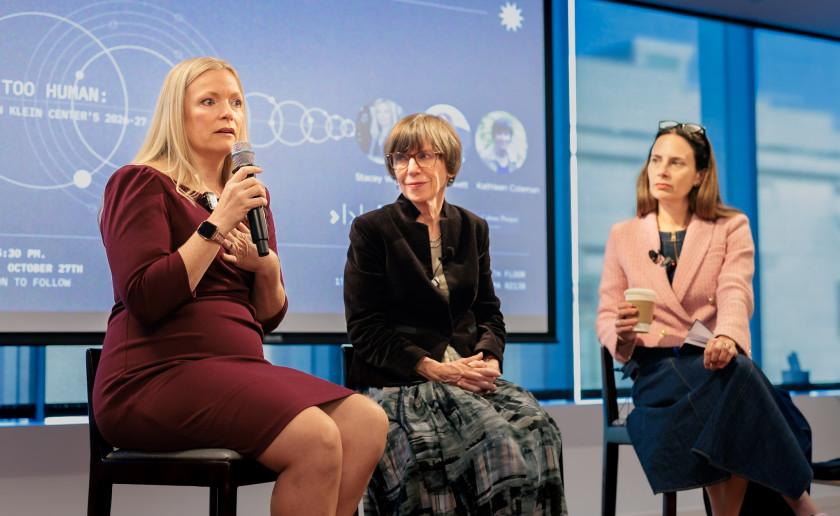
Wales told an audience at the Berkman Klein Center that the goal was humanizing her brother. She was afraid Pelkey wouldn’t be seen as a person if the judge knew him only from autopsy photos and video footage of the shooting. A moving, speaking avatar of Pelkey, trained on family photos and a YouTube video, might help to change that, she thought.
“When we’re told it’s time for you to express to the court, to the one person — the judge — who is going to make a numerical decision that is essentially valuing your brother’s life, you’d better believe I wanted the maximum that we were allowed to have,” said Wales, adding that her brother “was owed that.”
In addition to the AI avatar, which Wales presented to the judge alongside her own written impact statement, Wales said 10 other family members presented victim impact statements while dozens of friends submitted letters to the court. The judge ended up sentencing the shooter to 10½ years, more than the prosecution had asked for.
In September, a three-judge panel of the Arizona Court of Appeals overturned Horcasitas’ sentence, although his manslaughter conviction was upheld. The judges stated that the trial court had committed a “fundamental error” by allowing and relying on the AI-generated video for sentencing.
Coleman teaches a General Education course titled “Loss,” in which she and her students tackle how to cope with the inevitability of losing the people and things they hold dear. Coleman, who said she teaches that every loss is personal and that everyone grieves differently, said creating a script for an AI avatar of a deceased loved one raises complicated ethical questions, due to the living person retaining total control over what the avatar says.
“As soon as you can script something for somebody else, however sure you are that it is what they would have said, there’s the potential to deny the reality of human engagement,” Coleman said. “Nobody is ever completely predictable.”
Wales said the way she treated the creation of the Pelkey avatar was to put a lot of thought into the wording, avoiding anything she wasn’t absolutely sure her brother would say. For example, Wales said she stopped short of scripting the avatar to forgive Horcasitas, since she didn’t know if Pelkey would have done that. For the same reason, she didn’t have the avatar ask the judge for any specific length of sentence.
“It impressed upon me immediately that this was novel and pioneering, and with that comes great responsibility because any form of medium or technology can be used for good or for evil,” Wales said. “When I realized that this was the first time that this was going to be done, I knew that I had to very carefully not put my own thoughts in what I was going to have Chris say — to echo my anger, my frustration, my bitterness.”
A lot of unsettled legal questions remain around who has the rights to digital images, recordings, and assets once owned by the deceased. And when someone already owns those things — either because they were given or bequeathed — what permissions does the survivor have (legal or moral) to use them?
“The law is not providing a whole lot of consistency or guidance or reliability, especially around these questions of what happens when the digital assets that we have … involve what at least one legal scholar, Victoria Haneman, calls ‘the law of digital resurrection,’” Plunkett said. “That is deeply unsettled terrain, as is generally the case when new technologies meet family law, privacy law, consumer rights law, criminal law, and many other interrelated areas.”
Coleman noted that preserving memory has historically been a privilege of the wealthy. The only funeral monuments left behind from ancient Rome, for example, came from people who had enough money to build them, Coleman explained. She expects to see the same, globally, from AI avatars.
“We have to ask ourselves,” Coleman said, “whether having actual avatars of people we’ve loved will keep us supported in the necessity of engaging with our immediate human surroundings — whether one can actually retreat into a false reality of continuing to engage in a relationship, to some degree, that is no longer there.”
When English literature professor Deidre Lynch learned she was being inducted as a Fellow of the Royal Society of Canada, she felt a swirl of emotions. And she immediately thought of her 89-year-old mom, Barbara.

Seeking to adapt to the rapidly changing landscape, Harvard faculty convened a two-day summit this fall on revamping doctoral math education for the age of AI. The two dozen prominent mathematicians in attendance produced a report recommending urgent changes.
At the annual Volunteer Assembly, the FAS Dean tied a recent rise in applications and the caliber of the class to changes in campus culture.