Eileen O’Grady
Harvard Staff Writer
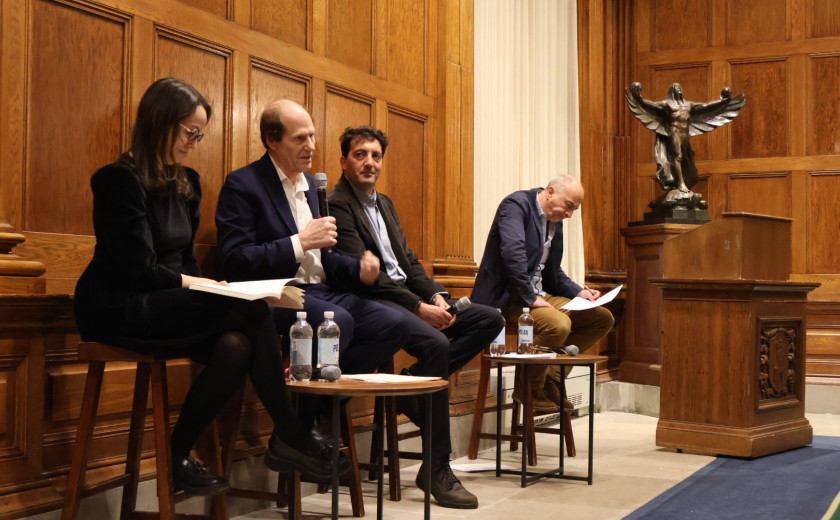
A recent event, hosted by the Public Culture Project, grappled with the political philosophy’s aesthetic appeals (or lack thereof).
/ Read time: 4 minutes
Harvard Staff Writer
If liberalism had an aesthetic, essayist and critic Becca Rothfeld says it might look something like: Trader Joe’s, fast-casual salad bowls, consulting jobs, the TV show “Parks and Recreation,” group fitness classes, and mixed-use developments featuring glassy apartment blocks.
“It is no secret that there has been a violent reaction against liberalism in America and indeed across the western world for the past decade,” the New Yorker staff writer recently told an audience packed into the Barker Center’s Thompson Room. “What I argue is that the crux of their distaste is just that: a distaste. A shudder of aesthetic revulsion. What they are reacting against is the texture of life under liberalism.”
Rothfeld was one of three thinkers to participate in a March 23 talk titled “Do Liberals Want a Beautiful World?” The event, hosted by the Division of Arts & Humanities’ Public Culture Project, also featured Robert Walmsley University Professor Cass Sunstein and The Point magazine editor Jon Baskin. Professor of the Practice of Literary Criticism James Wood moderated.
The theme arose from a February essay Rothfeld published in The Point, which critiqued Sunstein’s book “On Liberalism: In Defense of Freedom” (2025) and Ezra Klein and Derek Thompson’s “Abundance” (2025). Rothfeld argued that these defenses of liberalism failed to prove that liberalism can actually create a more beautiful and desirable world.
“Neither [book] was really rising to the challenge that post-liberalism raises, which is to show that liberalism can give rise to a better aesthetic, a richer and more beautiful form of life than the one we are currently living under,” said Rothfeld, who is also an editor at The Point.
She clarified that the term “liberalism” in this context refers not to the U.S. Democratic Party, but to a broad political philosophy defined by the values of freedom, cultural pluralism, and the rule of law. Fascism, Rothfeld argued, has no problem pushing its aesthetic, whether it be Leni Riefenstahl’s Nazi propaganda films or a kitschy nostalgic painting of a village. So why shouldn’t liberalism?
The Point, a Chicago-based magazine of philosophical writing, became interested in exploring the question of whether liberalism can produce a compelling vision of “the good life” after publishing a 2025 essay by Mana Afsari. As Baskin explained, the piece captured the phenomenon of young people migrating to the center-right after feeling intellectually unsatisfied by left and liberal spaces.
“We felt, as a magazine, there was a task here,” Baskin said. “Could we try to challenge our writers to ask themselves and try to answer some of these serious questions that people were not finding in the left-liberal intellectual spaces? Could we ask what ‘the good life’ had to do with the left and liberalism?”
Baskin agreed with Rothfeld’s assertion that liberalism struggles to offer people a clear vision of the good life. “Culturally, and even in some of the higher points of liberal art, is a portrayal of society as ‘good enough,’” Baskin said. “Not exactly beautiful, or deeply meaningful, in the sense that we often think of when we think of a strong aesthetic.”
Sunstein, who made it clear that he “loved” Rothfeld’s critique of his book, offered a different view. He argued that liberalism’s values don’t promise to provide any particular aesthetic. Rather, they create conditions for individuals to define beauty, art, and “the good life” for themselves.
“[These commitments] say, ‘Everyone in this room, go for it.’ What your conception of the aesthetic is, that’s yours. Make it yours. Exercise your agency,” Sunstein said.
He provided examples of art that he believes represent liberal values. The film “Days of Heaven” (1978), Sunstein said, demonstrates the kind of freedom promised under liberalism. The A.S. Byatt novel “Possession” (1990) captures pluralism. Winner of this year’s Academy Award for Best Picture, “One Battle After Another” (2025), reflects democracy.
“One thing one could do in defense of liberalism is paint a picture of it and say, ‘What do you think of the picture?’” Sunstein said. “And if the positive picture involves freedom of speech and freedom of religion and respect for experiments in living, what about that don't you like?”
Or try painting a picture of the alternatives, he said. “Hitler was consciously anti-liberal, post-liberal. Putin is an anti-liberal. Are these appealing things?”
Rothfeld raised concerns about the long-term sustainability of liberalism, if the vision it presents can’t compete with rival ideologies.
“What is it that draws someone to the political philosophy?” she asked. “Is it just the arguments pro and con? I think no; I think it's something aesthetic. I think the libidinal energy of a political ideology has at least as much of an effect as the arguments do.”

The Harvard theoretical physicist and neuroscientist has won the Dirac Medal and Prize, one of the highest honors in physics.

Deep in the woods of Petersham, Mass., the Harvard Forest Summer Research Program in Ecology is cultivating a renewable resource — future generations of scientists.

Forget about the ancient Greek myth of Icarus. For the last 10 years, Jenna Samra, Ph.D. ’18, and her colleagues have been pushing technology to fly closer to the hottest part of the sun. Samra, an astrophysicist at the Center for Astrophysics, an institution jointly run by Harvard and the Smithsonian, leads a scientific quest to study the solar corona.