Christy DeSmith
Harvard Staff Writer
Retelling 11-month occupation as America readies to celebrate its 250th
/ Read time: 8 minutes
Harvard Staff Writer
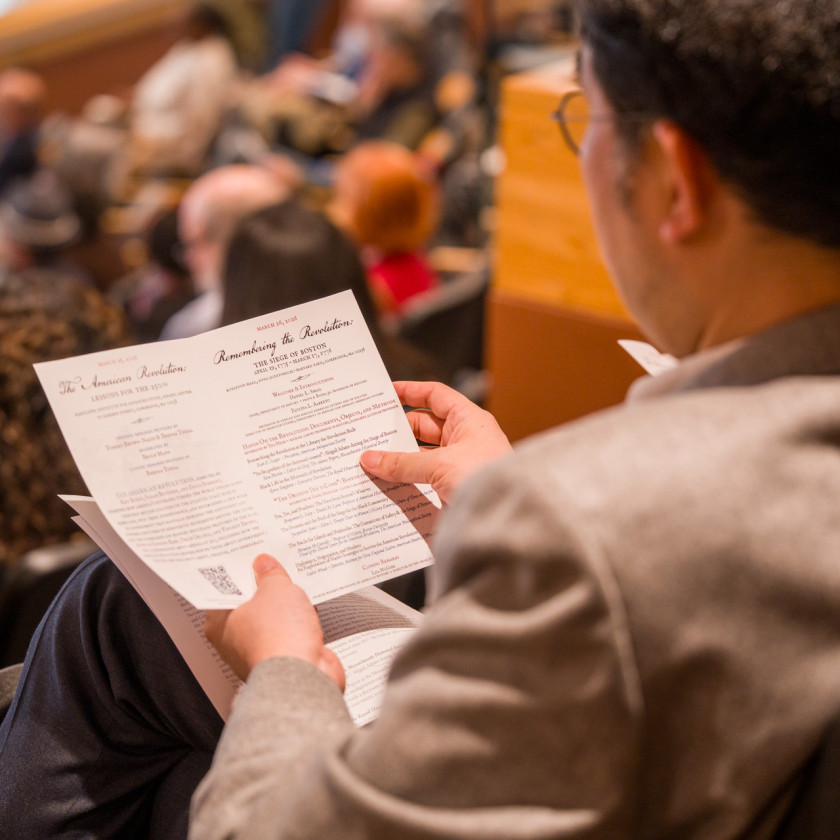
Evacuation Day, an official holiday in Massachusetts’ Suffolk County and the nearby Somerville public schools, commemorates the March 17, 1776, withdrawal of King George III’s troops from Boston following an 11-month occupation.
“The New England militia had decisively defeated the British Army in the first phase of the American Revolution,” said Brendan McConville, professor of history at Boston University and head of the David Center for the American Revolution at the American Philosophical Society.
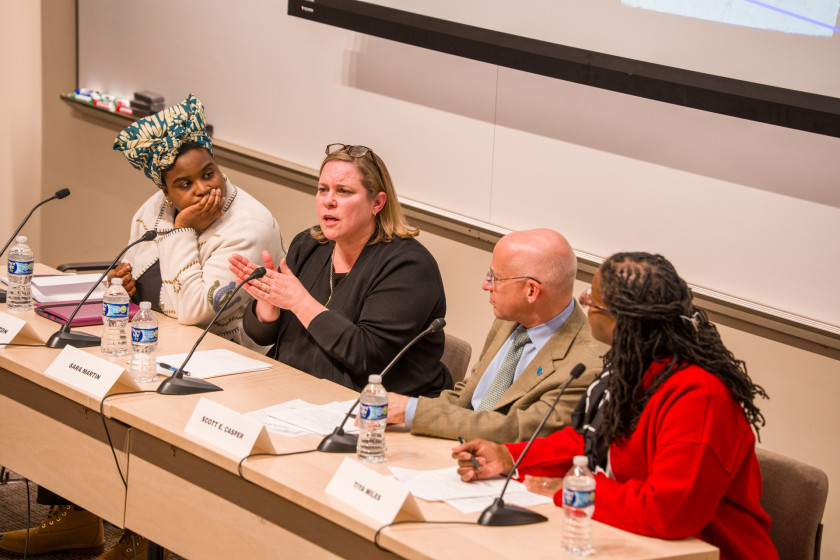
At a recent event, hosted by the Department of History as part of its “Harvard in 1776” series, experts revisited the years and months immediately preceding that British exodus. Last month’s symposium began with presentations on artifacts recovered from the era, including dispatches from future First Lady Abigail Adams. A separate panel delved into scholarship related to the Siege of Boston, when colonial forces effectively kept the outsiders cornered in the city.
Boston, at the time just a two-mile peninsula with a single road to the mainland, was home to a healthy maritime economy dominated by fishing, shipbuilding, and trade. The place had a certain reputation, explained panelist Benjamin L. Carp, professor of American history at Brooklyn College, in part due to its traditional Pope’s Day riots between rival gangs.
“It was a place of violence,” said Carp, author of “Rebels Rising: Cities and the American Revolution” (2007). “It was a rough-and-tumble place full of xenophobic Sabbatarians.”
Slavery was present, though less prevalent than elsewhere in British America. “On the eve of the siege, the city’s population was 16,000, with about 5 to 10 percent being Black,” noted panelist Jacqueline Jones, an emerita professor of women’s history and Southern history at the University of Texas at Austin.
In the 1760s, the king’s government had rolled out a series of regulations, most famously related to commerce and taxation. London also sought to tame the unruly port by boosting the presence of soldiers and customs officers. According to Carp, the behavior of British officials was perceived by the locals as “obnoxious.”
As the king tightened his grip on commerce, courts, political autonomy, and even individual movements, Boston’s waterfront community stood in resistance. Carp’s remarks focused on the Liberty Riot (1768), an early act of defiance against Britain’s crackdown. Panelists also touched on the Boston Massacre (1770) and Boston Tea Party (1773), which, as McConville put it in his remarks, led to the “breakdown” of imperial governance.
“Until the end of 1773,” he said, “the vast majority of provincials still believed that these tensions were going to blow over. Most of them still thought of themselves as being British and were still loyal to the British monarchy.”
On April 19, 1775, the British military, acting on orders from London, set out to seize munitions stored in the town of Concord. Also ordered were the arrests of John Hancock and Sam Adams, well-known agitators now regarded as ringleaders of a coordinated insurgency.
“It became a bloodbath,” McConville said of the Revolution’s opening battles, noting the ubiquity of memorials to those killed that day. “Within a week or so, a militia army of between 25,000 and 30,000 … appeared around Boston; we don’t know exactly how many.”
The British retreated to their military ships in Boston Harbor, with colonists blocking the neck that connected the city to the mainland. Suffering quickly bled into surrounding areas, the most populous in British America at the time.

“It was characterized by economic hardships, with the British retaining control of the harbor and thereby blocking access to markets,” noted panelist Sara Martin, editor in chief of The Adams Papers at the Massachusetts Historical Society.
Abigail Adams, who had relocated from Boston to a farm south of the city in 1774, acted as what Martin called a “war correspondent” by actively gathering intelligence. In a letter dated May 1775, Adams described the “imprisoned” inhabitants of the occupied city, enduring “hunger and famine” at the hands of the British.
“So brutal are they as to take away even to a [biscuit] if they find it by their inhumane searches, or a little chocolate does not escape even [though] in the pockets of the distressed women,” she wrote.
Black New Englanders were subject to disproportionate harms, said Jones, author of the Pulitzer Prize-winning “No Right to an Honest Living: The Struggles of Boston’s Black Workers in the Civil War Era” (2023). She noted the number of families split apart as loyalist enslavers fled as well as the ubiquity of British soldiers turning modest wooden dwellings into firewood.
But the siege also helped bring about what Jones called “the gradual destruction” of slavery as an institution in Massachusetts. “Some enslaved people began to just walk away from homes, shops, and farms,” she said. “Some owners manumitted their enslaved workers, especially after 1775. We find that during this period inventories no longer list enslaved people as assets. Some Black people were bought or sold for terms, but not for life.”
Hostilities peaked with the Battle of Bunker Hill, where the British faced a formidable multiracial army. According to panelist Kyera Singleton, executive director of the Royall House and Slave Quarters in Medford, Mass., colonial forces that day included the son of the formerly enslaved Belinda Sutton, for whom a courtyard at Harvard Law School is named. Panelist Cedric Woods, director of UMass Boston’s New England Native American Studies program, spoke of the “matrix of alliances” that brought “multiple Native peoples” into the conflict, including the Mashpee Wampanoag, Mohegan, and Pequot.
The June 17, 1775, battle was technically a British victory, but one that came at a steep price. McConville captured the extent of the carnage by sharing a famous letter, penned by a Tory loyalist in the aftermath.
“We were exulting in seeing the flight of our enemies, but in an hour or two we had occasion to mourn and lament,” she wrote. “In the evening, the streets were filled with the wounded and the dying; the sight of which, with the cries and lamentations of the women and children over their husbands and fathers, pierced one to the soul.”
General George Washington arrived soon after to lead the charge against the Boston-bound British. “With camp fevers rampant in the American forces, no gunpowder, a shortage of weapons, he could not storm the city,” said McConville, author of “The Brethren: A Story of Faith and Conspiracy in Revolutionary America” (2021).
The general’s fortunes eventually turned, thanks to a substantial lot of munitions recovered from upstate New York’s Fort Ticonderoga. In December 1775, a Continental Army officer named Henry Knox — the former proprietor of a fashionable Boston bookstore — set off with the caravan that moved all these guns, mortars, and cannons 300 miles to the outskirts of Boston.
McConville sped through the siege’s final chapters, which generations of Bostonians know by heart: Knox and his men delivered the goods to Washington in late January. By early March, the Continental Army was positioned with Knox’s haul on Dorchester Heights, with a straight shot at the enemy. The British knew their time was up.
As they departed, with Adams counting 170 enemy ships in the harbor, they exploded their own military fort at Castle Island. In their wake was a battered city, a quarter of its buildings destroyed and many more in tatters.
But it could have been far worse, McConville said.
“The British General William Howe and George Washington,” he explained, “passively agreed to allow the British to leave unmolested if they did not destroy the city, which they were considering doing.”

Being born a few days on either side of the school-enrollment cutoff date might seem like an arbitrary difference. But new research finds boys born just after the cutoff, who start kindergarten relatively old for their grade, enjoy far more advantages than previously known.
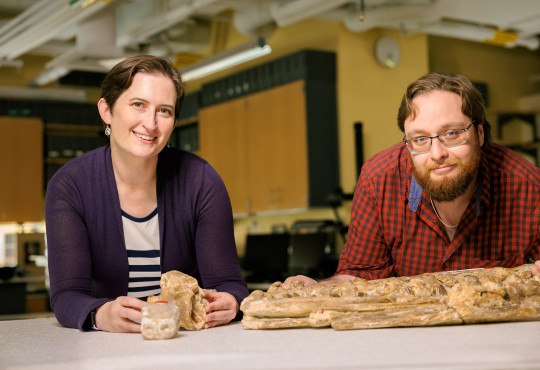
After 80 million years, a giant fossil jaw has quite a story to tell. Back in the age of the dinosaurs, Tylosaurus proriger was a fearsome predator — a bus-sized aquatic reptile with a crushing snout, daggerlike teeth, and knack for swallowing prey whole. How its bones wound up at Harvard is a tangled yarn involving a Wild West stagecoach station, the early western railroads, the infamous “Bone Wars” between rival fossil hunters, and a founding scholar of natural history.

New research by economist Rebecca Diamond found an increase in marriage among single women and an increase in employment rates among unemployed women after they started taking GLP-1 drugs for weight loss. Diamond says the pattern suggests that at least part of the female obesity penalty — the social and financial costs women bear due to their body size — is linked to first impressions.