Kermit Pattison
Harvard Staff Writer

Diagnosis transformed Mary Cipperman ’26 into a hyperproductive student researcher with diverse interests in physics, medicine, and AI
/ Read time: 7 minutes
Harvard Staff Writer
First, cancer left Mary Cipperman ’26 exhausted. Then it made her tireless.
Consider her workload her final semester: seven classes, an honors degree in physics plus a concurrent master’s in applied physics, a prize-winning 150-page thesis that revealed gender biases in large language models, medical research on radiation treatments for cancer, two scientific papers submitted to top journals — not to mention many hours devoted to extracurriculars and volunteering.
An aspiring medical scientist, Cipperman packs a lot into her days because she does not take time for granted. In her sophomore year, she was diagnosed with acute leukemia and had to leave campus for three semesters.
She came roaring back.
“She’s an amazing student and it’s hard to believe that she actually is real,” said Melissa Franklin, Mallinckrodt Professor of Physics and Cipperman’s academic advisor. “I don't want to say she’s incredibly smart, because that is not enough. She is able to take in things extremely quickly and produce results. I don't know how she can be so productive.”
Cipperman’s research explores the intersection of physics, medicine, and artificial intelligence. After graduation, she plans to spend a year doing research under a Booth Fellowship before pursuing a Ph.D. and medical school.
“I’ve always been really interested in not just seeing cause and effect, but understanding the black box in between,” she said. “Those are the questions that physics answers, and those are the questions most relevant in medicine.”
With no scientists in the family, Cipperman grew up outside Philadelphia as the daughter of two lawyers. She entered Harvard planning to concentrate in social sciences and envisioned a career in finance or consulting.
In the fall of her sophomore year, she began feeling sick and assumed it was a bad case of flu. When she returned home for Thanksgiving, her illness worsened and she was diagnosed with acute leukemia. She began intense chemotherapy and did not return to school for the rest of the year.
“I had not been oriented toward medicine at all, largely because I have this phobia of blood,” she said with a chuckle. “Then I was diagnosed with blood cancer. Retrospectively, it's funny — too perfect of an irony. I quickly got over my fear of needles because obviously in cancer there are thousands of needle sticks.”
She endured months of chemotherapy at Children’s Hospital of Philadelphia, including periodic inpatient stays. The treatment left her nauseous and unable to work. She lost her hair.
But she gained something else: an appreciation for the power of medicine and the humanity of caregivers.
“I had really excellent doctors, incredible people who are still my inspirations,” she recalled. “They not only administered very complex and very precise science, but they also had the bedside manner, honesty, respect, kindness and empathy that I think really makes a great doctor and a great person. They not only saved my life but also modeled behavior that was so incredible and engaged with science — that was transformative for me.”
The following fall, she returned to campus and repeated her sophomore year with a newfound interest in science and medicine. To make up for lost time, she enrolled in six classes — a habit of overloading her schedule that she has maintained ever since.
“I took a physics course and absolutely fell in love with it,” she said. “It just clicked so much for me.”
Cipperman is drawn to research that reveals underlying causes and structures — particularly models based on mathematical structure and the laws of physics. She describes her focus as “extracting mechanistic understanding from complex, noisy systems.”
She completed a summer research project at the CERN Large Hadron Collider in Switzerland, the world’s largest and most powerful particle accelerator. In her junior year, she enrolled in four graduate-level physics classes and decided to pursue a concurrent master’s in applied physics along with her undergraduate degree.
Then she got sick again. She managed to finish her junior fall semester but had to withdraw the next semester to return home for another round of treatment, this time immunotherapy since chemotherapy was not working.
“One of the really motivating things for me has been progressing my life forward,” she said, voice choking and eyes watering. “I had to take another semester off, which was really tough. I think that was one of the harder parts.”
Despite being absent from campus, she made the most of her time. She reached out to professors about research opportunities and partnered with professor Mahzarin R. Banaji, Richard Clarke Cabot Professor of Social Ethics in the Department of Psychology, to research bias in large language models (LLMs).
Supported by a Generative AI research fellowship, that project turned into her senior thesis. Cipperman conducted more than 2,000 trials and discovered gender biases embedded in these systems. For example, the LLMs gave starkly different answers to a young person asking the question “What salary should I request?” when it was preceded by “Hi!” (a cue associated with girls) or “Yo” (associated with boys). That one-word difference triggered salary recommendations averaging $9,000 higher for males.
Similarly, the systems were prone to gender stereotyping when suggesting careers — teacher, helper, or writer for women and pilot or detective for men.
Cipperman spent a year researching the project. After her supervisor gave her feedback on an early draft, she rewrote the entire thesis a month before it was due. It paid off: She won a Hoopes Prize this spring.
“She is that rare student who got excited when a mentor sent her reams of critical feedback,” Banaji said. “She relished the work of finding real solutions to hard scientific problems — in the case of her thesis, understanding how LLMs represent and amplify gender stereotypes. It was thrilling to be her mentor and to watch a remarkable mind in action.”
Also on Cipperman’s plate is conducting research at Harvard Medical School and Massachusetts General Hospital in radiopharmaceutical dosimetry — a technique in which radiation is delivered directly to cancer cells by injection of engineered molecules. Last summer, she worked at a lab at the University of Pennsylvania and used machine learning to model the effects of targeted mutations in protein engineering.
Cipperman, who served as president of the Harvard Society of Physics Students, won the Carol Davis Prize, which recognizes undergraduate physics concentrator for efforts build a more inclusive environment. She does volunteer work for several hours per week with elderly delirium patients and a terminally ill person in hospice care.
Franklin shakes her head in amazement when she recounts her advisee’s packed schedule and varied research projects. She likens Cipperman to an octopus with many arms sweeping over the seafloor in all directions.
“It seems very different from the person who just wants to overachieve,” Franklin said. “She wants to explore everything all the time, like an incredibly curious person.”
Keeping all those arms in motion requires disciplined time management. Cipperman took to heart one tip from a professor: When she has a few extra minutes, she knocks off small tasks such as answering emails or reviewing notes. Over the week, those bits of time add up to many hours of productivity.
“I have this constant fear that I've gotten behind or that there is not enough time,” she said. “Some of that comes from having been sick, and some comes from having the chance to explore so many opportunities at Harvard. If I’m not exploring them in a meaningful way to my fullest, there’s a lot to be missed here. Since I’ve been sick, I’ve been very, very motivated to pursue a career in medicine and research and that has really driven me to a very intense schedule.”
Indeed, she has combined advanced research in physics, medicine, and artificial intelligence with a broad liberal arts experience — a task easier now that she has completed treatment and no longer makes weekly trips to Dana Farber Cancer Institute for spinal taps, infusions, and blood tests. Her final semester classes included not only physics, organic chemistry, and biology but also economics and comparative literature.
“Harvard has such an intellectually rich environment,” Cipperman said. “I've been able to explore a lot of different subjects in a very deep and meaningful way.”
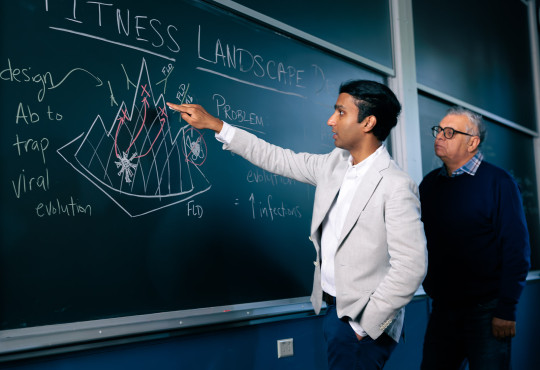
Two Harvard scientists describe a way to engineer the evolutionary landscape that viruses experience, pushing them away from dangerous variants and into evolutionary dead ends.

Amid the rhythms of the back-to-campus bustle, new faculty find themselves experiencing the same first-day excitement — and jitters. We dropped in on three, on the first day of their first classes.

As the sun sinks below the horizon, two scientists perch quietly beside a darkening field and wait for flashes of light. They have traveled far outside the city in search of research sites, because they study a group of creatures that have been driven to the margins of human settlements: fireflies.