Kermit Pattison
Harvard Staff Writer
A new study shows how natural selection for locomotion reshaped both extremities
/ Read time: 7 minutes
Harvard Staff Writer

To grasp the evolution of the human hand, look to your feet.
A new study by Harvard researchers shows that similar genetic mechanisms shape both human hands and feet during embryonic development. The study, published in the Proceedings of the National Academy of Sciences (PNAS), also found that natural selection during human evolution acted more powerfully on the foot due to the demands of upright locomotion. The hand was reshaped partially as a byproduct.
“So many studies look at hand evolution or foot evolution separately, but telling that story separately is to miss the point,” said lead author Alexander Okamoto, Ph.D. ’25. “Hand and foot evolution are really integrated.”
Many studies previously noted the strong link between hands and feet in humans and other primates. But most earlier research based those findings on anatomical comparisons. The new paper is the first to demonstrate a developmental linkage with human genetic data.
The work was performed in the lab of Professor Terence Capellini, chair of the Department of Human Evolutionary Biology. The Capellini lab studies the genetic mechanisms underlying the skeletal evolution of the human lineage and other primate species. Last year, the lab published a major paper on the evolution of the human pelvis and is also investigating the genes and regulatory mechanisms that shaped other body parts such as the shoulder, knee, and elbow.
“The average person probably looks at their feet and hands as very separate things that don’t have underlying similarity in biological mechanisms,” Capellini said. “But there really are connections, and there’s also biomedical importance to this work — things that affect the hands can affect the feet, and vice versa.”
For the new study, the researchers used functional genomic tools to identify patterns of gene expression and regulation in the embryonic development of hands and feet. They examined human embryos collected by a research program at the University of Washington in compliance with strict ethical guidelines established by the National Institutes of Health. The project received NIH funding before the agency announced new restrictions in January 2026 on using its grants for research involving human fetal tissue.
The researchers examined two key gestational periods: days 53 to 59 and days 67 to 74. As Okamoto explained, “It’s informative because it’s the window of development of cartilage, which prefigures most of the bones in the skeleton.”
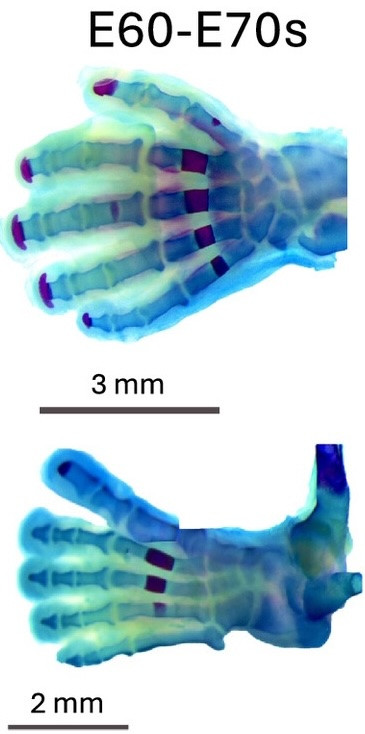
They took samples of the chondrocytes — the cartilage structures that later turn into bones — and analyzed the genes and regulatory elements active in local tissues.
For each digit of the hand and foot, they examined RNA transcripts, which reveal what genes were active in forming these regions. They also studied gene regulation with a tool called Assay for Transposase-Accessible Chromatin using sequencing (ATAC-seq).
Based on patterns of gene expression and regulation, the researchers identified “genetic modules” that shaped parts of both appendages. Genes often work across gradients that span multiple body parts and overlap with those of many other genes. In other words, they perform as symphonies, not soloists.
At least two of the three largest modules showed significant statistical associations between corresponding parts of both appendages — such as phalanges (fingers and toes) or metapodials (the long bones in the palm and midfoot).
“Most modules show very high correlation between homologous elements of the hands and feet,” said Okamoto, who conducted the search during his doctoral studies at the Harvard Kenneth C. Griffin Graduate School of Arts and Sciences.
With this shared genetic architecture, the same genetic mechanisms that form fingers also shape toes. But the researchers found this shared pattern of development was mostly driven by natural selection on human feet.
Both appendages represent major storylines in human evolution. Over millions of years, an apelike foot with a grasping big toe and long digits evolved into a stiffer, lever-like human foot with straight big toe and shorter digits. A simian climbing hand with a dinky thumb and four other long digits evolved into a manipulative hand with a robust thumb and shorter fingers.
Surprisingly, the researchers found no distinct genetic modules that distinguished the first digits — our big toes and thumbs. This was striking because both big toes and thumbs underwent substantial makeovers since our ape ancestors.
“With the hands and feet, we went in thinking there was going to be some dramatic shift in the thumbs and the big toes,” Capellini said. “And we didn’t find one.”
The shared genetic architecture of hands and feet also is common among our primate relatives such as apes and monkeys. Yet this ancient linkage became somewhat weakened over the course of human evolution, giving our ancestors more leeway compared to other primates to evolve feet or hands independently of the other appendage.
“While they can certainly evolve independently to some degree, they’re not fully independent — despite how functionally independent they are,” said Okamoto, now a postdoc at Carnegie Mellon University. “They haven’t fully lost that shared history.”
The new study builds upon research performed at Harvard nearly two decades ago by Campbell Rolian, Ph.D. ’08, now a professor at McGill University and a co-author of the new paper. In his dissertation research, Rolian showed that hands and feet were “serially homologous” structures that shared nearly identical developmental blueprints and likely evolved in tandem. Likewise, he suggested that selection on hominin feet was much stronger and likely led to parallel changes in the hands — themes echoed in the new genetic studies.
“It was a ‘foot first’ argument — bipedalism precedes the evolution of fine manipulation,” Rolian said. “We know this based on the fossil and archaeological record. Presumably, bipedalism imposes greater functional and biomechanical constraints on the shape of the foot for improved walking and running efficiency … the hand kind of went along for the ride.”
Now, he added, the new paper reveals genetic architecture that explains the parallel shifts in proportions in hands and feet. “This is good genomic-level evidence that matches what we see at the anatomical level,” Rolian said.
Darwin argued that upright locomotion emancipated the hands to use tools and manipulate objects. But the new study suggests that natural selection on the human foot might have facilitated the later evolution of manual dexterity. For example, bolstering the big toe and shortening of the lateral toes might have driven changes in hand proportions to allow a “precision grip” between thumb and forefinger.
“There’s been a tug of war that still exists to this day in the regulatory control and the genetic architecture of building hands and feet,” Capellini said. “You can’t uncouple them.”
Research described in this article was supported by the National Institutes of Health and National Science Foundation.

Harvard geoscientists reported that organic matter harvested from certain meteorites bears chemical traces of “primitive oxygen reservoirs” that have changed little since the birth of our solar system. The findings help trace the origins of organic matter that meteorites may have delivered to a young Earth, supplying the planet with ingredients essential for life.

Singer Mavis Staples, actress Angela Bassett, and soccer star Didier Drogba were among the honorees presented with W.E.B. Du Bois Medals Thursday at Sanders Theatre. The annual ceremony, hosted by the Hutchins Center for African & African American Research, recognizes outstanding contributions to Black history and culture.

“We will keep working at it until we get it right,” the FAS dean said.