Bethany Carland-Adams
Harvard Staff Writer
Hawaiʻi’s Alyssia Wiesenbauer arrived with an interest in studying volcanoes. She leaves with a deep knowledge of nature and museums.
/ Read time: 4 minutes
Harvard Staff Writer
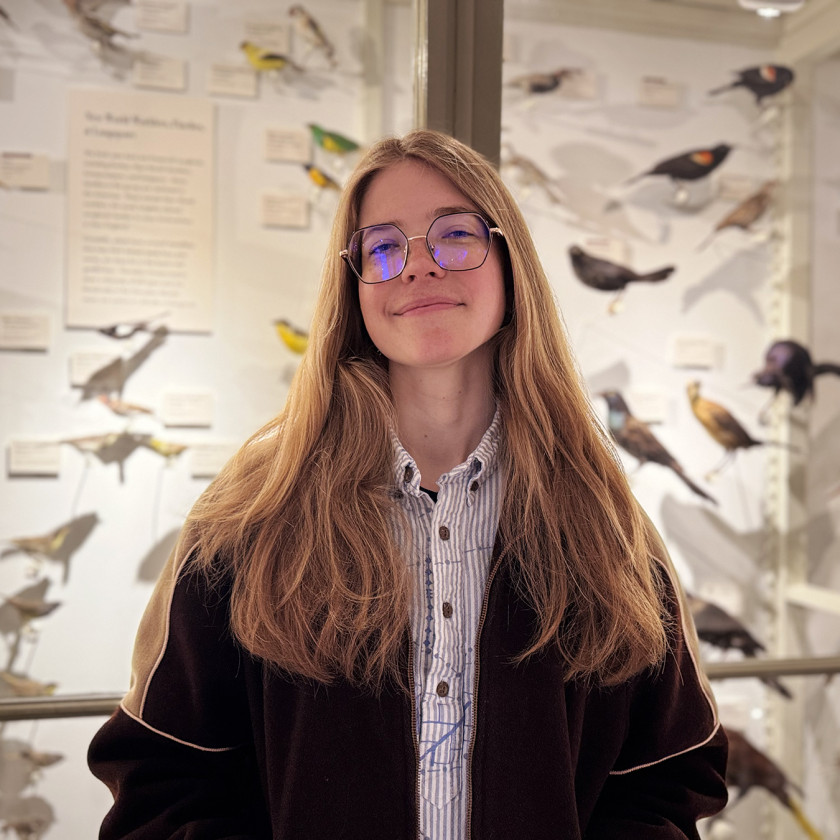
In 2018, the volcano Kīlauea erupted and damaged the family home of Alyssia Ursula Pualani Wiesenbauer ’26, located on the east side of the Island of Hawaiʻi. The experience was terrifying. But it also inspired a fascination with how generations of people have learned to coexist with the lava-spewing phenomena.
“While living through the eruption was traumatic, studying Hawaiian volcanology seemed like a natural way to gain insight into both Western and Kānaka Maoli ways of thinking about them,” Wiesenbauer shared. “In essence, living with volcanoes requires accepting their power.”
At Harvard, a curiosity about Hawaiʻi’s natural world helped spawn many more interests. The History of Science concentrator, who completed a thesis on the history of Hawaiian volcanology, picked up birdwatching and a fascination with local tree species. Volunteering with the Harvard Museums of Science & Culture (HMSC) student board, which creates ways to engage College students with the collections, proved the perfect outlet for combining these passions.
Wiesenbauer’s hallmark has been a series of tours that let students glimpse HMSC’s inner workings. “I have always loved how excited people get when they realize how much exists behind the scenes, from individual objects to the people who take care of them,” she said.
Wiesenbauer credits her late grandfather with inspiring a love for the environment. She recalled her Opunda, as she called him, sharing vivid stories about growing up in Bavaria, tales of mountain climbing and skiing, and dreams of visiting Alaska. “While he never made it to Alaska, he instilled in me a drive to experience the world through nature,” Wiesenbauer said.
Also influential was a childhood teacher named Mr. Lan. “Our discussions pushed me to understand the place people have in the natural world, leading me to study the History of Science at Harvard,” she said.
In Cambridge, taking a first-year seminar called “Tree,” taught by Arnold Arboretum Director William “Ned” Friedman, demonstrated that “both science and history can be studied — not just in a lab or archive, but outside with people who nerd out about trees,” Wiesenbauer said.
As a Ho Family Student Guide at the Harvard Art Museums, she now leads a “Nature of Art” tour, which concludes with a visit to a swamp white oak tree. As she graduates, she’s also saying goodbye to her favorite tree on campus: the Japanese maple outside of Houghton Library, which Wiesenbauer has been photographing daily for more than three months.
Falling in love with birdwatching happened during a course led by Scott V. Edwards, Alexander Agassiz Professor of Organismic and Evolutionary Biology and curator of ornithology at the Museum of Comparative Zoology.
“Birdwatching has been a wonderful exercise in keeping a keen eye on my surroundings and finding beauty in small things,” Wiesenbauer said. “Much like birdwatching, working with museum collections requires close looking and attention to detail.”
Wiesenbauer cites the ʻiʻiwi specimen in the Birds of the World gallery as her favorite specimen in the Harvard Museum of Natural History. But her feelings for it are complicated, she explained, with avian malaria and feral cats putting ʻiʻiwi bird conservationists on watch.
“Initially, it brought me joy as a reminder of my home and the beautiful honeycreepers that reside there,” she said. “Looking at the specimen now, I ask myself: Why is it that the first time I saw this beautiful bird, it was behind glass, rather than on the island where we were both born and raised?”
Growing up, Wiesenbauer always enjoyed perusing collections at the Pāhoa Lava Zone Museum, Lyman Museum, and Pacific Tsunami Museum, owned and operated by members of her community. “The passion and care the docents had for their collections when they shared their knowledge and love for the science, history, culture, and art of Hawaiʻi inspired me to pursue museum work,” she said.
At HMSC, she has expressed her own passions by showing classmates everything from Kronosaurus fossils to herbarium specimens like the rare hau kuahiwi (Hibiscadelphus giffardianus) plant. She relays to her classmates the incredible fact that a single plant of kuahiwi was discovered in a kīpuka (an area spared by lava flow) in 1911. It was then cultivated to prevent total extinction.
“Alyssia has been a rock-steady, linchpin member of the HMSC’s Student Advisory Board,” said Wendy Derjue-Holzer, an education director at the Harvard Museums of Science & Culture. “She is a warm presence who is endlessly curious about the world.”
After graduation, Wiesenbauer will return to her home state to work on a photo digitization project at the Hawaiʻi Volcanoes National Park. “This project will ensure that the collection and the history attached to it are more accessible to the public,” she explained. “It’s my dream come true: to teach people about the place that I love in the place that I love.”

Why do so many people feel lonely in a world designed for connection? As Ian Corbin sees it, Americans are experiencing a crisis of belonging, which he attributes to some fundamental misunderstandings about what humans need to flourish.


Weiss, professor of the classics and an expert on ancient Greek culture plans, to prioritize the expansion of educational resources.