Emma Friedlander
Harvard Correspondent
Ph.D. candidate tracks how political movements develop across borders
Harvard Correspondent
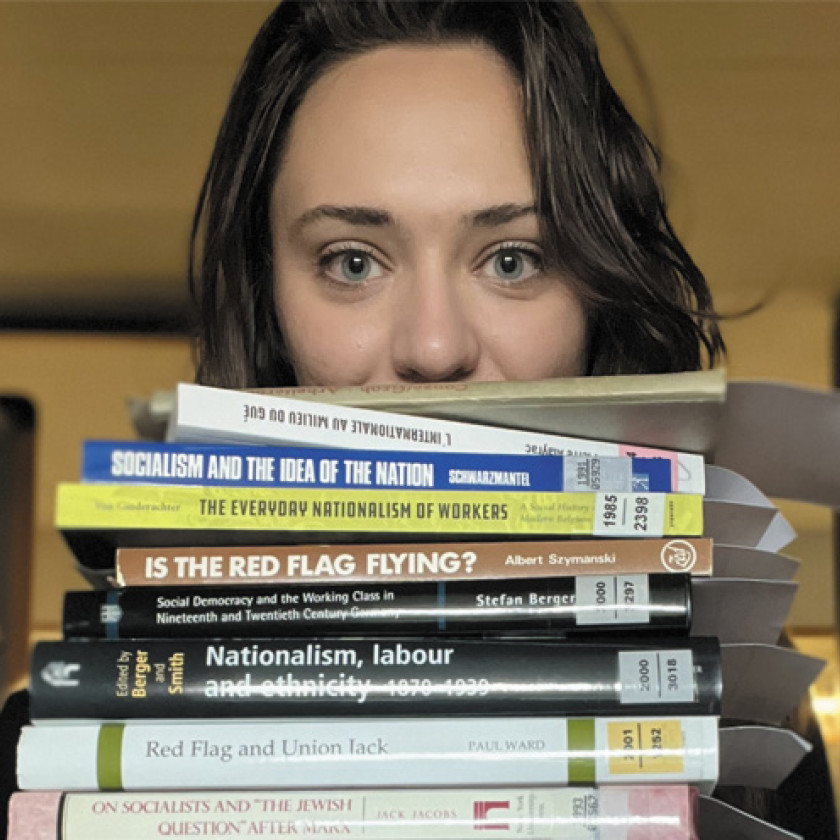
Natalie Behrends received an unusual present for her 10th birthday: a biography of Mary Harris “Mother” Jones, the turn-of-the-century American labor activist. The book, a gift from a friend whose parents worked for the American Federation of Labor and Congress of Industrial Organizations (AFL-CIO) sparked a lifelong interest in international labor history.
“As a kid, I was fascinated by those considered ‘outlaw labor organizers’ in the late 19th and early 20th centuries, like Mother Jones and Elizabeth Gurley Flynn,” she recalled. “Then it turned out that a lot of people in the labor movement were immigrants, like my family.”
Behrends carries her fascination with immigration — and her family history — into her work as a Ph.D. student in history at Harvard Kenneth C. Griffin Graduate School of Arts and Sciences (Harvard Griffin GSAS). Her dissertation explores how a complex international network of socialist activists developed from around the turn of the 20th century — research that provides scholars with a new understanding of how both socialism and nationalism evolve across state boundaries.
Central to Behrends’ work is The Second International, a transnational association of socialist political parties and trade unions active from 1880 to 1919, which hosted major conferences every five to ten years. Future prime ministers engaged in intense debate about what socialist government should look like — among themselves and with history-making theorists and activists like Germany’s Rosa Luxemburg and Russia’s Vladimir Lenin.
“There’s this whole cadre of fascinating people who all had the same education and political development before the First World War and who went in bizarre directions,” Behrends said. “Even Mussolini was technically a member of the network that I’m talking about. But so was the prime minister of Belgium during and after the Second World War. The Labour Party in Britain has its origins in this network. It’s just a fascinating and fertile space.”
These conversations laid the groundwork for the emergence of socialist governments from the late 1910s into the early 1920s in nations like Britain, France, Germany, Poland, and Australia. Behrends found that these regimes evolved directly out of The Second International and its discussions about whether socialists should participate in electoral politics — and whether socialism and nationalism were even compatible.
“Prior to the First World War, there had been no concept of a socialist nation-state,” Behrends explained. “Socialists are grappling with the idea of being in government. In the case of radical socialists, there’s the idea of revolution. But in the case of democratic socialists, they’re grappling with the idea of government and participating in parliamentary government.”
Each chapter of Behrends dissertation focuses on a major debate within the international socialist network and how socialist governments implemented these ideas after World War I — including electoralism, labor migration, territory and territoriality, self-determination, and socialist war. Behrends said that the chapter on self-determination was both the trickiest to research and her favorite.
“The idea that self-determination should be an intrinsic right enshrined in some kind of international code of laws was attractive to a lot of revolutionaries in and outside of the socialist movement who had spent their lives as members of minority cultural groups within larger empires,” Behrends said. “But as a socialist principle, it proved kind of hard to justify because it clashes with the idea that class divisions transcend national borders. What was so fascinating about this chapter was how, within The Second International, you can come across the full range of opinions on national self-determination. And yet after the First World War, there are only a handful of socialists who would seriously argue that national self-determination wasn’t a solid socialist principle.”
Behrends is struck by both the possibility and the naïveté of the decades between 1880 and 1910. “A lot of people aren’t thinking about what will happen when they actually have the ability to govern,” she said. “What does happen is that many who are maybe on the fringe of the socialist movement end up going hard-right nationalist or aggressively populist. They slowly make compromises to stay in government and erode the ideas they once had. So, it’s not a very happy story, but it is fascinating.”
These lessons about the interactions between political and national identities ring true today. “It’s essentially about the interaction between a sense of personal identity and a sense of political justice,” Behrends said. “It’s the interaction between yourself as a person and member of a cultural group, and as part of an economic system and a political system.”
Behrends’ primary adviser, Sven Beckert, Laird Bell Professor of History, confirmed the dissertation’s importance for understanding the surge of nationalism in the present day.
“Natalie’s dissertation is a contribution to better navigate our own age of renewed nationalism,” he said. “Global history seeks to understand historical problems without limiting the research to the borders of one particular modern nation-state. In an age of surging nationalisms, it is important to remind ourselves that history unfolds across borders and is best understood from such a global vantage point.”
Derek Penslar, William Lee Frost Professor of Jewish History, said Behrends’ work will have a major impact on nationalism studies and the global history of the left. “Its massive source base, including archival materials from many countries, allows Natalie to trace developments on a granular level and to go far beyond conventional works that focus either on a leadership elite or grassroots activism in a single location,” he said. “Her work will provide a model for students of global political history in the late nineteenth and twentieth centuries.”
That work also has a human side. After spending countless hours among the people’s archives, a few figures especially captured Behrends’ interest: Meyer London, the second socialist elected to the United States Congress, who was killed by a streetcar in 1927; Luxemburg, who in her off-hours from being a leading socialist theorist kept a personal herbarium; and the Hillquits, a Jewish immigrant activist couple .
“I’ve read a lot of Morris and Vera Hillquit’s letters to each other,” Behrends said. “I think they were particularly close because Morris had tuberculosis his whole adult life. Vera took care of him physically but was also involved in his intellectual work. I learned he was about 5 feet 2 [inches tall], and she was under 5 feet — I saw a picture of the two of them together! Their letters to each other and to their kids are so sweet.”
Behrends grew up in a Polish-speaking community in Washington, D.C. Her grandparents migrated to the United States from Poland immediately after World War II, and her mother spoke Polish almost exclusively until high school. Throughout childhood, Behrends attended Polish-language school. She describes this aspect of her upbringing as Polish nationalist, conservative, and religious. This contrasted with the socialist immigrant community she learned about in books.
At first, this contrast inspired Behrends to research Polish- and Yiddish-speaking immigrant groups and their interactions with the Socialist Party of America (SPA). Then she discovered that the SPA, as well as smaller Polish and Yiddish socialist groups, were part of a bigger network. “It was impossible to talk about the development of socialist ideas in the United States without talking about the rest of the world. And that led me to be a global history Ph.D. student.”
Behrends’ family history also inspired her interest in the turbulent 20th century. Her grandmother was born in a village near Lwów, which today is Lviv, Ukraine. When World War II broke out, she was deported to a labor camp. She escaped to Mexico in 1943 and crossed the border into the United States in 1946. Behrends’ grandfather was born in Silesia, a Polish-speaking region that was part of Germany at the time and is now in Poland. He emigrated to the United States in 1945 as a displaced person.
Although her grandparents differ from the socialist activists Behrends studies, their origins in the postwar world order motivated her interest in borderlands, migration, and governments in transition.
“It’s another reason why I’m interested in moving people,” she says. “I always had to explain, ‘Well, my grandparents are from Poland … kind of.’ My grandfather was born in what wasn’t Poland at the time but is now. And my grandmother was born in what was Poland at the time, but isn’t now.”
Her background also provided Behrends with the Polish language skills she uses in her project, examining members of the Second International in partitioned Poland and in diaspora labor communities. However, studying a global network requires even wider knowledge. Behrends picked up French in school and then learned German during study abroad as an undergraduate at New York University (NYU).
“Then I realized that it was a pretty quick jump from German to Yiddish, especially with my Slavic language background,” Behrends says. “I took Yiddish at NYU, and I use it a lot in my research.”
Behrends needed English, French, and German to read the papers of The Second International archives, housed at the International Institute for Social History in Amsterdam. She used Polish and Yiddish for additional research among labor party archives and library collections all over the world. Beyond Amsterdam, her research has brought her to New York, London, Warsaw, and Melbourne.
“I’m really lucky that the organization I’m most interested in, The Second International, has a central archive,” she said. “To start the research for this project, I spent nine months there, essentially just reading every single document in that archive.”
After Behrends defends her dissertation this spring, she will transform it into a book manuscript. She is also toying with ideas for next projects, though she is keeping them under wraps for now.
“They’re both along the lines of what I would call a global microhistory,” Behrends said. “An intense study of either a place or an event that follows these waves and repercussions and networks absolutely as far as they will go.”
Of course, she added, every new project comes with its challenges. “I’m worried that now I’m going to have to learn Finnish!”

The Harvard theoretical physicist and neuroscientist has won the Dirac Medal and Prize, one of the highest honors in physics.
Deep in the woods of Petersham, Mass., the Harvard Forest Summer Research Program in Ecology is cultivating a renewable resource — future generations of scientists.

Forget about the ancient Greek myth of Icarus. For the last 10 years, Jenna Samra, Ph.D. ’18, and her colleagues have been pushing technology to fly closer to the hottest part of the sun. Samra, an astrophysicist at the Center for Astrophysics, an institution jointly run by Harvard and the Smithsonian, leads a scientific quest to study the solar corona.