Kermit Pattison
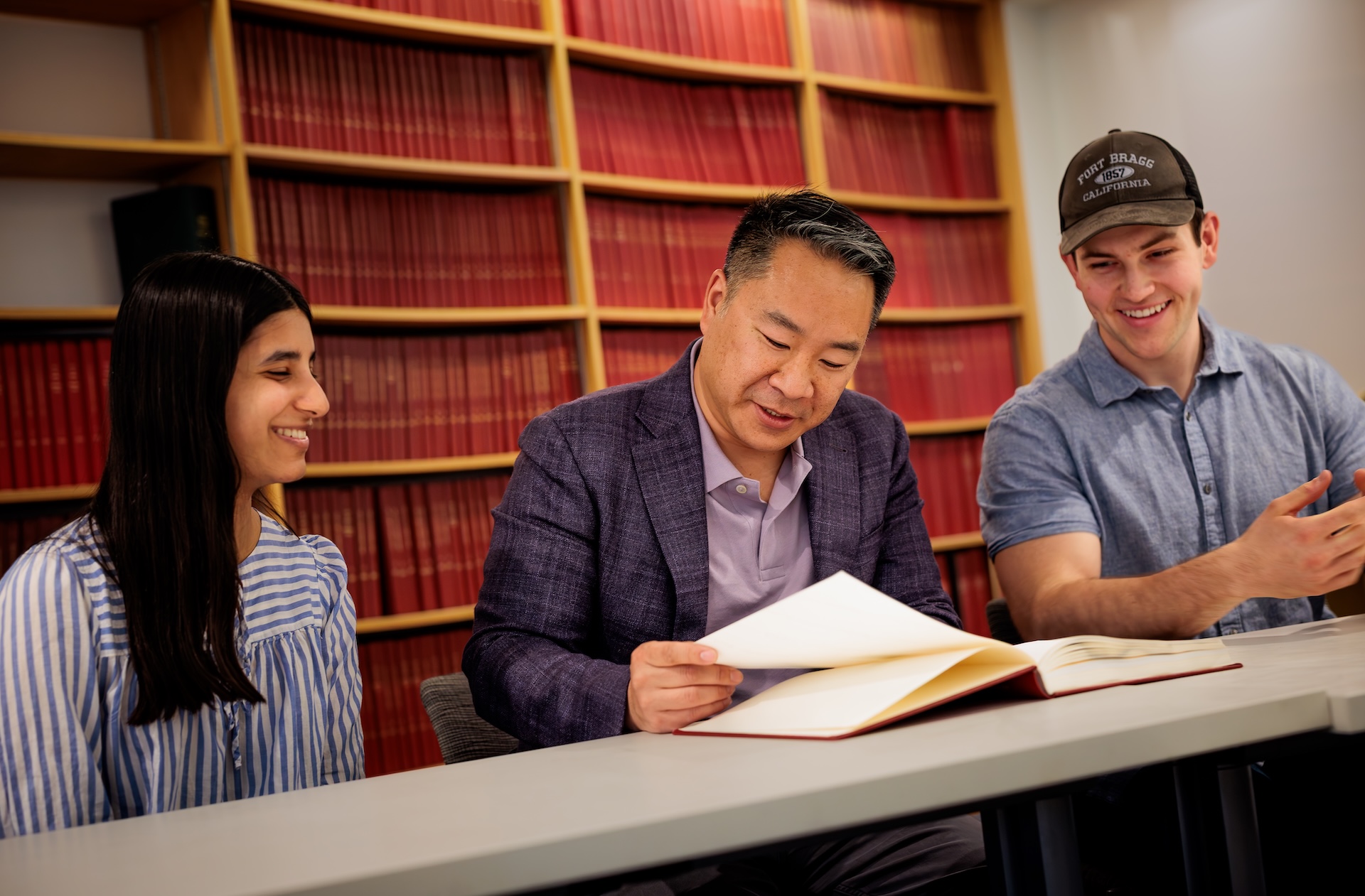
Tutorial’s enduring impact marks a century of training future scientists and physicians
A great mentor turned Bruce Alberts into a scientist.
Back in 1956, Alberts arrived at Harvard as a first-year who had never taken a high school biology class or even known anybody who worked as a scientist. Still, he assumed he would go to medical school and become a physician. When he picked biochemical sciences as his concentration, he was assigned a tutor, a longstanding tradition in the program, separate from his academic advisor. His tutor — then a postdoc — gave Alberts papers to read, stimulated him with discussions, and helped him find a job in a lab doing groundbreaking research during the exciting years after the discovery of the double helix structure of DNA.
“He was sort of like a wise parent because he understood the system and helped me spend my time much more productively,” recalled Alberts, now 88 years old. “It was an important part of making Harvard much more like a small college, because otherwise I would have been lost.”
That partnership changed his life. By his senior year, Alberts had co-authored two papers in major journals with that tutor, Jacques Fresco (both worked in the lab of Paul Doty, a pioneering molecular biologist). The relationship continued for decades: Fresco went on to a long career at Princeton and recruited Alberts to his first faculty position. For more than half a century, Alberts also thrived as a professor at the University of California, San Francisco, authored the landmark textbook “The Molecular Biology of the Cell,” served as president of the National Academy of Science, and editor of Science.
“The tutor,” said Alberts, “was critical for rescuing me from a medical career.”
That transformational experience is one example of a tradition celebrating its 100th anniversary this year. Since the founding of Harvard’s first program in biochemical sciences in 1926, the tutorial has remained a core component of the undergraduate experience. Today, every sophomore studying molecular and cellular biology (MCB) and chemical and physical biology (CPB) is assigned a tutor. They meet regularly until the students graduate — and mentorships sometime persist informally for years afterwards.
The centennial anniversary of biochemical sciences at Harvard will be celebrated with three events over the next year.
The Power of Scientific Thinking: From Classroom to Crisis
Apr. 22, 2026
From Breakthroughs to Better Health
Oct. 3, 2026
Transforming Biological Discovery: From Tools to New Questions
Mar. 2027
“We really use the tutorial to make students dive deep into primary literature,” said Dominic Mao, assistant director of undergraduate studies for MCB and CPB. “In some ways, it’s more intense than a classroom setting.”
The program maintains a pool of 64 tutors, including faculty from Harvard and other institutions such as the Massachusetts Institute of Technology (MIT). Tutors — who all possess advanced degrees in life sciences — also come from outside academia and include physicians, research scientists, and consultants. Each may advise one or several students and meet at least four times per semester. The partnerships often include career exploration, mentoring, finding research opportunities, and guidance for applying to graduate programs and fellowships.
“It’s somebody to bounce ideas off of, not somebody who’s going to give you a grade at the end of the day,” said Professor Rachelle Gaudet, the MCB chair who served as head tutor for 18 years. “It often turns into more of a mentoring and coaching type of relationship. I think that’s what makes it special.”
Since 1955, about 4,400 students have gone through the tutorial program. Prominent alumni include former U.S. Surgeon General Dr. Vivek Murthy, Pulitzer Prize-winning author Jared Diamond, winners of the MacArthur Foundation “genius grants,” numerous professors, physicians, scientists, and at least one Nobelist.
Martin Chalfie ’69, Ph.D. ’77, described himself as an undistinguished undergraduate who initially remained uncertain about whether to pursue a career in science. After declaring biochemistry, he was paired with two tutors who were physicians in Boston hospitals. The first assigned him to read “The Molecular Biology of the Gene” by James Watson, a Harvard professor who had won a Nobel Prize a few years earlier.
The next tutor assigned him scientific papers, including one by George Wald, another Harvard Nobelist. The tutor urged Chalfie to visit Wald and ask questions. He hesitated; how could a lowly undergraduate dare approach a Nobel Prize winner?
“He basically said to me, ‘Don’t be an idiot — go talk to him!” recalled Chalfie. “And I did, and I survived that.”
He did more than survive. Now a professor at Columbia, Chalfie earned a Nobel Prize himself in 2008 for the discovery and development of the green fluorescent protein, GFP. Amid the rush of media attention and congratulatory messages, he got a call from his former tutor, then in his 90s.
“Over the years, I’ve always thought that sort of personal attention was a very good aspect of my undergraduate courses,” Chalfie said. “I probably recognized it more after I left than when I was there.”
The tradition continues. This year, 176 concentrators in MCB and CPB participate in tutorials.
“The tutorial program has been one of my favorite parts of being at Harvard,” said Chris Lavallee ’27, a double concentrator in MCB and economics. “When people ask about the Harvard experience, what I describe is the connections that you form. My mentor takes each of us under his wing, asks us what we’re interested in, and lets us explore that.”
His tutor, James Young ’00, also went through the tutorial program three decades earlier and won prizes for his undergraduate thesis. “I had a great experience,” he said. “Now I have the luxury and time to try to give back.” An internal medicine physician, Young currently devotes himself to a “stealth phase” commercial venture developing wearable diagnostic medical devices.
He decided to become a tutor after a chance reconnection with his own former tutor in his hometown of Lincoln, Massachusetts. He now advises eight undergraduates and holds regular meetings with them individually and in groups. He also fields questions by email, texts, and phone calls. He discusses research papers and thesis projects, and even aspects of “adulting” such as how to file taxes or enroll in health insurance. When students proposed starting a biochemistry society, he donated funds to get the organization off the ground.
Lavallee was uncertain whether to pursue medical school. Young helped arrange several days of shadowing with specialists at Massachusetts General Hospital.
“It kind of feels like there’s so many choices, and you have no way of narrowing it down, and everyone knows what they want to do except for you,” said Lavallee. “But the tutorial program has let me feel good about my choice — now I want to go to med school. I’m happy about that, but I couldn’t have said that a year ago. I was freaking out.”
Another advisee, Manya Gupta ’28, a double concentrator in MCB and economics, values learning from older students in Young’s tutorial group.
“My favorite part so far is the times when we’re all together,” said Gupta. “We were together last week for dinner and talking about theses. I’m still very much on the fence about doing one, in which concentration, and all of that. It’s been really amazing to have people who can guide me and who have faced the exact same problems, even in my specific concentrations.”
The Biochemical Sciences program was founded in 1926 by Professor Lawrence Joseph Henderson, who did pioneering research on blood chemistry and authored the 1913 book “The Fitness of the Environment” (a departmental prize for best undergraduate thesis bears his name). He made mentoring a cornerstone of the undergraduate experience — and it endured through a century of groundbreaking discoveries in the biological sciences and reorganization of departments.
Stephen C. Harrison ’63, now a professor at Harvard Medical School, served as head tutor from 1972 to 1996. He said the program aimed to prepare both future scientists and physicians.
“One of the historically important roles of the concentration, especially in the postwar years, was to send scientifically sophisticated and well-educated students into medicine,” said Harrison. “American medicine needed doctors who understood modern biological sciences and chemical sciences, and we helped fulfill that role. One of the effects was to give undergraduates much more intellectual depth, rather than a sort of careerist view of, ‘Oh, I want to get into medicine and make a lot of money as a surgeon.’”
Harrison — the moderator of a centennial celebration of the tutorial — hopes to convince current students that science remains an essential pursuit, especially after political attacks to discredit scientific authority in recent years.
“My goal is to make students realize that they have a historic mission,” he said. “If they’re going into science, their lives are not going to be as easy as they hope, but there’s something really important for them to do — trying to restore public faith in science, appreciation of scientific reasoning, and guiding policy.”
Evolutionary biologist Erin Hecht on the ancient breed that can fine-tune according to surrounding sound
Harvard scientists describe promise and peril of accelerating technologies
Henry Louis Gates Jr. was awarded the 2026 Thomas Jefferson Foundation Medal, a recognition for public figures who excel at pursuits held in high regard by the founding father.