Eric Moskowitz
Harvard Staff Writer

Classroom changes produce renewed elevation of civil discourse, fearless intellectual pursuit, academic rigor
Harvard Staff Writer
Pictured above from left: Standing Committee on Undergraduate Educational Policy (EPC) member Stuart Shieber, FAS senior civil discourse advisor Eric Beerbohm, Edgerley Family Dean of the FAS Hopi Hoekstra, Classroom Social Compact co-chair David Laibson, Harvard College Dean of Undergraduate Education Amanda Claybaugh, FAS Standing Committee on General Education co-chair Jason Ur, Danoff Dean of Harvard College David Deming, Derek Bok Center for Teaching and Learning Faculty Director Karen Thornber, EPC member Alisha Holland.
In 32 years as a Harvard professor, David Laibson ’88 has taught thousands of undergraduates. A dutiful institutionalist, he’s also presided for the last seven years as faculty dean of Lowell House, previously chaired the Department of Economics, and served as a member of more committees than can be counted on two hands.
So he naturally accepted in early 2024 when Edgerley Family Dean of the Faculty of Arts and Sciences Hopi Hoekstra asked him to help lead an effort to study and define a Harvard College education and “develop practical recommendations for engendering a vibrant learning environment,” even if committee work could sometimes be thankless. After all, Laibson considered the state of the classroom to be dire.
And that’s essentially what the Classroom Social Compact Committee he co-chaired with history professor Maya Jasanoff ’96 revealed, after a full year of town halls, informal discussions, and number crunching. Its January 2025 report laid out a set of “hard truths” — namely, that Harvard undergrads shied away from discussing controversial topics in class and in residential life, gravitated to courses with light workloads and easy grading, and invested increasing energy in extracurriculars while painting by numbers academically, even as they collected more A’s than ever.
But the report also provided detailed blueprints for creating “a transformative educational experience,” offering a host of recommendations that aligned with ongoing efforts across FAS — including reimagined training for instructors from the Derek Bok Center for Teaching and Learning — to “recenter academics” at Harvard College.
Three semesters after that report landed — and two after its adoption by the faculty — Laibson and others with a decanal perch and a classroom view say campus culture has shifted palpably already.
To Laibson, it has meant witnessing the 800 students in his Economics 10 course — as well as the scores he’s gotten to know well in Lowell House — invest themselves in class and engage in more of the challenging conversations that many would have shied away from two years ago.
To Karen Thornber, faculty director of the Bok Center, it was watching 700 instructors who participated in “Pedagogy in Practice” training — the first mandatory prep in FAS history for new teaching fellows and assistants — fan out to join the front lines of instruction as leaders of sections and labs, better equipped to facilitate engaged and lively class discussion.
And to Eric Beerbohm, director of the Edmond & Lily Safra Center for Ethics and faculty dean at Quincy House, it was as visible as seeing far more students rushing to class — following widespread adoption of attendance requirements — while he’s out with his kids and dog in the early morning.
“It's actually just a few dials you turn, and you can really change things,” said Beerbohm, the Alfred and Rebecca Lin Professor of Government and Hoekstra’s senior advisor for civil discourse.
From University Hall, that’s what Hoekstra hoped would happen when she organized the Classroom Social Compact Committee in her first full year as dean: candid, comprehensive analysis coupled with practical recommendations. “It became clear that we had drifted from our academic center of gravity. The answer was never going to be one policy or one semester of reform,” she said. “In a place as large and complex as the FAS, it had to be a collective effort, pursued steadily and piece by piece over time.”
When it comes to discourse, Beerbohm said, the climate just a few years ago leaned heavily on what the philosopher Kwame Anthony Appiah calls ascribed identity, meaning labels others fasten to you — at the expense of identities you achieve through your own thinking and choices. “You can achieve an identity, and you can be ascribed one,” he said. “For a stretch, it felt like everything was on the ascribed side. Students were hearing that where they came from settled what they had to contribute.”
So they clammed up. But it would be a mistake to attribute that reluctance to speak entirely to “cancel culture.” From his own work on classroom climate, Beerbohm came to think a fair amount of the silence had a simpler source: Students were hesitant to speak up because they simply hadn’t done the reading.
While already serving as Hoekstra’s civil discourse adviser, in April 2024, Beerbohm was named by President Alan Garber and Provost John Manning as co-chair of an Open Inquiry and Constructive Dialogue Working Group that worked in harmony with the Classroom Social Compact Committee to foster free exchange of hard questions and ideas in the name of academic excellence.
As one outcome, last fall, Beerbohm gave a lecture on civil discourse to all 1,600-plus first-years within 48 hours of their arrival in Cambridge, the second annual orientation lecture on academic freedom, following one in 2024 by his mentor, Anne T. and Robert M. Bass Professor of Government Michael Sandel. Except they don’t call them “lectures” or mention “civil discourse” or “open inquiry.” Instead, like a parent blending a few vegetables into a recipe, Beerbohm tried to “strike the register that works for them,” asking students to consider how they value and maintain friends even when they disagree on profound matters, while explaining Aristotelian, Kantian, and Emersonian views of friendship.
Evidently it worked, at least anecdotally. Six months later, while welcoming first-years into Quincy after Housing Day, Beerbohm marveled over a blocking group that “shouldn’t exist” — students who had become friends across ideological lines, and who chose to live together for sophomore year while embracing, not avoiding, vibrant debate. The group told him that they’d been inspired by a Sanders Theater orientation discussion on friendship — without even realizing it was him.
That there’s even a debate over whether academics should be recentered starts with an accepted premise that might surprise people who haven’t set foot in a classroom for years: that academics stopped being central to the Harvard undergraduate experience some years ago. “Most definitely,” said Jason Ur, Stephen Phillips Professor of Archaeology and Ethnology and the co-chair of the FAS Standing Committee on General Education.
Sure, many students were invested in their concentrations or engaged deeply in certain courses. But extracurriculars prevailed more than ever, while becoming less oriented around academic affinities and more about providing preprofessional practice or advocacy experience. “Those are all obviously good things. It's just that I feel like they’ve taken up a bigger proportion of students’ time, and I think there’s been a resistance to pushing back against that,” Ur said.
Jasanoff and Laibson can readily tick off the reasons classroom expectations relaxed and extracurricular competition intensified. The 2008 financial crisis and its extended aftershocks raised the already extraordinary stakes for Ivy League admission and heightened the pressure to make a higher education degree pay off with a lucrative job. The first generation of Harvard undergraduates to grow up with iPhones and come of age blitzing through short TikTok videos arrived less equipped than their predecessors to power through or process substantial reading assignments. Able to catch up via recorded lectures, students skipped class entirely — or arrived only to succumb to the distractions of buzzing phones or browser windows.
An increase in the number of students from under-resourced backgrounds and high schools made the College a more democratic place, but it also meant faculty could no longer make certain assumptions about the educational foundation of incoming students — just one reason, along with too few people doing the readings, FAS faculty abandoned the Law School and Business School cold-calling that puts students uncomfortably on the spot, Jasanoff and Laibson said. All the while, grades drifted ever upward, accelerating during the pandemic, until flat A’s accounted for two-thirds of letter grades, while a B+ would send a student to your door “in a state of shock and panic,” Beerbohm said.
“We folded over the last decade,” said Laibson, the Robert I. Goldman Professor of Economics. “As attention spans went down, our assignment lengths went down, and we became more and more timid in asking for serious work outside of class.”
Except that was then, in Laibson’s telling, a long and fruitful year ago. “I knew that the report would have a positive effect. I didn’t think it would do nothing. But I didn’t expect the pace of change that I’ve seen,” he said. “The academic environment on campus has deeply intensified.”
That was affirming news to Jasanoff, who has been on leave as Coolidge Professor of History this year and cautiously anticipates a return to an invigorated campus. She said the committee’s careful review process sowed its success. “In a lot of ways, it meant that the work of the committee was not the report,” she said, calling their 30 listening sessions, forums, and meetings, plus hundreds of informal conversations, a model for “open inquiry.” She added, “The work of the committee was meeting with people and talking with them, and then, I hope, accurately reflecting what we heard.”
But listening sessions alone don’t guarantee change. Both Jasanoff and Laibson surmised that whatever has happened in the last year is bigger than one report.
“This report has had the good fortune of arriving at a time when there were many other stakeholders asking similar questions, pushing in a similar direction. I also think it came at a time when our community was eager to think about these issues with us,” Laibson said, whether that meant pushing back on “cancel culture,” trying to address the distraction of laptops and phones in the classroom, and examining the pitfalls and potential of AI, amid swirling societal forces and political pressures. “A lot of elements jointly contribute to the changes that we’re seeing.”
Some changes preceded the report. In spring 2024 — during a raw and ragged year of campus protests and intense media scrutiny — only 33 percent of graduating Harvard seniors reported that they agreed with the statement, “I feel free to express personal feelings and beliefs about controversial topics.” But that very same spring, Dean of Undergraduate Education Amanda Claybaugh added questions to the Q Course Evaluation — the anonymous surveys completed by students at the end of each semester — beyond the traditional feedback for instructors. The new questions asked whether “most students listen attentively with an open mind and a willingness to change their point of view as they learn more about the topic,” as well as whether they felt “comfortable [in this class] expressing [their] views on controversial topics.”
The Classroom Social Compact Committee Report that followed made numerous additional recommendations: Instructors, including graduate students and teaching fellows, should be mindful of the power of their own speech, whether on a social media post, a classroom aside, or a laptop sticker. Classroom discussions should be confidential, employing a version of the Chatham House Rule. Faculty should help students learn to “think rigorously and critically about evidence,” while assessing and distinguishing between assertions, interpretations, and assumptions, and listening and responding in good faith. Attendance should be expected, even required. Assessments should be designed to enable differentiated grading.
That was a moment the Bok Center was waiting for. When Hoekstra asked Thornber to take the helm at the Bok in spring 2024, she embraced the challenge. The center previously skewed toward theoretical approaches to teaching and learning while providing support mainly to those truly struggling and to those who were already excellent teachers and wanted to get even better. Hoekstra wanted the Bok to better align with FAS and university strategic priorities and serve more faculty and instructors.
Thornber, Harry Tuchman Levin Professor in Literature and of East Asian Languages and Civilizations, reimagined Bok structure and offerings, including new in-person sessions — the mandatory two-hour fundamentals program for graduate students; an assortment of workshops for faculty — to a retooled website that anticipates almost every question an instructor might have. That includes extensive resources on everything from building rapport to structuring the semester to “Teaching in the Age of AI.” Instructors also utilize the Bok’s Learning Lab (a large multimedia classroom, studio, black-box theater, and maker space) and its staff to develop multimodal assignments and approaches to teaching that increase rigor and student engagement in creative ways.
On a recent morning, Madeleine Woods ’19, the Bok’s assistant director of AI initiatives, was helping students from “Calvino and Computation” (Comp Lit 166X) create their own generative AI tools to compose plausible “new” memos by Italo Calvino, four decades after he died, leaving his Six Memos for the Next Millennium to be published posthumously. The students had read Calvino’s works, but instead of writing a final essay, “they’re writing a system that can produce an essay, or a system that can produce thousands of essays,” Woods said. “It’s not asking students to do less when they’re working with AI. It’s actually asking them to do substantively more complex work.”
That’s the kind of AI use that Christopher Stubbs, the Samuel C. Moncher Professor of Physics and of Astronomy, envisions in his role as artificial intelligence adviser to Hoekstra. “We have an obligation to equip our students when they go off into the world to be thoughtful, experienced, skeptical, ethical users of these tools,” said Stubbs, former dean of the Division of Science. “At the same time, on the downside, these tools are an incredibly seductive shortcut” and a crutch that can provide “an illusion of competence.”
Stubbs said the College has made progress on articulating appropriate AI policies at a course-by-course level instead of imposing one-size-fits-all rules across the board. But a lack of clarity still prevails in some courses, leading to apprehension or misunderstanding between students and faculty over “what constitutes fair use.”
Stubbs identifies as a bit of an outlier on recentering academics, endorsing extracurriculars as an essential part of the educational process. “When I look back to my own time as an undergraduate, I think a lot of my meager leadership attributes trace back to experiences that I had then that were outside of the classroom,” he said. Still, he added, Harvard is in no danger of overcorrecting, and academic excellence should be paramount.
For Thornber and others invested in the recentering effort, the grading proposal due for a vote at the May 5 Meeting of the Faculty “will make the largest difference of all, because it will create opportunities for students who really do want the classroom to be the center of their experience to be recognized, just as we recognize our star athletes, our star chorale singers, our star debaters.”
Few today choose to invest substantial effort in a course if they can get an A for a few hours of work. If the proposal passes, Thornber said, that lesser effort would instantly become the exception instead of the rule.
Laibson hopes it will finally eradicate “gems” — the courses many students flock to because they couple easy grading with a light workload. “The real question is why gems have been offered in the first place,” he said.
Ur is rooting them on. His standing committee once envisioned Harvard College’s Program in General Education (Gen Ed) as a laboratory for tackling grade inflation and compression, because everyone must take four Gen Ed courses to graduate, from a menu of about three dozen offerings a year. Gen Ed courses, many of which are co-taught, are meant to be “the jewel of the Harvard College experience” — multidisciplinary classes that expose students from all concentrations to critical questions animating humanity, such as: why the past matters, how the arts help express what it means to be human, and how science works.
Because Gen Ed courses must be approved by the committee before being offered, and because they are regularly reviewed, Ur thought they might be a walled garden where they could roll back the grading curve in those 30 to 40 classes. But before they got very far, the committee accepted grading as a collective-action problem so thorny it would require a policy change College-wide.
Last fall, new Danoff Dean of Harvard College David Deming tried to explain what “recentering academics” meant to parents at Family Weekend, ticking off the need to tackle grade inflation, regain attention from social media and digital devices, and restore the classroom as a “sacred space where you can engage deeply and have rich conversations that are simply not possible once you leave Harvard.” In other words, “I want students to have to count on two hands — maybe even three — the number of classes at Harvard that changed their lives and the way they think about the world.”
Several years ago, Jasanoff introduced what should have been one of those Gen Ed classes, “Ancestry: Where Do We Come From and Why Do We Care?” The course examined ancestry from numerous perspectives — biology, anthropology, genealogy, history, law, and memory — while challenging its conventional definition as the study of identity and evidence. Jasanoff wanted to equip students with qualitative and quantitative “historico-analytical skills” that would extend beyond the semester “into a lifetime of research and inquiry into the implications of ancestry as a form of history and field of individual and collective study.”
Though enrollment approached 400, she mothballed the class in frustration after a few semesters. Partly it was the pandemic, with Zoom courses “enough to kill anyone’s enthusiasm for teaching anything.” But even in person, in the previous semesters, student preparation and engagement levels “were really troublingly low.”
“It created a dynamic in the class that was uninspiring for a teacher, and that was undermining for some of the people in the class who were very engaged and excited by the material,” Jasanoff said. So many students came to class “checked out” that it was impossible to establish “a common basis for anchoring a meaningful discussion of something challenging.”
Still, as Jasanoff heard Laibson describe the rejuvenated academic environment, she had a thought. “Should there be a reform to the grading policy,” she said, “I would be excited to bring that course back.”
UPDATE — May 20, 2026: In a decisive vote, faculty approved the grading proposal discussed in this story.
Being born a few days on either side of the school-enrollment cutoff date might seem like an arbitrary difference. But new research finds boys born just after the cutoff, who start kindergarten relatively old for their grade, enjoy far more advantages than previously known.
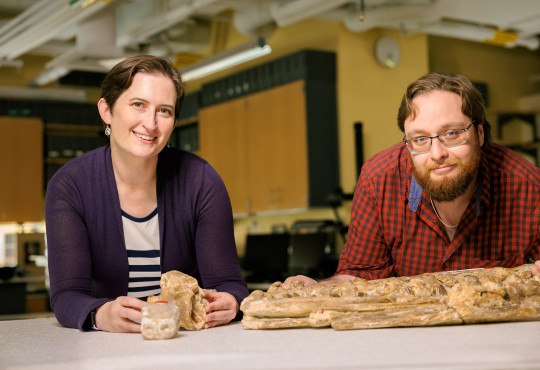
After 80 million years, a giant fossil jaw has quite a story to tell. Back in the age of the dinosaurs, Tylosaurus proriger was a fearsome predator — a bus-sized aquatic reptile with a crushing snout, daggerlike teeth, and knack for swallowing prey whole. How its bones wound up at Harvard is a tangled yarn involving a Wild West stagecoach station, the early western railroads, the infamous “Bone Wars” between rival fossil hunters, and a founding scholar of natural history.

New research by economist Rebecca Diamond found an increase in marriage among single women and an increase in employment rates among unemployed women after they started taking GLP-1 drugs for weight loss. Diamond says the pattern suggests that at least part of the female obesity penalty — the social and financial costs women bear due to their body size — is linked to first impressions.