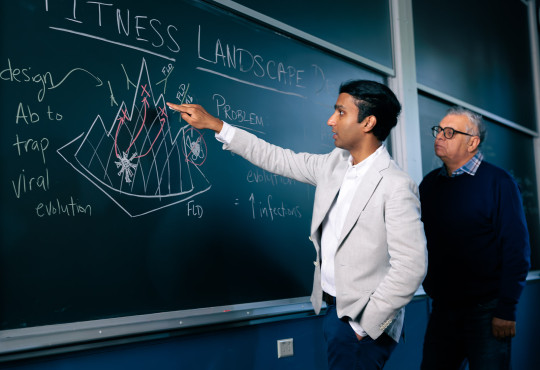
How to build an evolutionary trap for viruses
Two Harvard scientists describe a way to engineer the evolutionary landscape that viruses experience, pushing them away from dangerous variants and into evolutionary dead ends.
Two Harvard scientists describe a way to engineer the evolutionary landscape that viruses experience, pushing them away from dangerous variants and into evolutionary dead ends.

Upon moving to Cambridge, geophysicist Xiyuan Bao often relied on navigation software to find his way through the unfamiliar network of roads. He realized the same technology could help him find something else: a solution to a mystery deep within the Earth.

Blazars, or galaxies powered by supermassive black holes, act as anchor points in the sky. They shine brightly in telescope observations, but because they are so far away, they appear almost perfectly fixed.
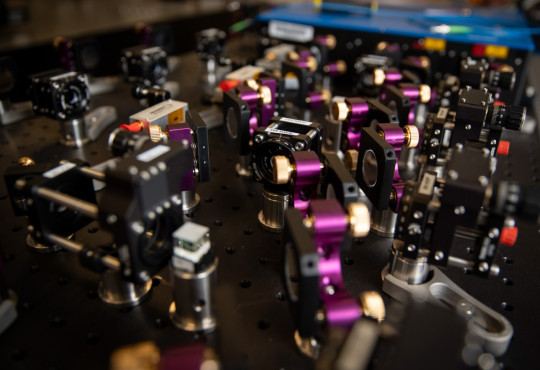
The institute will bring together 39 researchers across fields including mathematics, computer science, engineering, physics, and chemistry.
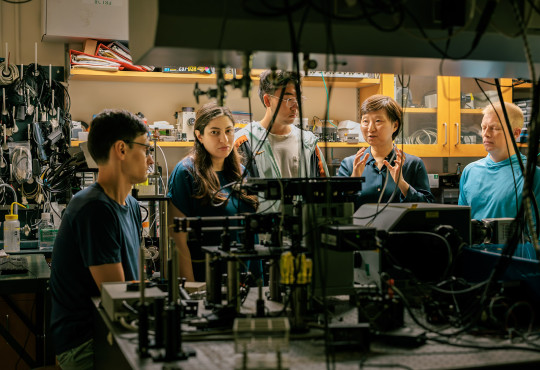
The technology, described in a new paper in Cell, could reshape how scientists investigate tissue function and disease.
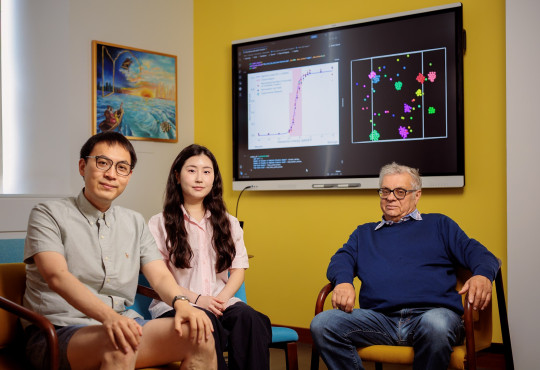
Researchers in the Department of Chemistry and Chemical Biology combined biophysics, structural biology, and simulation to solve a manufacturing question.

Forget about the ancient Greek myth of Icarus. For the last 10 years, Jenna Samra, Ph.D. ’18, and her colleagues have been pushing technology to fly closer to the hottest part of the sun.
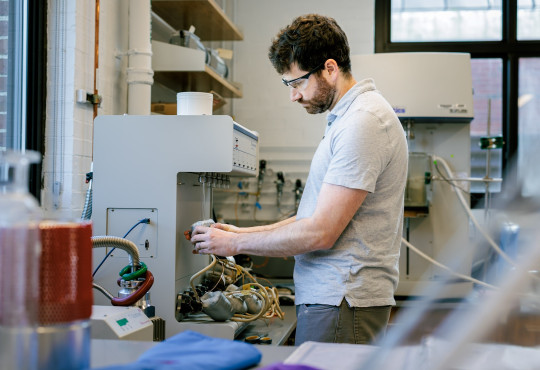
FluxBio’s near-term focus is to help biomanufacturers get more out of the reactors they already own.
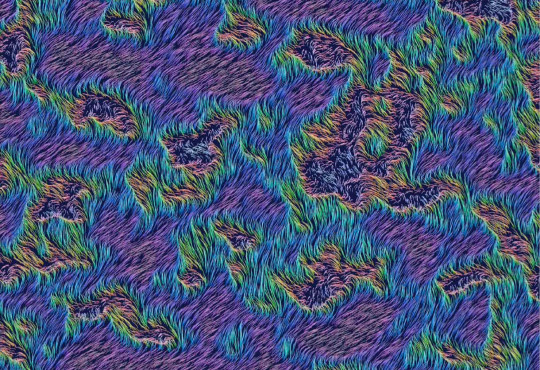
A team from The Rowland Institute at Harvard has uncovered complex nanoscale orders in a chemical compound that has long mystified researchers when exposed to extreme cold.

The first-of-its-kind discovery is expected to set off a search for signs of life.

An earthquake alert system mines data from billions of Android phones, the most common smartphone in the world, and easily the most popular in less wealthy nations.