Eileen O’Grady
Harvard Staff Writer
New research from the lab of Elizabeth Spelke shows simple games have powerful effect on children growing up in poverty
/ Read time: 5 minutes
Harvard Staff Writer

Games can make learning fun. New research suggests they can also teach important social and emotional skills to kids facing adverse early childhood experiences.
A recent study by Elizabeth Spelke’s team in the Harvard Laboratory for Developmental Studies describes how games aimed at improving social skills, played in preschool settings, boost social-cognitive development for Brazilian children living near or below the poverty line. The results, published over the summer in Communications Psychology, suggest these games can help equip young people for success in the classroom and in life.
“When I began to study children’s learning in preschools and schools, I thought that an interest in the content taught in schools, and a motivation to master it, were the primary determinants of young children’s successful learning,” said Spelke, Marshall L. Berkman Professor of Psychology. “I now believe, however, that a child’s social engagement with teachers and classmates is just as important.”
The findings have their roots in India, where, for the past decade, Spelke’s team has investigated how games can help kids learn math. In one study involving math games for preschoolers, researchers assigned social-cognition games to a second group of students. Although the second group was intended only as a control, its participants got researchers’ attention by logging noticeable gains.

The Harvard Laboratory for Developmental Studies, explores the way infants and young children learn about the world that surrounds them.
Much of this work involves describing how infants’ understanding changes over time, eventually arriving at an adult-like state. The lab includes four professors exploring topics from number to language to social relations in an effort to better understand how the mind works.
Learn more
“We found that children got better at reasoning about people’s mental states — their actions, emotions, and perceptions — after playing these games,” Spelke said. "That’s where the Brazil team came in and asked, ‘What about children with other social-emotional challenges? Do you think they’d benefit from these social games?’”
Spelke didn’t know the answer. “But I was glad the team wanted to find out,” she said.
Existing research shows that early childhood is a sensitive period for human neurodevelopment. Adverse childhood experiences, such as poverty or exposure to violence, can have long-lasting impacts. But targeted interventions, aimed at helping kids succeed, have also made a difference.
With this in mind, Nara Côrtes Andrade of the Federal University of Juiz de Fora and Chrissie Ferreira de Carvalho from the Federal University of Santa Catarina developed the curriculum for a series of social-cognition games, called CuriousMind, in Spelke’s lab with funding from the Lemann Brazil Research Fund. The psychologists built upon the structure of math games Spelke’s team had implemented in India. But CuriousMind was adapted for a Brazilian context, with Portuguese words as well as cartoon characters and situations familiar to children in that country.
The co-authors conducted their study at six public preschools in the city of Salvador, located in the Brazilian state of Bahia. The students involved were 5- and 6-year-olds, mostly from families living near or below the poverty line. At two participating schools, teachers implemented the CuriousMind games. At two other schools, students played math games. At the remaining two schools, no games were introduced.
One of the CuriousMind interventions was called “Emotion Explorer,” a board game where children take turns interpreting emotions in photographs of facial expressions before choosing which face corresponds best with a cartoon scenario. For example, after looking at a cartoon image of a child who has just dropped an ice cream cone, players must choose whether a sad or excited facial expression is the better fit.
Also in the CuriousMind series was “Mind Hunter,” a card game where students interpret characters’ mental state and pick the likeliest outcome. In one scenario, a boy sees a girl holding both a cake and a lollipop. A thought bubble beside his head reveals that he wants the cake, not the lollipop. After looking at the image, players must choose which item the boy is more likely to ask the girl for, given what is known about his preferences.
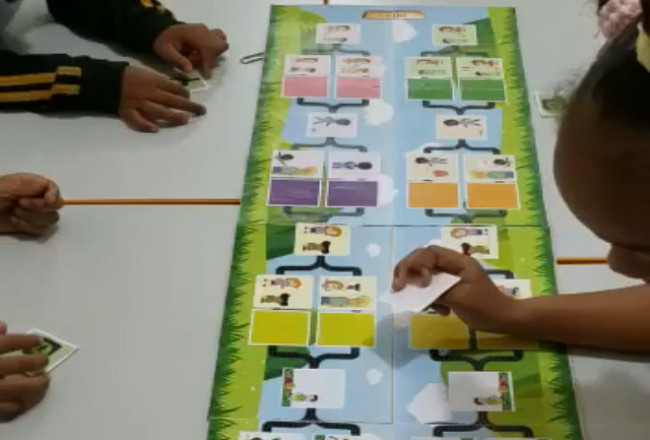
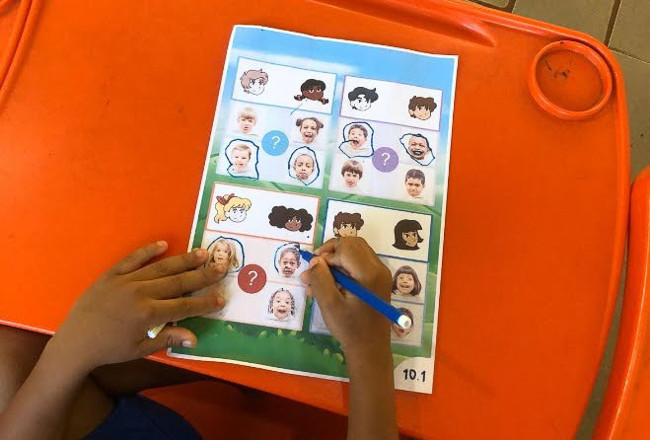
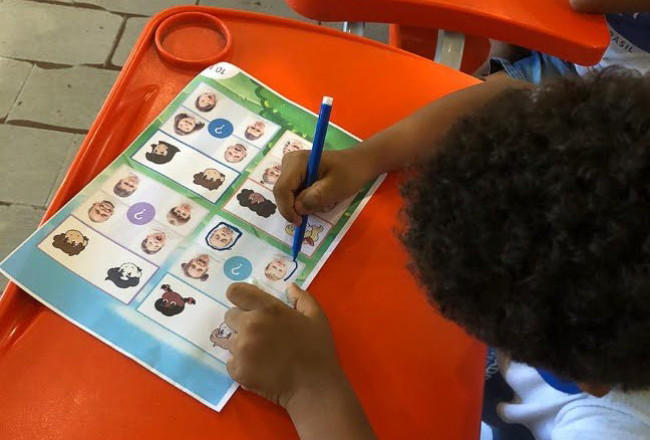
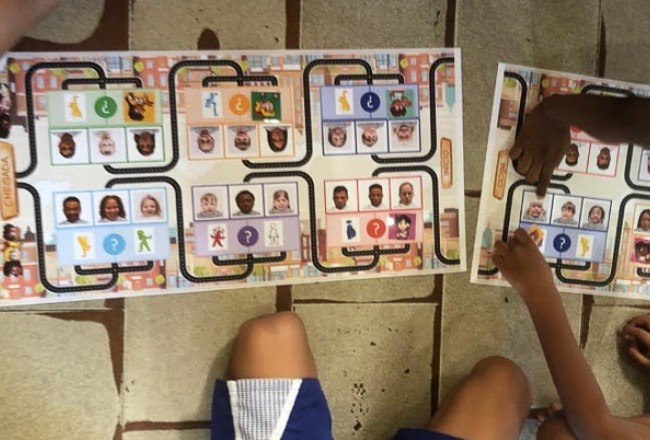
In assessments conducted after four months of children playing for several hours a week, researchers found the group assigned to CuriousMind games made large gains in recognizing and labeling emotions, while also improving their broader social understanding. By contrast, children in the two control groups showed no comparable progress on social cognition.
“It was by no means a foregone conclusion that the games would play out in the same way in Brazil,” Spelke said. “The population in Brazil was quite different from the population we had studied in India, both culturally and clinically. But it was very interesting to see that they did. Children with diverse backgrounds and challenges may learn in similar ways.”
The findings suggest that interventions in the form of play help social and emotional development in early childhood, even for students experiencing adverse socioeconomic conditions. It also seems the CuriousMind curriculum can be used as a model for this type of intervention.
Spelke added that the study — which combines neuroscience with cognition, education with economics — underscores the importance of using interdisciplinary approaches to discover more about how children learn.
“I would love to see more attention paid to this particular synergy between basic research in developmental cognitive science on the one hand, and research in education on the other hand,” Spelke said. “These are both wonderful fields, and when they come together with the third field of economics, where we learn rigorous techniques for evaluating the ideas that emerge when we engage with each other, then it’s even better.”

Luiselli, an incoming professor of English, was nominated for her novel “Beginning Middle End.” It tells the story of a mother and 12-year-old daughter starting over in Sicily after the elder’s divorce, as they figure out how to rebuild amid encounters with the island’s daily life and its winds, waters, and volcanoes.

“We have never before shown an entire exhibition from the French and Creole-speaking Caribbean,” said Cécile Fromont, M.A. ’04, Ph.D. ’08, faculty director of the Hutchins Center’s Alain Locke Gallery of African & African American Art.

The Biological Laboratories at 16 Divinity Avenue first opened in 1931. In the 95 years of its existence, the storied building has been home to the pioneering evolutionary biologist E.O. Wilson, a dozen eventual Nobel laureates, and even a self-described “zombiologist” or two.