Clea Simon
Harvard Correspondent

Anthropologists, psychologists, and biologists traded research findings on conditions that foster cooperation across social boundaries
/ Read time: 6 minutes
Harvard Correspondent
Cooperation can make us stronger, building alliances and increasing the availability of resources. A recent symposium hosted by the Human Evolutionary Biology Initiative brought together researchers to examine this principle, sharing studies and findings on intergroup cooperation from a variety of fields. Focusing on the crossing of social boundaries, the full day of presentations featured psychologists, evolutionary biologists, and more, all addressing how animals from ants to zebras to humans work with each other — or don’t.
Opening remarks by Martin Surbeck, associate professor in the Department of Human Evolutionary Biology, focused on the power of this interdisciplinary exchange, with research by the event’s presenters “narrow[ing] down the very basic ecological and sociological behavior needed for cooperation to emerge.”
The day’s first panel covered “Relationships Across Social Boundaries.” Severine Hex, a Harvard fellow in behavioral ecology and sociobiology, has studied social structures in plains zebras for the past seven years. She spoke about the equid’s “harems,” or groups of one male and several unrelated females, which form the core mating groups within larger zebra herds. These harems can be threatened by all-male “bachelor” groups, which seek to “parasitize” — or steal — females.
“Zebras need to spend 15 hours a day eating, so this behavior is really disruptive,” Hex explained. But members of a harem can also reach out, as Hex illustrated, focusing on the example of two females who interacted with females from another harem who had lost their male.
Cyril Grueter, an Oxford University professor of evolutionary anthropology, covered primate social behavior across boundaries among the golden snub-nosed monkeys of central China. With social groups based on one male and his female mates, female outreach between groups was once again central in stabilizing the larger troupe in these monkeys’ social structure, he said.
However, Grueter’s field work has also surfaced cooperation among unrelated males, including those who went on “boundary patrols” and chased away unaligned bachelors.
Integrative anthropologist Anne Pisor, of Penn State University, turned the lens on humans, describing how people in both the Bolivian Amazon and in Kenya define themselves. Noting how shared identities — delineated by common language or traditions — can “overlap,” she spoke of how groups can come together through social occasions or via necessary interactions around resources. As an example of the latter, she described older men in Kenya negotiating the shared use of a watering hole before younger warriors had the chance to engage aggressively.
These connections, she explained, are defined by several factors, including layers of kinship, trade, and friendship. “Relationships often span distance and space,” she said. “Even though groups seem very ‘slippery’ in humans, there’s a lot going on in intergroup dynamics.”
Focusing on how to encourage such interactions, Harvard psychologist and Alfred and Rebecca Lin Professor of Civil Discourse Joshua D. Greene previewed his online game Tango. The two-player quiz game aims to heal divisions among those with opposing political and social viewpoints. Tango, which has already been played by Harvard students, uses fun challenges and questions to help pairs uncover similarities.
“People need some reason to want to engage,” Greene said. With the added incentive of prizes, such as tickets to Red Sox games, he said, Tango has already helped “roll back years of increased animosity.”
A panel on “Cooperation Between Groups” found Bristol University behavioral biologist Stephanie King presenting her research on bottlenose dolphins. Explaining their “nested alliances,” all based on keeping mating groups intact, she outlined how dolphins not directly involved with a group will still help protect its existing order — for example, by defending females from marauding males. Although questions remain, she explained that more than 40 years of research in Australia’s Shark Bay has shown “order maintained through affiliative contact and synchrony,” such as rubbing pectoral fins and surfacing together.
University of St Andrews behavioral ecologist Leveda Cheng discussed differences in cooperation and aggression between chimpanzees and the apparently more peaceful bonobos, specifically looking at the role of oxytocin in both species. While this hormone usually regulates maternal care and offspring protection, she detailed what may be its additional “tend and defend” function in promoting social bonding.
Sarah Mathew, a professor in Arizona State University’s School of Human Evolution and Social Change, talked about her findings on the seminomadic herding societies of northwest Kenya, where disappearing resources, such as water, are increasing conflict. While these clashes have often turned deadly, agreements to share grazing areas provide hope. One such agreement, between the Toposa and the Turkana people, has held for more than three years, Mathew said. To forge such peaceful cooperation, the different communities focused on similarities, in this case building on “their larger identity based on shared language,” she said.
A presentation by Mina Cikara, Frederic Wertham Professor of Law and Psychiatry in Society, kept the focus on human interaction. Specifically, Cikara concentrated on how the appearance and growth of new groups — such as recently arrived minorities — influence relationships between existing groups. This, she said, is largely subjective, noting that “who you run into” makes more of an impression than actual demographic information. While such impressions and changing views offer opportunities for politicians looking to stir up discontent, they can also help forge alliances, even unlikely ones of the “devil you know” variety.
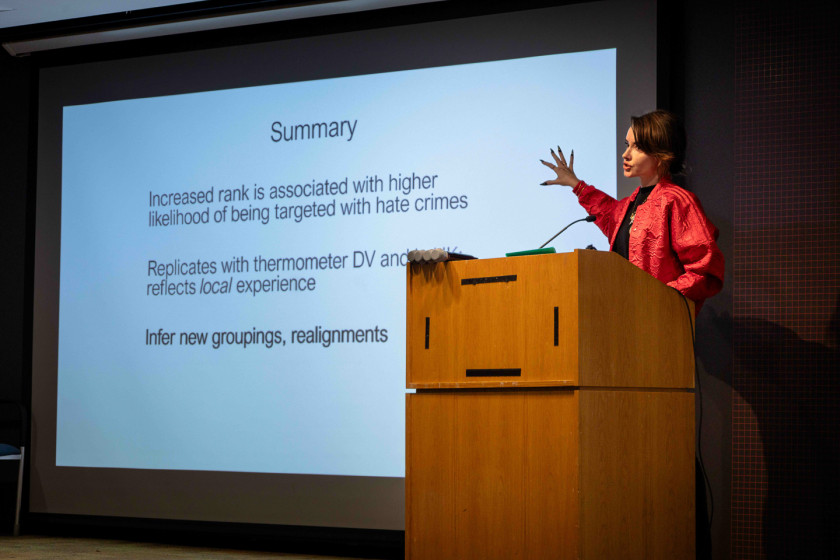
The day’s final panel covered “Mechanisms Underlying Cooperation Across Social Boundaries.” University of York behavioral ecologist Elva Robinson opened by introducing her work on ant colonies. In her long-term research, she has found “extensive peaceful cooperation” between nests. However, when nests interact, it is often the case that “one group pays a cost,” especially when resources are scarce, and coalitions to keep out a third group have been witnessed.
Intriguingly, Robinson noted, genetics don’t seem to play a major role in these interactions. “It makes sense to tolerate your neighbor whether or not they are kin,” she said.
Boston University anthropology professor Luke Glowacki spoke about the mechanisms underlying human cooperation across social boundaries. “Conflict is inevitable in social species,” he offered. But while such conflict can lead to intractable war among all primates, he said, citing the example of the eastern chimpanzee, “humans can and do frequently make peace.”
Looking at how groups build durable peace, he broke down the process into three steps: preventing aggression, coming up with a way to resolve conflict as it arises, and finding a way to signal future, ongoing cooperation. Naming actions like agreeing on compensation for losses due to violence or the ritual destruction of weapons, he noted that humans have an advantage in forging lasting peace.
“We are different from other species,” he said. “We can resolve conflicts, reduce aggression, and signal future cooperative intent thanks to our psychology and cultural technologies.”
Harvard’s Joseph Henrich, Ruth Moore Professor of Biological Anthropology, spoke about intergroup prosociality and the influence of social norms. Using the example of ties forged by marrying into other families or clans, he pointed out how taboos — such as that of marrying cousins — can enable one to marry into a family living farther away, extending those long-distance connections. Other rituals, such as initiation rites that unite adolescents from different groups, can also establish lifelong bonds.
“Ritual is often as important or more important than kinship,” he said.
The symposium closed with a round of comments on what participants had learned. David Haig, George Putnam Professor of Organismic and Evolutionary Biology, who moderated one of the day’s panels, observed that family relations come with obligations, while relations with friends — and, by extension, colleagues — can be easier. Robinson noted that, across species, “we’re not seeing preferential behavior toward kin.”
“Cultural evolution in humans might be similar to what genetic evolution is doing in other species,” Henrich concluded. “It just takes longer in genetic evolution.”


I think it’s very important for us as classicists to take a work like Nolan’s ‘Odyssey’ as a work of adaptation that is aiming to produce new relations with antiquity and not to think about it in overly deferential terms, or in terms of fidelity or accuracy,” said classics professor Emily Greenwood.

The findings unlock a path to harnessing ultra-fast magnetic materials and cleaner computer memory and hardware — enabling performance gains that could solve major energy bottlenecks facing modern data centers.

A new exhibit at Harvard’s Collection of Historical Scientific Instruments, opening Friday, probes how calipers and spirometers never simply recorded differences. They helped invent them.