Eric Moskowitz
Harvard Staff Writer
New exhibition at Collection of Historical Scientific Instruments probes how calipers and spirometers never simply recorded —but helped invent — differences
| 6 minutes
Harvard Staff Writer
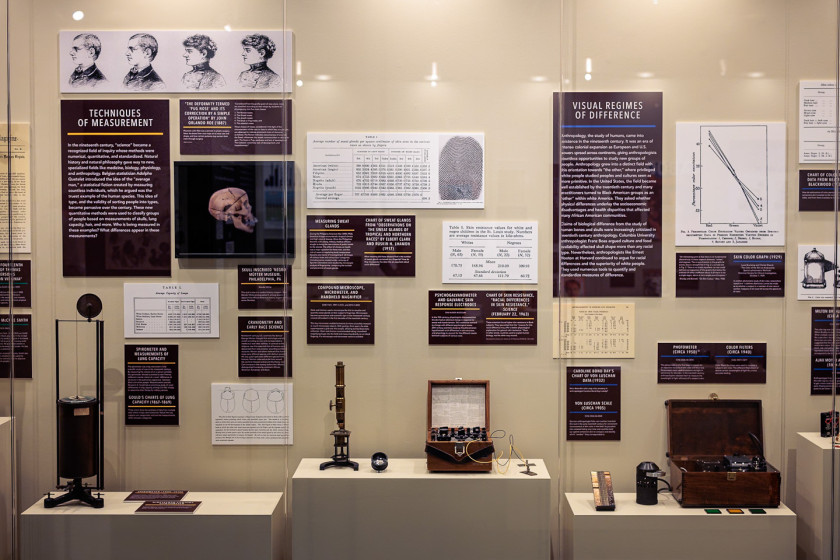
Visitors to the Collection of Historical Scientific Instruments’ new exhibit on race and measurement can tap an iPad as the screen changes colors to test their reaction time. Nearby, an 1890s predecessor — a telegraph key wired to a stopwatch — rests in a display case.
Back then, University of Pennsylvania psychologist Lightner Witmer used a wired stopwatch like this to test how fast subjects responded to audible, visual, and electro-shock signals. In 1895, a writer connected to Witmer published some of the reaction times in Psychological Review, sorted by race.
The resulting tables in the academic publication looked every bit as scientific as the wired device itself, appearing to demonstrate conclusive differences in reaction times among white, Black, and Native American subjects. But the writer, R. Meade Bache, magnified modest differences among a small sample size to present supposed proof confirming his own prejudice. He believed people of color were inferior, framing reaction time as an inverse reflection of brain development.
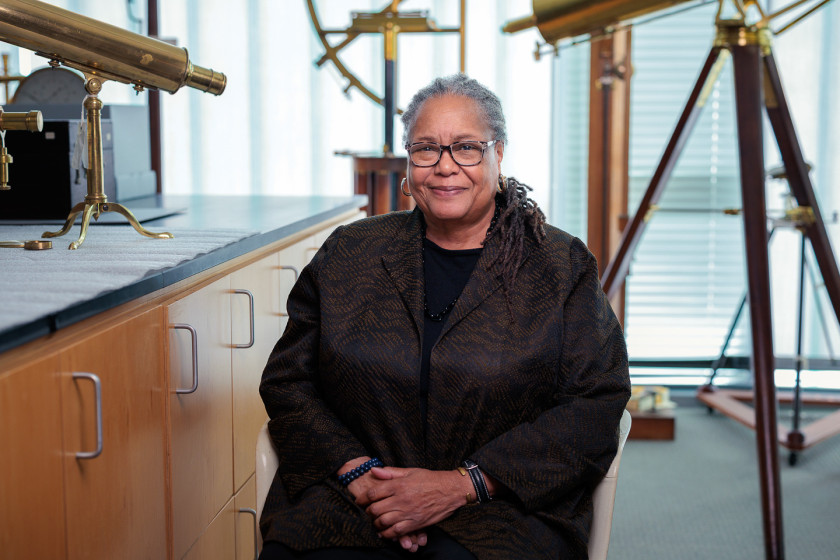
“He claimed that the slower reaction time of white people was because they were more civilized, thought too much, and Black people were just reacting like an animal would,” said Evelynn Hammonds, curator of “Measurement on the Color Line: Scientific Instruments and the Making of Human Categories,” during a walk-through of the exhibit, which opens Friday in CHSI’s second-floor gallery, upstairs from the main collection. “A measurement of reaction time as a representation of whether some individual is civilized, or that an individual from a particular group is civilized? How do you go from the measurement to that idea?”
Hammonds, Barbara Gutmann Rosenkrantz Professor of the History of Science as well as a professor African and African American Studies at Harvard, said instruments and devices are central to the story of “race as an object of scientific interest,” a tale as old as the transatlantic slave trade, which rose up alongside the age of scientific inquiry.
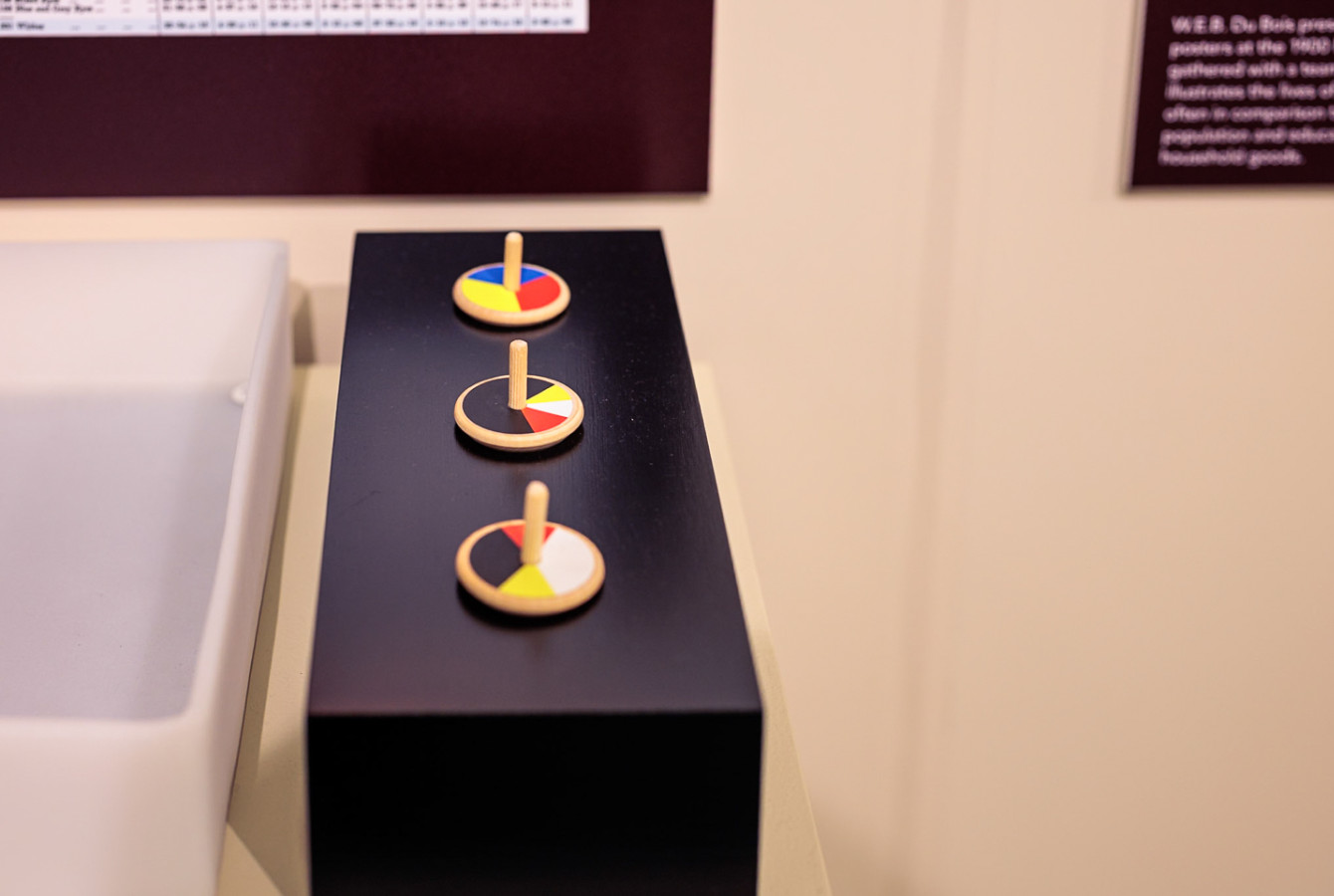
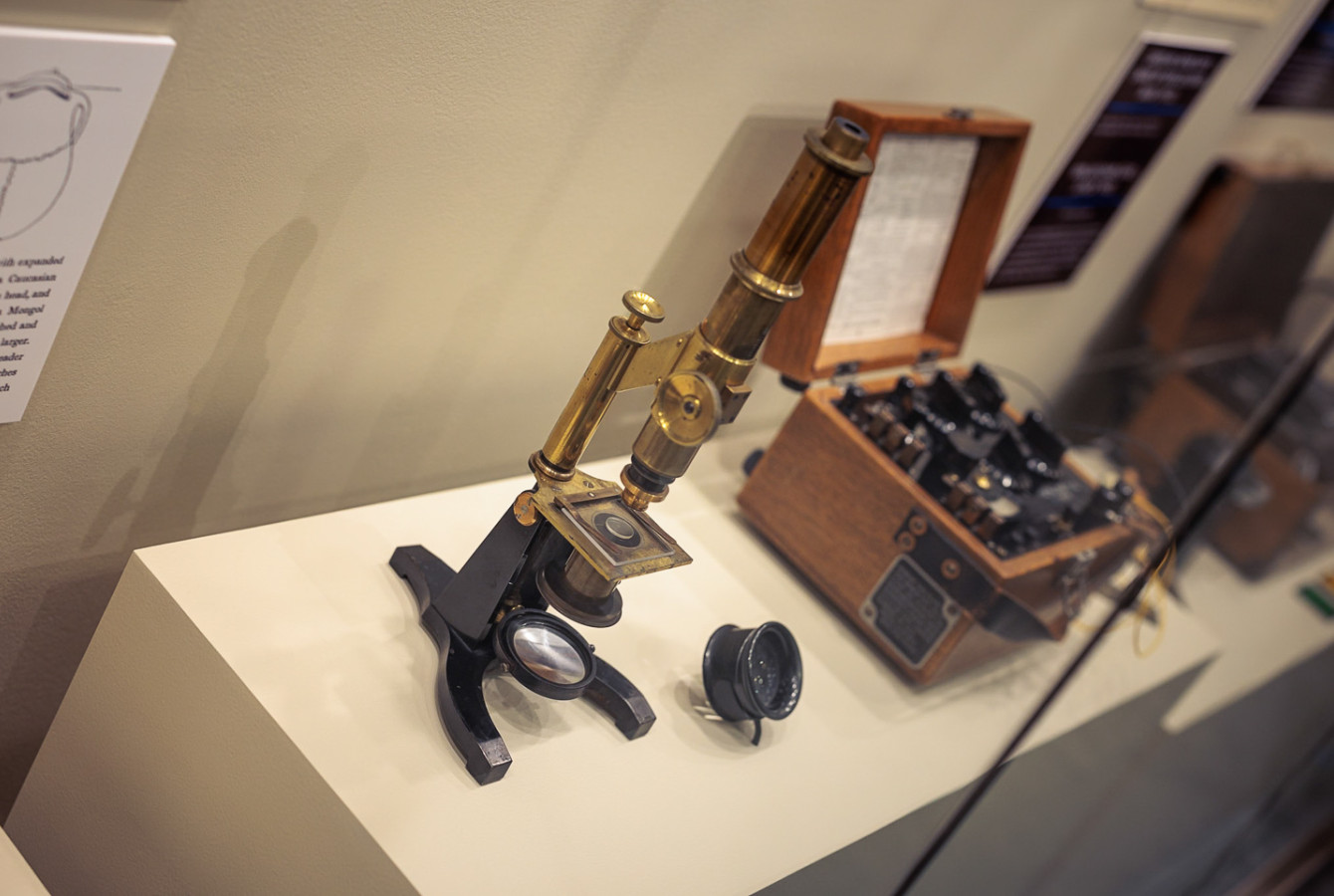
To that end, the exhibition — which Hammonds curated in collaboration with postdoctoral fellow Emma Broder — opens with a 1792 edition of Carl Linnaeus’ “Systema Naturæ,” which offered a system for classifying plants and animals that extended to humans, whom Linnaeus grouped in four “varieties”: Europeans, Americans, Asians, and Africans. But machines and devices figure prominently, including multiple generations of spirometers — notably used by B.A. Gould for a large-scale study of the lung capacity of Black and white troops during the Civil War, embedding biases into pulmonary treatment that have persisted into this century — and equipment for measuring the number of sweat glands on a fingertip. Metal calipers share space with Milton Bradley spinning tops introduced in the late 19th century to teach children about color blending, which the eugenicist Charles Davenport, who began his career at Harvard, employed to match skin colors.

“It’s the critical throughline of the exhibit that we’ve come to trust measurements and facts produced by machines as objective,” Hammonds said, even as those machines and the “data” they produced have been harnessed to actively “produce ideas” about race, not just reflect them.The genesis for Measurement on the Color Line dates to the early 1990s, when Hammonds began teaching at the Massachusetts Institute of Technology and started a monthly workshop for scholars interested in tracking the “history of scientific racism.” That led to the 2009 book “The Nature of Difference: Sciences of Race in the United States from Jefferson to Genomics,” which Hammonds co-edited with Rebecca Herzig, a Bates College professor who had studied with Hammonds as a graduate student.
“I have been looking at these questions for a very long time,” said Hammonds. Among the queries posed to visitors on the walls of the exhibition: “If race is the answer, what is the question?” and “Everybody thinks they know what race is — but do they?”
People might reflexively respond, “‘Race is a social construct,’” Hammonds added. “But if you ask for more details about what kind of social construction it is, what you get are all these things that are related to biology, not to social structure or social relations. It’s all about hair, hair type, eye shape, nose shape, skin color. The social world is produced by ideas about biology and bodily differences.
“So, ideas about race always start by returning to questions about the body. Well, where did this idea — that race was located in the body — come from, and how did it become so important?”

In addition to tracing the ways scientific disciplines sought to record or manufacture physical justifications for social hierarchies, the exhibition also illuminates the work of pioneering African American scholars who challenged the dominant ideas of their day on race.
That includes James McCune Smith, who was born into slavery in New York in 1813, earned a medical degree in Scotland, and became the first Black physician in the United States. McCune Smith used his background in medicine and statistics to rigorously debunk Thomas Jefferson’s writings that biological differences distinguished the races, as a justification for slavery.
When Jesse Owens won a record-breaking four gold medals at the 1936 Summer Olympics, some theorized that he benefited from “natural” physical traits inherent to Black people, an argument intertwined with the notion that they were inferior intellectually. William Montague Cobb, a physician who was also the first African American to earn a doctorate in physical anthropology, conducted anatomical studies of Owens and other prominent Black and white athletes of the day, demonstrating that no single physical trait distinguished people by race.
And yet, some version of that debate has lingered over professional sports and nearly every Olympics since, said Hammonds, who included a near-life-size photo of her former student Gabby Thomas ’19 in action at the 2024 Olympics, where Thomas won three gold medals as a sprinter. The image is juxtaposed with a controversial quote from a journalist in 2003, claiming that different populations have distinct physiological structures conferring sporting advantages. “It still comes up,” she said.
October 16, 2026–August 15, 2027
Sunday–Friday, 11 a.m.–4 p.m.
Free and open to the public
Collection of Scientific Instruments
1 Oxford St., Cambridge
Measurement on the Color Line is bookended with contributions from Harvard-affiliated scholars over a century apart. Five years after becoming the first African American to earn a doctorate at Harvard, W.E.B. Du Bois presented a groundbreaking exhibit at the 1900 Paris Exposition, offering data tracing the remarkable progress of African Americans since the end of slavery while presenting racial differences as a product of social conditions, not biology. And he did so with a set of modernist infographics, including a spiral — illustrating the urban and rural Black population in 1890 — that Hammonds employed as a repeating motif throughout the exhibition.
More recent objects include a set of pulse oximeters for visitors to test — ubiquitous during the COVID-19 pandemic, and a source of controversy for their bias in measuring oxygen saturation for people with darker skin tones — as well as a Monk Skin Tone Scale, developed by Harvard Professor of Sociology Ellis Monk. The chart helps train computer algorithms to recognize a wider range of skin tones, with benefits for dermatological treatment as well as the ability of cameras and self-driving cars to perceive people of color.
Amid these technological artifacts, an eye-catching screenprint hangs near the end of the exhibition, showing a set of hands pollinating vanilla flowers — a work by Lucy Kim, a former artist-in-residence at the Broad Institute of Harvard and MIT who prints images using bacteria genetically modified to produce melanin, the pigment that gives humans their eye, hair, and skin color. The work asks visitors to consider how perception influences our categories and beliefs.
Nearby, a set of quotes serve as parting thoughts, including words from Hammonds: “Race is a human invention. We created it, we have used it in ways that have been, in many, many respects, quite negative and quite harmful. And we can think ourselves out of it. We made it; we can unmake it.”

I think it’s very important for us as classicists to take a work like Nolan’s ‘Odyssey’ as a work of adaptation that is aiming to produce new relations with antiquity and not to think about it in overly deferential terms, or in terms of fidelity or accuracy,” said classics professor Emily Greenwood.

The findings unlock a path to harnessing ultra-fast magnetic materials and cleaner computer memory and hardware — enabling performance gains that could solve major energy bottlenecks facing modern data centers.

Harvard geoscientists reported that organic matter harvested from certain meteorites bears chemical traces of “primitive oxygen reservoirs” that have changed little since the birth of our solar system. The findings help trace the origins of organic matter that meteorites may have delivered to a young Earth, supplying the planet with ingredients essential for life.