Clea Simon
Harvard Correspondent
Liquid helium and round-the-clock attention were necessary for research — with implications for quantum computing
Harvard Correspondent

Extreme cold is both a necessary and extremely challenging factor in many branches of science. Imaging materials through transmission electron microscopy (TEM) at ultracold temperatures allows atomic-scale examination of samples of everything from inorganic crystals to complex biomolecules. Extreme cold conditions for TEM have most recently been sought through the use of liquid helium — which boils at -421 degrees Fahrenheit or 4 Kelvin — to keep samples extremely cold. Last fall, researchers at the cross-disciplinary Rowland Institute pioneered a way to hold liquid helium and achieve such low temperatures during the TEM process.
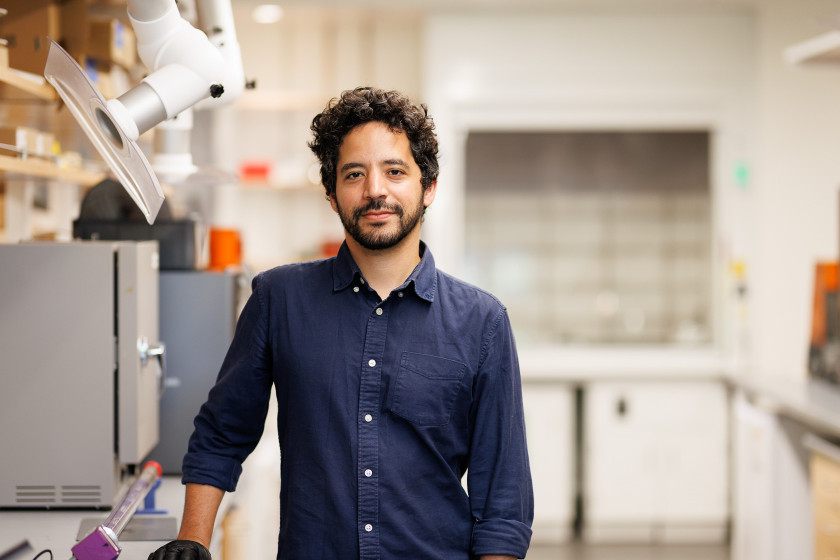
In a paper for Nature, a team led by principal investigator and Rowland fellow Ismail El Baggari describes this innovative tool to examine a material with perplexing behavior at ultracold temperatures: quantum paraelectric SrTiO3, or strontium titanate.
Strontium titanate belongs to a class of materials called paraelectrics, which are closely related to ferroelectrics, the division of materials used, or being explored, for quantum chips that operate at extreme cold. The difference is that ferroelectrics have atoms that shift away from high symmetric positions to form local electric dipoles. When these dipoles line up, the whole crystal macroscopic is given polarizations that can point in specific directions — that is, the material can now conduct electricity. In paraelectrics, no local electric dipoles — hence no permanent, long-range polarizations — exist.
None of this is permanent, however, as paraelectrics can become ferroelectrics — with certain recognizable steps along the way. In a typical paraelectric-to-ferroelectric switch, as the material comes close to the phase transition between para- and ferro-, the materials display local, randomly oriented atomic shifts as the associated dipoles organize into long-range ordered patterns, and the material exhibits strong macroscopic response to an applied voltage. As could be expected, strontium titanate exhibits many of the macroscopic signatures of being close to a ferroelectric transition when held at low temperatures. However, in a twist, it doesn’t transition or become polarized, and instead remains paraelectric, or non-ferroelectric, even when cooled to ultracold: the expected phase transition never happens.
“When a ferroelectric transition happens, it has all these macroscopic experimental signatures, and strontium titanate has those signals,” El Baggari, now a member of the faculty at the University of British Columbia, explained. “It keeps all the macroscopic responses indicating that it’s really, really close to a ferroelectric transition.”
Even as the element was cooled to ultracold temperatures, it never became polarized. “We went all the way to the lowest temperatures we can achieve, and it never happened,” El Baggari said. While this strange stability in strontium titanate was revealed decades ago, the precise structure of its quantum paraelectric behavior at low temperature has remained unknown.
The key breakthrough came from being able to image the material at the hyper-local scale. “Using the transmission electron microscope, we could directly take pictures of the local dipoles at the nanoscale,” El Baggari explained. “The question is whether no dipoles exist in SrTiO3 at all temperatures, or if there are some other structures that we haven’t yet conceptualized.
“Microscopy gives direct pictures,” he added. “And now that we can cool the sample to very cold temperatures, into the quantum paraelectric phase, we can see exactly how the material evolves.”
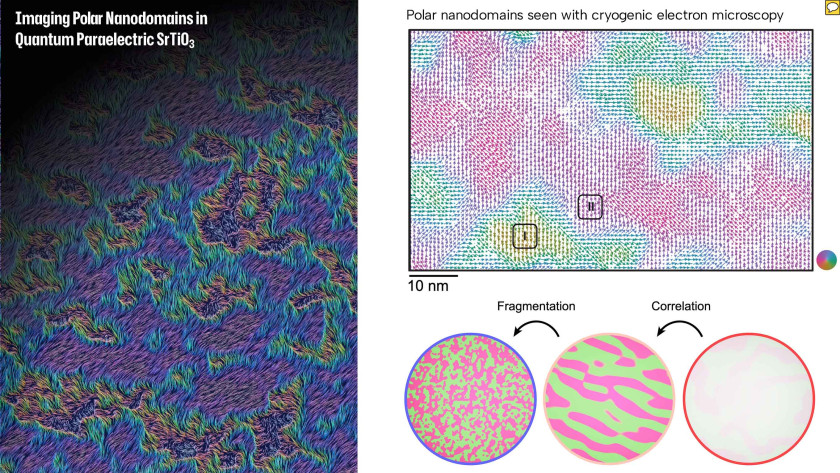
Being able to visualize this for the first time with TEM, El Baggari was surprised that the direction of the dipoles alternated, rather than picking a singular direction. Because these dipoles alternate over such small distances, techniques with sufficient spatial resolution, like TEM, are necessary to detect them.
Uncovering these characteristics required crazy hours, with the team working for three or four days straight every six weeks or so. That was, in part, because the necessary high-level cryogenic microscopy is still being developed, and arranging time on the machinery is difficult.
Add to that a desire to avoid wasting the super-cooling helium, as well as the necessity of watching these experiments constantly, and the result was “super long experiments, where we’re solving all these technical problems,” El Baggari said. “Almost all of the data that we got was taken late at night.”
“Because these are high-resolution microscopes, they use complex electromagnetic lenses, but they also drift a lot,” he continued. “So your sample is moving, your alignments are moving. It was realign and realign and realign and then change the temperature — and then everything would move again.
“It’s a very interactive three or four days. It’s not just press a button and go home.” However, “the team made it fun,” El Baggari added. “We were solving problems left and right constantly while doing science together.”
Moving forward, the researchers hope to discover more about the element’s unique properties in a variety of conditions.
“The exciting next step is to watch the transition happen,” said Yang Zhang, the paper’s lead author, who worked as a postdoctoral fellow in the El Baggari lab. “If we stretch the crystal or introduce chemical dopants,” — a substance used to produce an electrical characteristic — “we can tune strontium titanate toward a ferroelectric state and we hope to directly see how the local dipoles begin to interact, align, and form a long-range polarized state.”
“We’ve barely scratched the surface,” Zhang said. “We don’t yet understand the mechanism of why this material behaves this way.” Being able to image the local structure will be of immense help toward that goal.
Also contributing to this work was Robert Hovden’s team (University of Michigan) and the group led by Pu Yu (Tsinghua University, Beijing).
This research was funded primarily by The Rowland Institute at Harvard and partially by the National Science Foundation, grants 2507716, DMR-2309029, and ECCS-2025158, and the U.S. Department of Energy, DE-SC0024147.

Through the Research Accelerator Challenge, donors raised $100 million for new endowed doctoral fellowships.

Researcher Matthew Nock pioneered the technique of using smartphone technology to survey high-risk adults and adolescents in real time. In a new study, Nock and his team report using the technology to predict 75 percent of suicide attempts in the week before they occurred.

The Hutchins Center for African and African American Research has named its 2026 cohort of W.E.B. Du Bois Medalists, including actress Angela Bassett, humanitarian and soccer legend Didier Drogba, and five-time Grammy-winning singer Mavis Staples.