Eric Moskowitz
Harvard Staff Writer
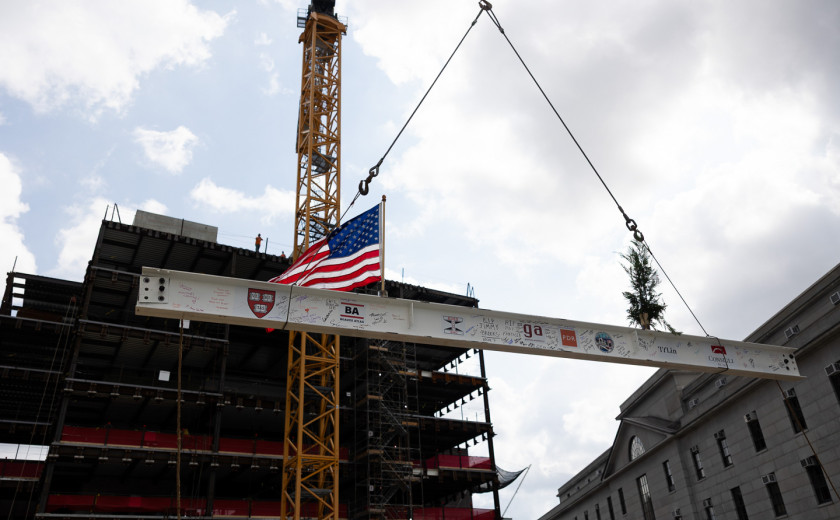
Final beam hoisted into place at the top of the future Pritzker Hall
/ Read time: 3 minutes
Harvard Staff Writer
When laborers were preparing to break ground last year on Pritzker Hall, the future home of Harvard’s economics department, faculty on the construction-facing side of the Littauer Center — the department’s longtime home — worried about the noise. But concerns quickly gave way to delight in the view, as the foundation took shape and the steel climbed skyward.
“None of them were willing to trade for an office on the other side, because they just loved watching it,” said Edward Glaeser, Fred and Eleanor Glimp Professor of Economics, at a recent topping-off celebration to commemorate the placement of the highest beam on the nine-story Pritzker Hall.
At Littauer, construction-gazing has become so popular it’s even caused traffic jams on the central stairway, where the window wall affords a perfect frame on what he called “the hottest show in town.”
“For all of us who work with a laptop, it’s just amazing to see real work being done,” said Glaeser, who began his remarks wearing a Harvard hard hat (“I kind of like pretending”) before doffing the helmet. “It’s amazing to see what actually makes America grow.”
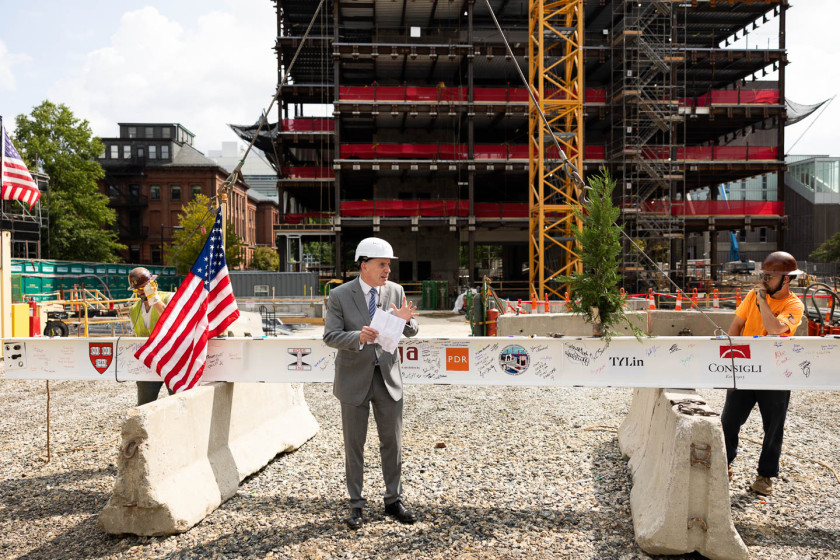
The topping-off ceremony is a construction rite rooted in ancient Scandinavian rituals that has become popular in the United States and parts of Europe.
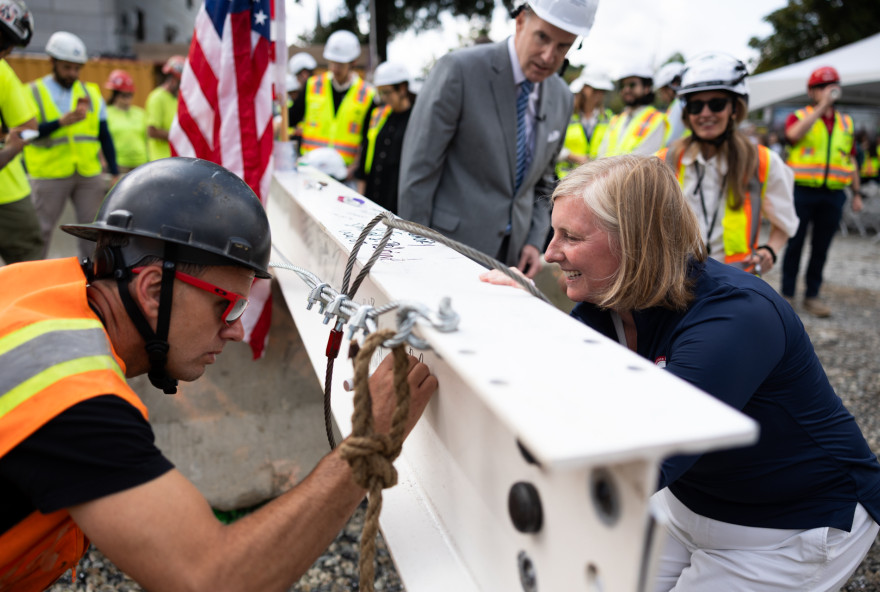
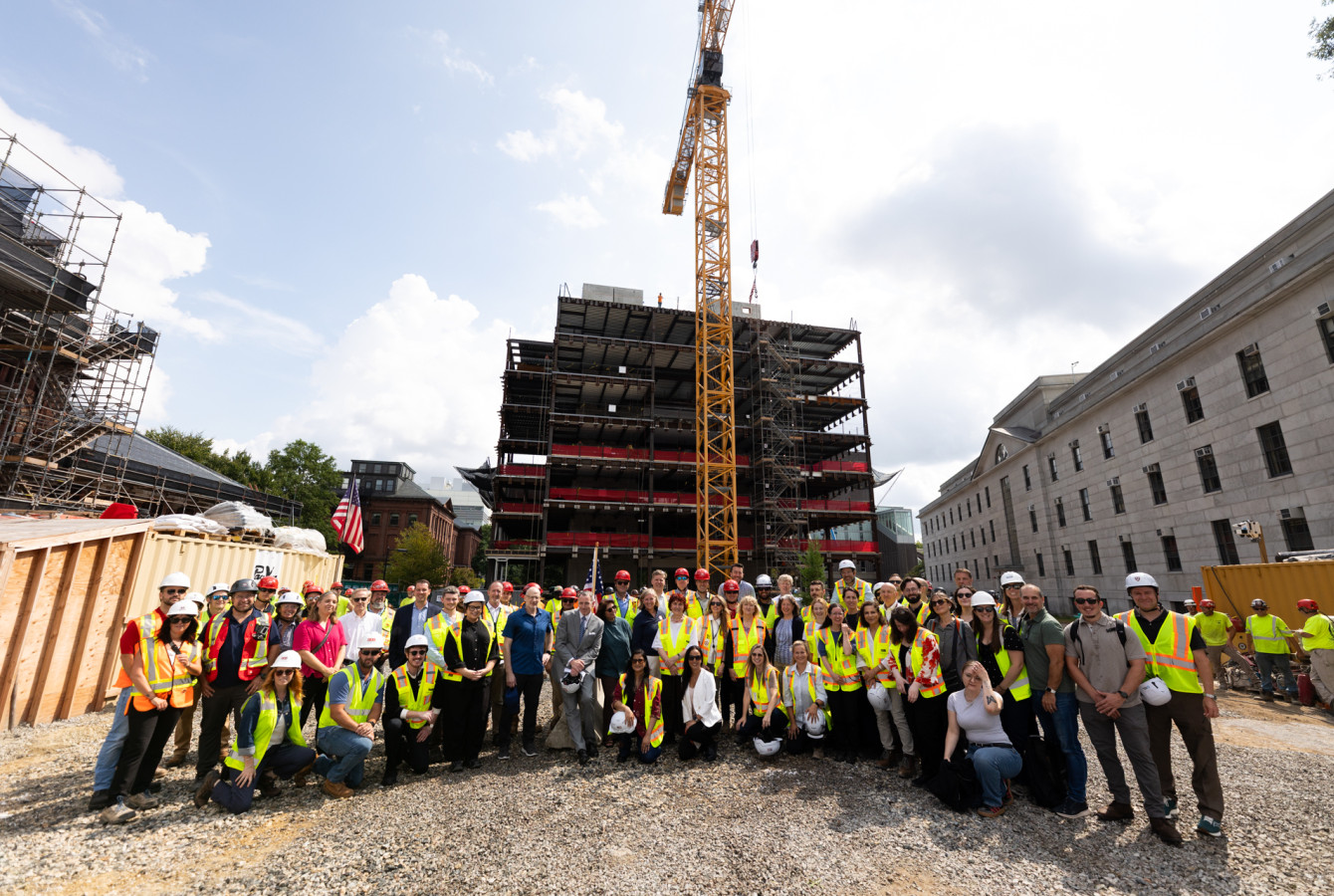
The celebration on August 27 brought together workers from the construction trades along with stakeholders from the University, the Faculty of Arts and Sciences, and the Department of Economics — plus the architecture, design, and engineering teams — all to commemorate the milestone, honor the laborers, and recognize their safety record.
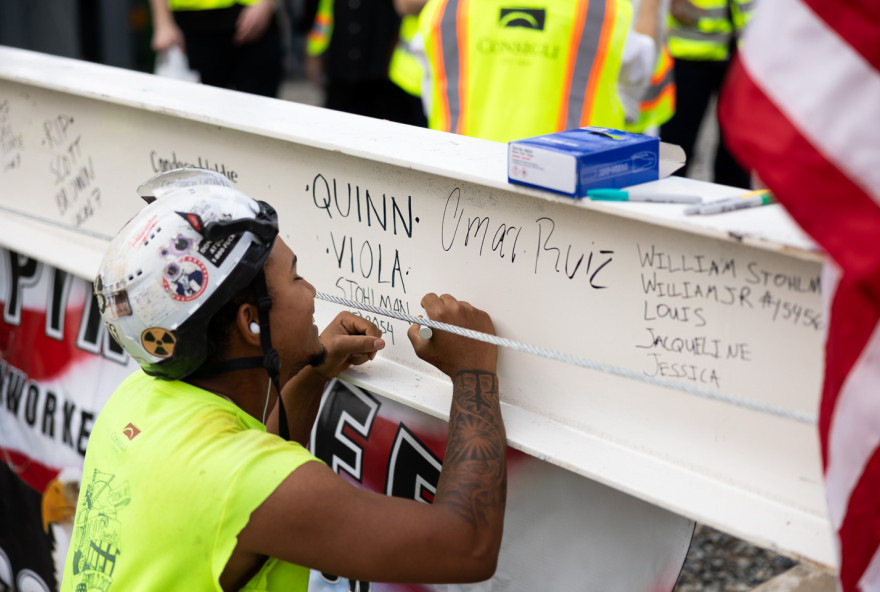
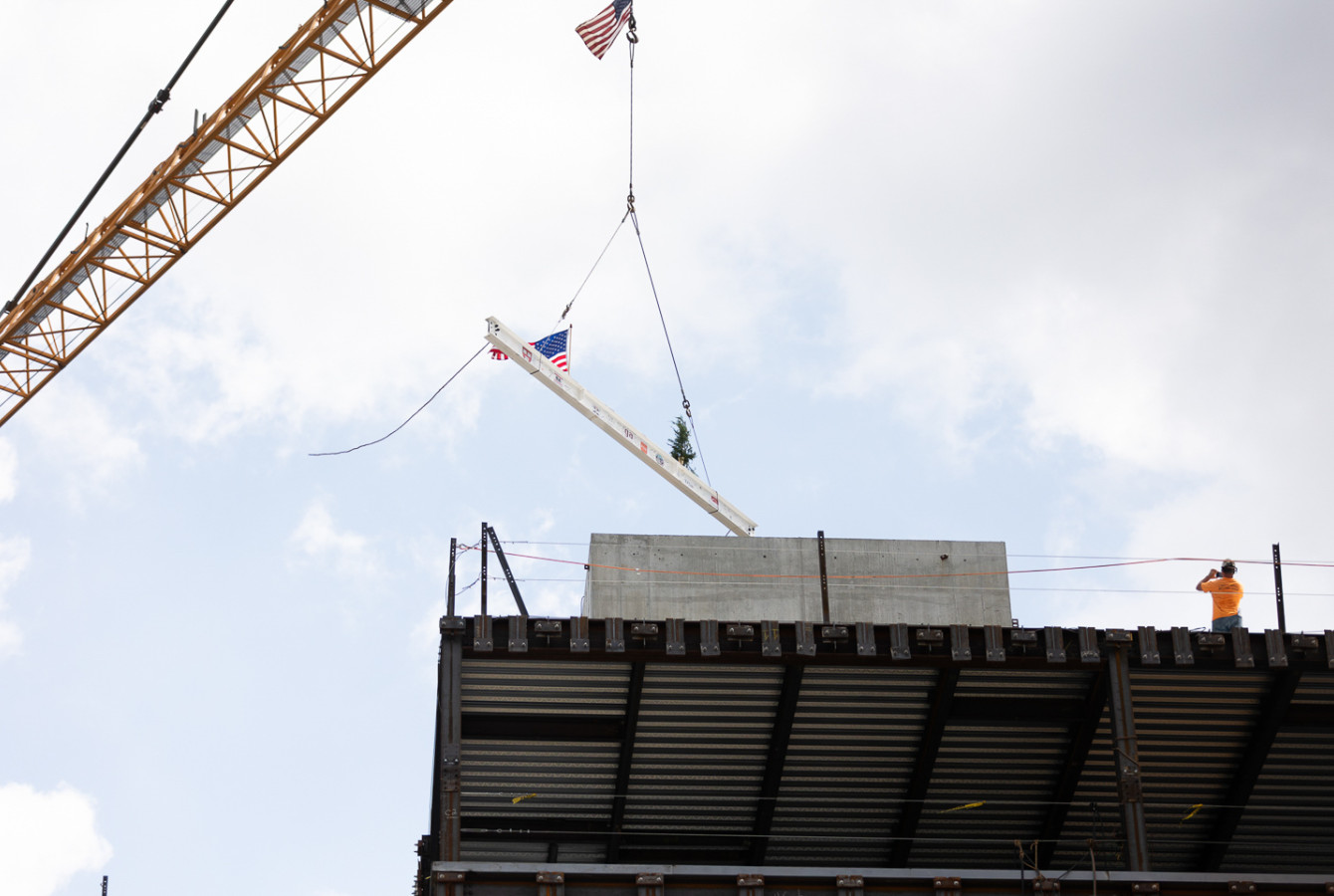
All were invited to sign their names or write a message on the whitewashed beam, which featured decals with the colorful insignias and logos of the various trades, firms, and organizations involved. The beam was topped with an American flag and a small evergreen, a nod to the Scandinavian tradition. Hopi Hoekstra, Edgerley Family Dean of the FAS, thanked the donors who are making the building possible.

The project was set in motion five years ago with a lead $100 million gift from Harvard Corporation Senior Fellow Penny Pritzker ’81, the philanthropist, entrepreneur, and former U.S. secretary of commerce, and her husband, Bryan Traubert, and has been bolstered through additional donations by alumni from a variety of graduating classes.
Mobilization work on-site started in June 2025, with the first steel beam placed this past spring. As of the ceremony, 721 tons of steel had been used to form the structural frame and decking.
Grafton Architects of Ireland designed the building, which is scheduled to open in early 2028. The project is managed by the Harvard Capital Projects group within central administration, on behalf of the FAS.
After the signing, more than 80 people packed in for a photo before the beam. Glaeser spoke, quoting Winston Churchill: “First we shape our buildings; thereafter, our buildings shape us.”
“All of you who are actually working on this building, you’re shaping our lives for the rest of our work lives in this space,” he said. “This building is not just a structure. It’s a machine to enable interactions. It’s a machine to enable teaching. It’s a machine to enable learning. It’s a machine to enable research.”
Glaeser said it would provide an ideal home for the world-class department, with lower-floor lecture halls for undergraduates who are beginning their journey with economics — and upper floors full of seminar rooms and offices to bring faculty and graduate students close together. “This building is not just steel and concrete,” he said. “It is hope for a better economics department. It is hope for a better university, a better commonwealth, a better country, a better world.”
The ironworkers’ “WooHoo!” crew — the team that had hoisted so many beams since the spring, and that named themselves after their preferred heads-up call — stood ready to lift the wire-cradled beam, with a radioman on the ground and two workers up high: a crane operator and a crane oiler, both of them women.
“Let’s hoist the beam!” said Amy Finlayson, associate director for campus growth and redevelopment. Scores of heads — and phones — tilted skyward, tracing the path of the graffitied steel. A barbecue feast followed. In the afternoon, the construction crews resumed work.
Two Harvard scientists describe a way to engineer the evolutionary landscape that viruses experience, pushing them away from dangerous variants and into evolutionary dead ends.

Amid the rhythms of the back-to-campus bustle, new faculty find themselves experiencing the same first-day excitement — and jitters. We dropped in on three, on the first day of their first classes.

As the sun sinks below the horizon, two scientists perch quietly beside a darkening field and wait for flashes of light. They have traveled far outside the city in search of research sites, because they study a group of creatures that have been driven to the margins of human settlements: fireflies.