Kermit Pattison
Harvard Staff Writer
Scientists discover how fruit flies learn while playing with tiny spheres
Harvard Staff Writer

For more than a century, the fruit fly has been a workhorse of the biological sciences that has helped scientists to make fundamental breakthroughs in fields such as genetics and neuroscience.
As it turns out, human scientists are not the only ones learning during these experiments. A recent study by Harvard neuroscientists in Current Biology shows how fruit flies are themselves figuring things out — in this case, how to manipulate balls with “play-like” experimentation.
“Fruit flies are probably much smarter than we thought,” said Kenichi Iwasaki, a postdoctoral scholar at the Rowland Institute and lead author of the study. “Most of us didn't know that fruit flies have this intelligent or physical capacity to manipulate objects. There are several strong signs of learning.”
The new study grew out of previous research that showed how the scientist could direct the movements of fruit flies like “living micro-robots.” In an earlier study published last year in Proceedings of the National Academy of Sciences, the team demonstrated how they made Drosophila melanogaster walk in a path that spelled out “HELLO WORLD” and navigate mazes. Next, they turned to another question: Could they steer the flies to unfamiliar objects and see how they interact?
“This all came out of us just having fun seeing if we could get flies to do something a little bit silly,” said Aleksandr “Sasha” Rayshubskiy, senior author of the two studies who led the research as a fellow at the Rowland Institute. “But we eventually learned that if we guide flies towards a ball, then interesting behavior emerges that people haven't seen yet because no one had this way of guiding them.”
Flies do not naturally seek out objects with no obvious rewards like attractive tastes or odors. But the researchers developed a clever method to guide flies by exploiting their “optomotor response.”
When a fly sees a moving visual stimulus, it reflexively follows in the same direction. The scientists projected a rotating “pinwheel” of alternating blue and black stripes centered on the fly. When the pinwheel rotated clockwise, the fly turned right; when the pinwheel spun counterclockwise, the fly turned left. Rayshubskiy described the technique as a “steering wheel in the fly's head.”
“They are born with a lot of the functions that you would want in a robot,” he said. “They can walk, fly, and search for food. And they’re easy to make.”
Better yet, Drosophila has been intensely studied since the early 1900s so researchers had detailed knowledge of its biology, including its full genome and a wiring diagram of its brain. Consequently, they could peep inside the fly’s neurological system as it encountered a novel object — in this case a mini gym ball almost as wide as the fly’s length and 10 times heavier.
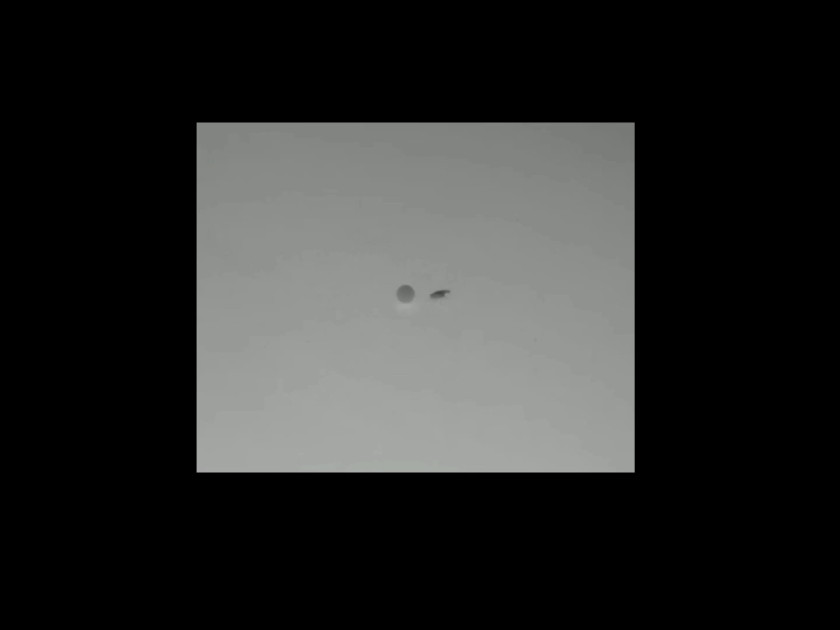
At first, the flies showed little interest, but after repeated exposure they apparently decided to play ball.
“Flies started to grab the ball rather aggressively and manipulate it in such dexterous ways that had not been previously reported,” said Iwasaki. “It turns out that flies love to grab a plastic ball with their forelimbs and ‘throw’ it using their whole body.”
To their astonishment, scientists saw the flies perform other acrobatic moves such as jumping on and off balls. They found flies performed five behavior “motifs” such as the “ball walk,” in which they rolled the balls by walking on top or along the sides. In all, researchers observed nearly 30,000 ball interactions by 48 male flies.
“The flies weren’t just manipulating a ball: they were learning something important about the object while moving it around,” said Iwasaki. “The flies were, in fact, learning the physical properties of the ball and changing their behavior toward it.”
Over time, the flies developed a marked preference for immobile balls over mobile ones, apparently because they valued stability.
“Over and over again, we saw the same thing — flies learned to prefer the ball that does not move,” said Rayshubskiy. He called it “a vivid demonstration of ‘learning by doing’ in a minimal nervous system.”

Next, the scientists sought to understand what parts of the fly brains controlled this behavior. They pinpointed a type of neurons called H-Delta cells in the “central complex” of the fly brain. When the researchers silenced those neurons, the learned preferences were reduced significantly.
The study marks the first time these well-known model organisms have been documented doing this kind of behavior — literally learning on the fly.
As the authors wrote, “even small insect brains are capable of structured learning and adaptive exploration.”
“This study may have the potential to change people's perception about how intelligent fruit flies are,” said Iwasaki. “Some people think fruit flies may not be as ‘smart’ as other animals. But if they look at the videos and see how dynamic the interactions are, that could change how people think about what these small insects are actually capable of.”
Kenichi Iwasaki, Sena Kawano, Ashnu Cassod, Charles Neuhauser, and Aleksandr Rayshubskiy, Current Biology 35, no. 22 (2025): 5475–89.e4.
Kenichi Iwasaki, Charles Neuhauser, Chris Stokes, and Aleksandr Rayshubskiy, Proceedings of the National Academy of Science [PNAS] 122, no. 15 (2025): e2426180122.

Harvard geoscientists reported that organic matter harvested from certain meteorites bears chemical traces of “primitive oxygen reservoirs” that have changed little since the birth of our solar system. The findings help trace the origins of organic matter that meteorites may have delivered to a young Earth, supplying the planet with ingredients essential for life.

Singer Mavis Staples, actress Angela Bassett, and soccer star Didier Drogba were among the honorees presented with W.E.B. Du Bois Medals Thursday at Sanders Theatre. The annual ceremony, hosted by the Hutchins Center for African & African American Research, recognizes outstanding contributions to Black history and culture.

“We will keep working at it until we get it right,” the FAS dean said.