Kermit Pattison
Harvard Staff Writer
Center for Astrophysics scientists retrace development nearly 60 million light years away
Harvard Staff Writer
Harvard astrophysicists have developed a novel technique of “chemical archaeology” to reconstruct the formation of distant galaxies over billions of years.
“It's an entirely new method of tracking the history of galaxies outside our Milky Way,” said Lisa Kewley, director of the Harvard-Smithsonian Center for Astrophysics, Professor of Astronomy, and lead author of the new study.
In a paper recently published in Nature Astronomy, an international team of 11 scientists described how they extracted “fossil records” of oxygen from optical data obtained by powerful telescopes. They retraced the 12 billion-year history of a spiral galaxy 56 million light years away from Earth — the first application of these methods outside our home galaxy.
“When we look at galaxies, we are seeing them at just one instant in time,” said Lars Hernquist, Mallinckrodt Professor of Astrophysics and co-author of the new paper. “Reconstructing their past history is difficult, but the paper shows how this might be possible by combining observations of the chemical composition of a galaxy with detailed numerical simulations.”
The new technique exploits oxygen as an archival record.
In astronomical terminology, all elements heavier than helium are called “metals,” even those in gaseous form. In the Big Bang, only hydrogen and helium (plus a trace of lithium) were created, and the remaining elements formed in subsequent stellar processes.
The abundance of metals in the interstellar medium — termed the “metallicity” — provides a measure of galactic evolution. The new study focused on oxygen, which is produced by nuclear fusion in stars. Its abundance provides clues about the histories of star formation and galaxies.
In the new technique, light from the galaxy is captured by a telescope and then is split into spectra of colors for every pixel. The optical wavelengths provide indicators of gases at each location.
“We can make a map of oxygen,” said Kewley. “We can make a map of hydrogen, nitrogen, sulfur, and all the lines that we see in the spectrum across the whole galaxy. The resolution is unprecedented — it’s 10 times more than we’ve ever been able to do in the past.”
With this information, researchers reconstructed a “metallicity gradient” showing the variation in oxygen abundance radiating from the center of the galaxy.
The study combined three-dimensional spectroscopy with high-resolution simulations produced by the Illustris Project. The data was collected by the Las Campanas Observatory in Chile as part of the TYPHOON survey and processed with technique called the Progressive Integral Step Method (PrISM).
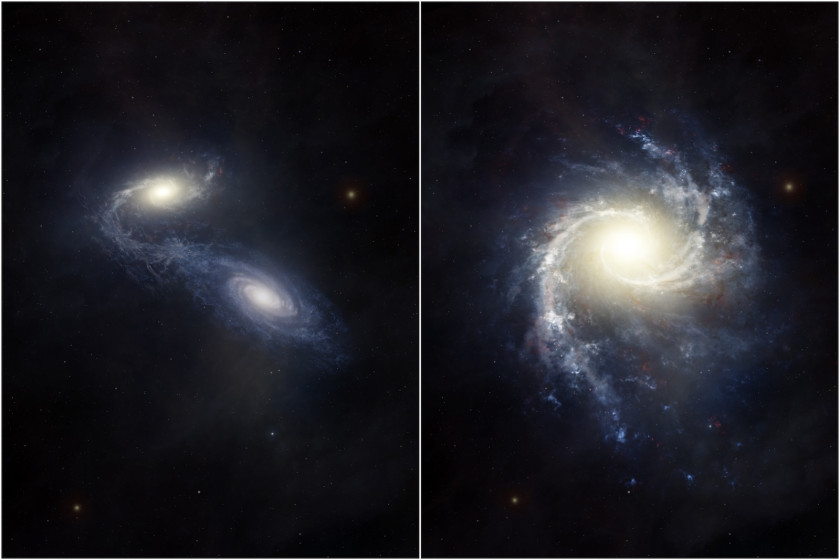
The researchers used these methods to examine a “face-on” spiral galaxy called NGC 1365, which is located in the constellation Fornax. This so-called “double-barred spiral galaxy” is one of the largest known to astronomers and estimated to be about twice the size of the Milky Way. A beam of light would require more than 200,000 years to travel across it.
The researchers examined about 20,000 simulations produced by the Illustris TNG project and found one that closely matched the metallicity gradient and stellar mass of NGC 1365. They used this simulation to infer the galaxy’s probable history of mergers and growth.
The study found that NGC 1365 had a metallicity gradient with three distinct zones representing different phases of history. It began as a small galaxy some 12 billion years ago through multiple mergers with smaller “dwarf galaxies.” The outer spiral arms of the galaxy likely formed relatively late in the last several billion years.
According to Kewley, these findings support the theory that galaxies formed "inside out,” beginning small and growing over time through the infall of more small spiral galaxies and other materials. It suggests that spiral galaxies took shape by multiple collisions over time.
“This paper shows how observations and simulations used together can tell us about the past history of galaxies outside the Milky Way,” said Hernquist. “Because the method is general in its applicability, it should be possible to apply it to other galaxies in the future.”

The Harvard theoretical physicist and neuroscientist has won the Dirac Medal and Prize, one of the highest honors in physics.

Deep in the woods of Petersham, Mass., the Harvard Forest Summer Research Program in Ecology is cultivating a renewable resource — future generations of scientists.

Forget about the ancient Greek myth of Icarus. For the last 10 years, Jenna Samra, Ph.D. ’18, and her colleagues have been pushing technology to fly closer to the hottest part of the sun. Samra, an astrophysicist at the Center for Astrophysics, an institution jointly run by Harvard and the Smithsonian, leads a scientific quest to study the solar corona.