Eric Moskowitz
Harvard Staff Writer
“Well, what does one do now?” David Bakalar ’47 asked, grinning, at a recent reception
/ Read time: 6 minutes
Harvard Staff Writer

When David Bakalar first set foot at Harvard, he was a 17-year-old child of immigrants commuting by bus from Lynn, his $500 “nonresident scholarship” covering tuition and a study space at Leverett House but not room and board. A high-school chess champion who had scarcely heard of Harvard before a teacher encouraged him to apply, Bakalar had $50 to his name, saved from working nights at one of the nation’s first drive-in theaters.
That was 1942. On a recent summer afternoon, Bakalar ’47, M.S. ’48, returned to campus at 101, arriving at the Science Center for a celebration in his honor.
A lot had transpired in between. He witnessed the Japanese surrender at Tokyo Bay as a Navy radar technician, served as a technical consultant to the Marshall Plan as a newly minted Ph.D., and worked on an invention called the transistor at Bell Labs, down the hall from future Nobel laureate William Shockley. Then he started the pioneering semiconductor firm Transitron, growing a shoestring startup into a Wall Street darling of the postwar high-tech boom, while hiring young engineers who went on to build such companies as Intel and Teradyne.
Drawn to the arts initially as a collector and philanthropist, Bakalar, along with his wife, Sandra, donated the monumental Henry Moore bronze that greets visitors to the southeast corner of Harvard Yard, near Lamont Library, in 1981. Brimming with ideas, Bakalar plunged into artmaking himself in retirement and wound up becoming a noted sculptor, with dozens of works installed on academic, corporate, and museum campuses around the world, from Israel’s Technion to MIT and the Longy School of Music in Cambridge.
Smitten with the movies since childhood, he also tried his hand at filmmaking, conceiving of an uplifting romantic comedy set in New Bedford, hiring screenwriters and a director to execute his vision, and paying to produce an indie film called “Passionada” — starring Jason Isaacs and Emmy Rossum — a five-year adventure that yielded a Columbia Tristar deal and positive reviews, if not box-office returns.
But all of that was only the backdrop for the June 23 gathering, which celebrated another artistic outlet that Bakalar has embraced in his four-decade retirement: painting, which he dabbled in for years before taking it up more seriously in his 90s. Three large-scale, semi-abstract canvases from his “Brain Series” now hang in the lobby of the Science Center, recently renamed Zimmer Hall. They will remain on display there through the end of 2026, before moving to Lehman Hall, home to the Student Center at the Harvard Kenneth C. Griffin Graduate School of Arts and Sciences.
The mixed-media and acrylic works — two 80-by-40-inch paintings and one 80-by-60 — evoke the synapses of the brain while drawing inspiration from E = mc2, Albert Einstein’s landmark mass-energy equivalence formula.
“I love this, because it shows his creativity at the intersection of art and science,” said Brenda Tindal, chief campus curator for the Faculty of Arts and Sciences and executive director of the FAS Office of Academic Culture and Community. “I’m often thinking about ethos — like, what is the spirit of a particular place? — to really ensure that the artwork is in alignment with the mission or theme of the space, and this felt like such a perfect match.”
Tindal, who curates 11 million square feet of space for the FAS, facilitated the gift through Bakalar’s son Steven ’82. She first admired his father’s 20-painting “Brain Series” online before seeing them firsthand on a visit to David Bakalar’s Chestnut Hill home and studio.
Guests at the reception included family, friends, and Harvard administrators and staff. Janet Daniels, director of the Student Center at Harvard Griffin GSAS, said the paintings — “big, geometric, colorful, and abstract” — will be a perfect fit for Lehman, a cross-disciplinary social, intellectual, and recreational space for graduate students. “Not only because they were made by one of our former students — I love the idea of art for our students, by our students — but also because they represent how our students are constantly challenging ideas and making discoveries,” Daniels said.
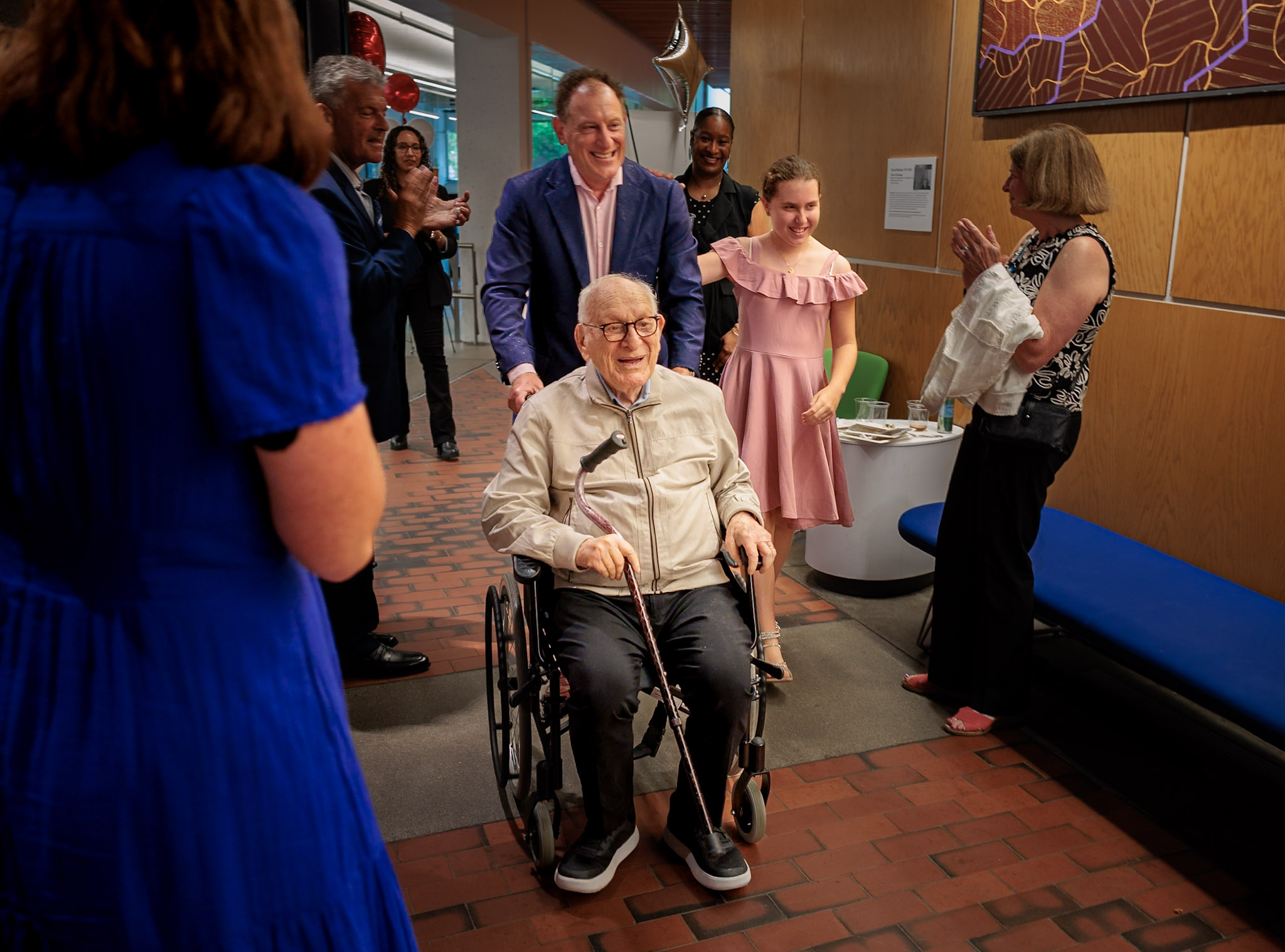
Soon, Bakalar arrived. “The man of the hour is here!” Tindal announced.
“These are all your pieces, Dad,” his son Steven said. Bakalar took in the scene, wide-eyed.
“Well, what does one do now?” the centenarian said, grinning.
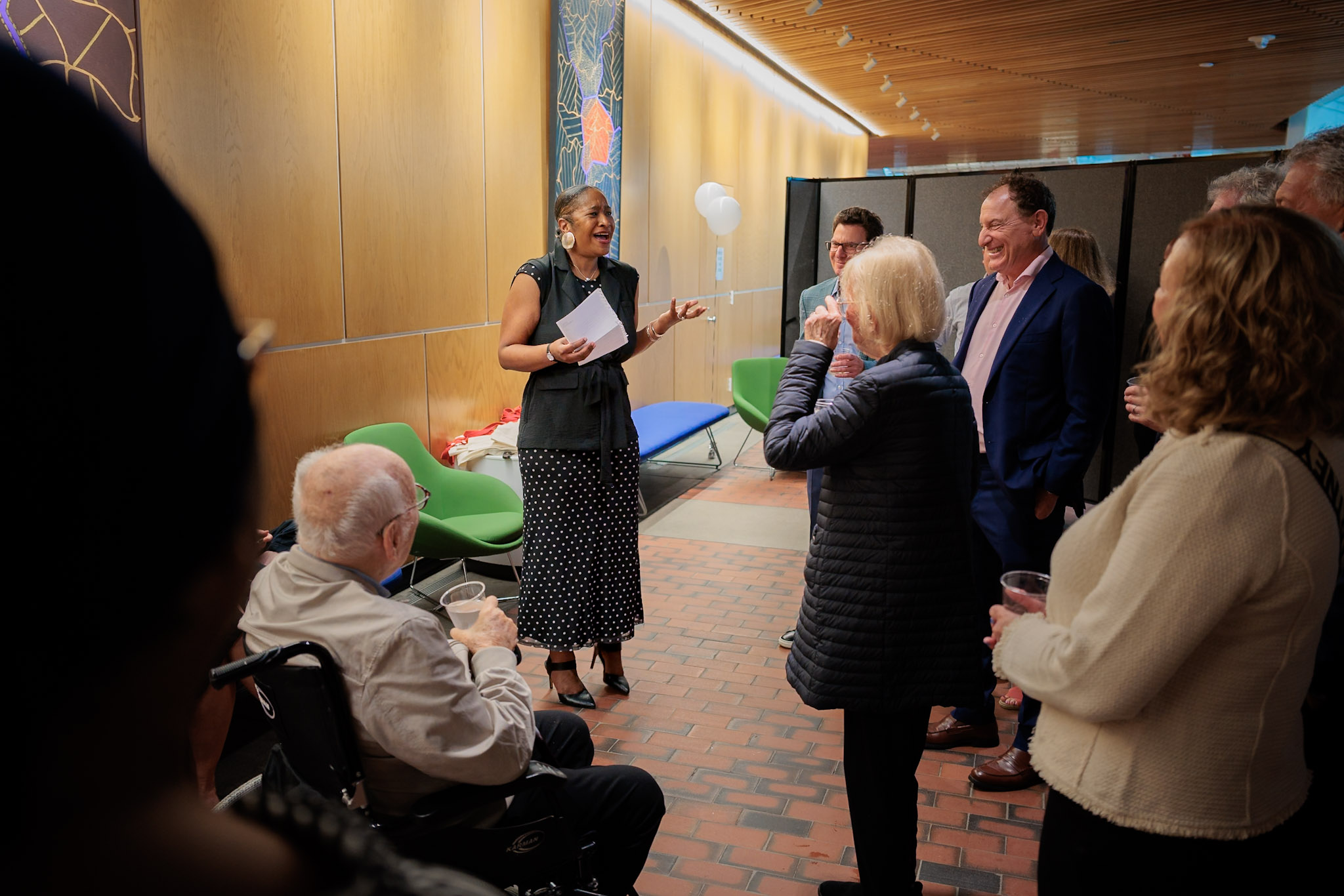
Tindal proposed a toast, expressing gratitude for “all that you’ve done for Harvard, and all that your work will continue to do to inspire discovery and creative expression.” When she referred to Bakalar’s “ingenuity and your creative genius,” he shook his head.
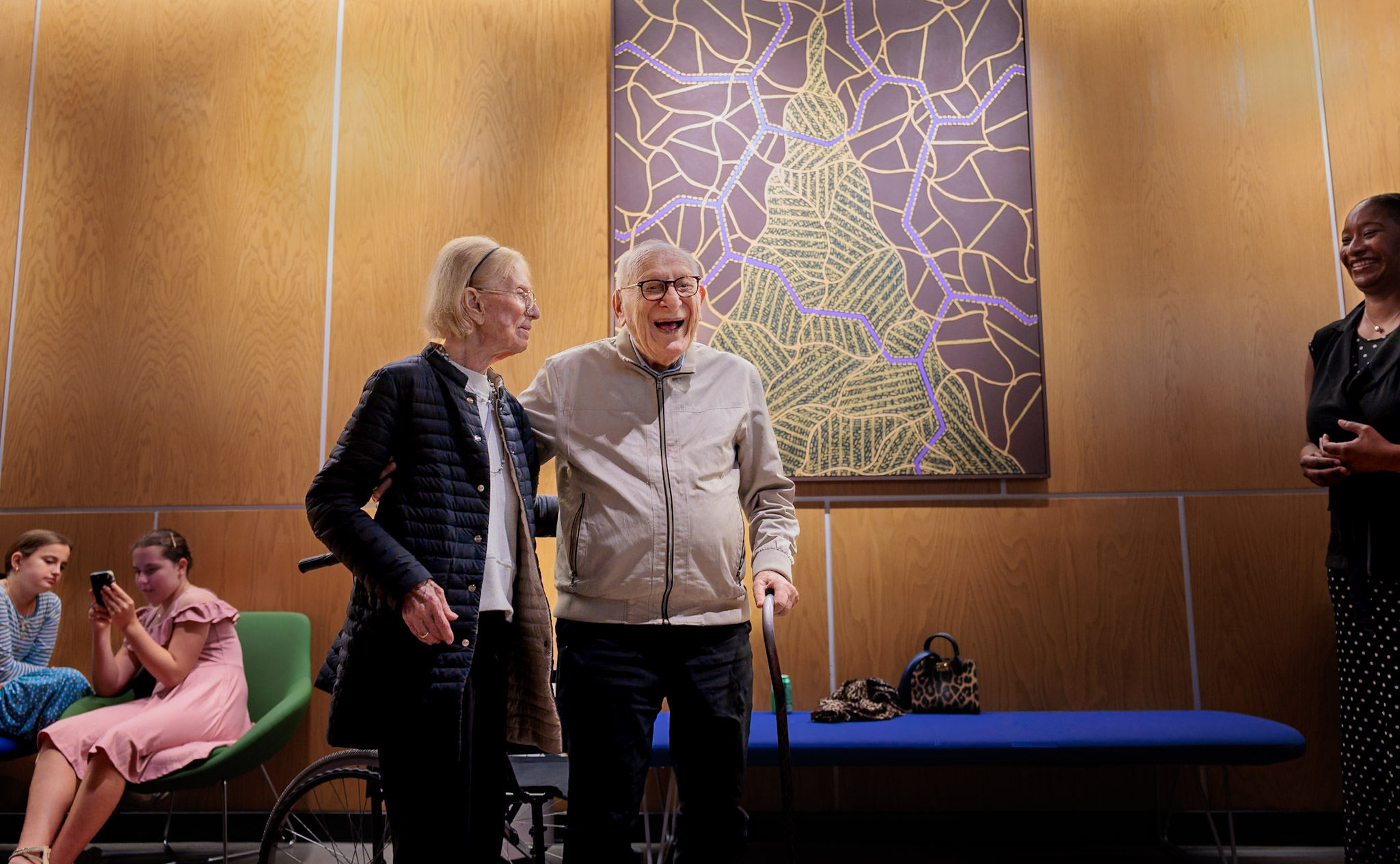
Then it was his turn. Rising from his wheelchair, Bakalar stood before the central painting and delivered a self-deprecating assessment of his own handiwork — “I didn’t think these were my best,” he said, chuckling — and the broader artistic challenge of translating to canvas “the famous equation by Einstein that changed the world.” But he was unambiguous when it came to gratitude for his education.
“Harvard gave me my life,” said Bakalar, who was born in Chelsea in 1924 to an immigrant Jewish family from Motal, a village variously part of Poland, Lithuania, Russia, and now Belarus. After his father died of a heart attack in 1929, his mother and older brother kept the family afloat.
Growing up, he had little exposure to the arts — or to life beyond the North Shore. “I was just hoping to be able to get to a college and learn something,” said Bakalar, with a warm, warbly voice and working-class Boston accent. “What’d I know?”
With World War II raging in Europe and the Pacific, he crammed three years of study into two before enlisting in the Navy, assigned to the USS South Dakota. He was aboard that battleship on September 2, 1945, when it anchored beside the Missouri in Tokyo Harbor for Japan’s formal surrender, affording a view of the proceedings.
At Zimmer Hall, he recounted a lesson from that moment. Ever since Pearl Harbor, he had consumed a media diet about the supposedly fanatical nature of Japanese soldiers. Granted shore leave in those first days of peace, Bakalar and other sailors entered Tokyo with trepidation, seeing Japanese soldiers still in uniform lining the wharf, shouting at the Americans. Worried that they were walking into a trap, Bakalar and his mates soon made out the word shigaretto! — and discovered the Japanese servicemen wanted to trade souvenirs for cigarette rations.
The lesson? Don’t believe everything you read, he said, and be “open to new experiences.”
Bakalar, who returned to campus on the GI Bill to finish his undergraduate degree and then earn a master’s in physics, offered a good-humored apology at the party for having next “abandoned Harvard” for a doctorate in physical metallurgy at MIT. “Either one is world-class,” he said, “turning out people who keep their eyes open and their minds open.”
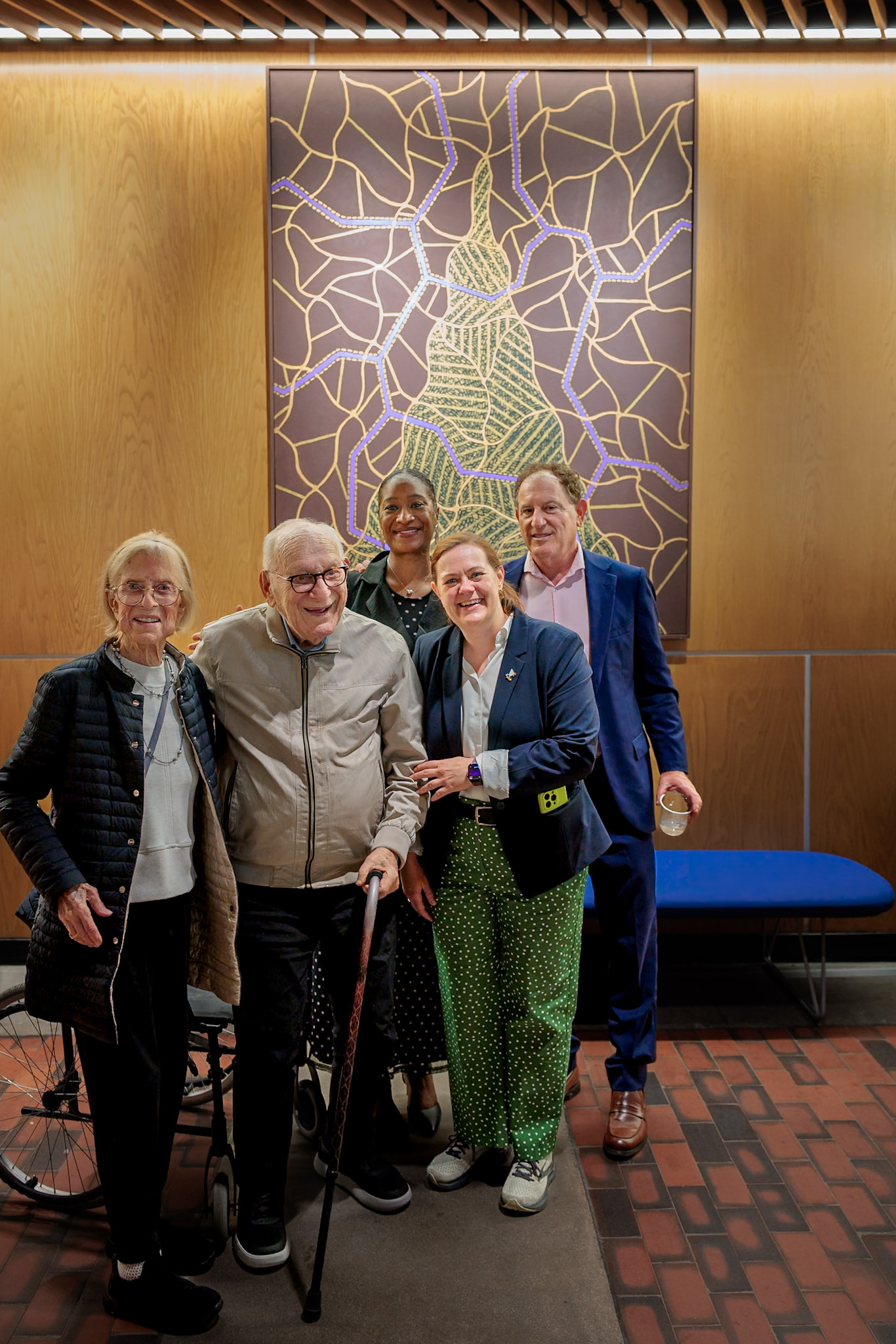
Posing for photos with Tindal and Daniels, Bakalar raised his cane and pointed it impishly at the camera. “It’s a wonderful experience to get older and be exposed to these positive things in the arts and sciences,” he said, “and I think it’s never-ending.”

The first-of-its-kind discovery is expected to set off a search for signs of life.

After a series of temporary belt-tightening measures were introduced to give the FAS flexibility to respond to financial turmoil from Washington, the administration prepares to make longer-term changes to address a significant structural deficit.

An earthquake alert system mines data from billions of Android phones, the most common smartphone in the world, and easily the most popular in less wealthy nations.