Clea Simon
Harvard Correspondent

Earth and planetary science professor Mostafa Mousavi on the earthquake warning technology he co-created with Google scientists
Harvard Correspondent
When two powerful earthquakes hit Venezuela two weeks ago — one with a magnitude of 7.2 and the second of 7.5, the most powerful to hit the country since 1900 — millions were endangered, and more than 2,000 were killed. But some, perhaps several hundred people, were saved. Their Android phones alerted them to the quakes a few seconds to two minutes before they hit full power, thanks to an innovative technology born of a team of engineers and researchers that includes new Earth and Planetary Sciences assistant professor S. Mostafa Mousavi.
The 11.4 million alerts that went out to phones in the earthquake-affected area as part of the Android Earthquake Alert System (AEA) relied on an existing technology built into most smartphones called an accelerometer, which senses when a phone is moved or shaken. Although it has been employed in a variety of uses, from measuring a user’s daily steps to detecting severe automobile accidents, the technology was originally designed for a much simpler purpose: making sure that the image on a phone appeared right-side up, whether the user was holding the phone horizontally, vertically, or even upside-down.
“The main objective for putting the accelerometer on the phone was to detect the orientation of the phone and present a landscape or portrait view on the smartphone screen,” explained Mousavi. “But we can use the same sensor for detecting earthquake signals as well.”
The accelerometers in phones are tiny sensors built using microelectromechanical systems (MEMS) technology. While MEMS sensors in phones are less sensitive than those in actual seismographs, “they can do a similar thing, sensing the shaking of the ground,” said Mousavi. “They need to be cheap enough so they don’t make your devices too expensive, but they are still sensitive enough to record nearby earthquakes. Almost any earthquake that humans can feel this phone can also record.”
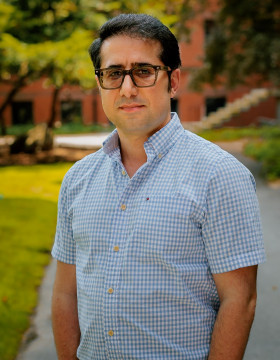
Assistant Professor of Earth and Planetary Sciences
S. Mostafa Mousavi is an observational earthquake seismologist who uses AI to process large seismic datasets and gain insights into earthquake characteristics and dynamics.
Full profile
The AEA system functions by compiling data from the accelerometers of billions of Android smartphones to create a global seismic network capable of real-time earthquake signal detection and low-latency alert transmission (milliseconds) via the web. The system’s effectiveness in detecting earthquakes relies on the spatial distribution of active phones and the impact of noise generated by human activity during the seismic event. The detection methodology relies on the fundamental principles of seismic waveform propagation. Basically, earthquakes send out two different kinds of waves. P — or primary — waves, come out first and travel faster but are less likely to cause damage. They are followed by S — or secondary — waves, which follow more slowly and are stronger, capable of causing more damage. Central back-end servers aggregate smartphone triggers from P- and S-wave arrivals to categorize them as seismic events, determine the quake’s source location and calculate its magnitude, Mousavi said.
After characterizing an earthquake source, the AEA then sends alerts to phones in areas expected to experience ground shaking exceeding three specific intensity levels. The first is shaking that may be perceptible but will likely not cause harm. The second is stronger and warns the users to be ready for ground shaking. The third alert is issued for the areas that are highly likely to experience moderate to severe shaking “that has some potential for minor to severe damage to the buildings,” explained Mousavi. One million four hundred thousand alerts of this type, which ask the user to take a protective action such as “drop, cover, and hold on,” were sent to users’ phones in Venezuela on June 24.
Timely processing of noisy data from thousands of phones to accurately detect an earthquake and estimate its source properties (i.e., hypocenter and magnitude) involve some difficult scientific and engineering challenges, Mousavi said. Beginning around 2019, these were first tackled by Mousavi and the AEA team at Google (and chronicled in Science last year), which included researchers Richard Allen, Patrick Robertson, Marc Stogaitis, Alexei Barski, Robert Bosch, Youngmin Cho, Steve Malkos, Boone Spooner, Nivetha Thirusverahan, and Greg Wimpey.
Firstly, earthquakes had to be distinguished from non-earthquake seismic events such as thunderstorms and associated thunder (sound waves) that could similarly shake many phones across a large area. “The art was to look at many phones collectively and distinguish between different types of events based on the physics of wave propagation and patterns of triggered phones,” said Mousavi.
Once a pattern recognizable as an earthquake was identified, other questions arose: What is the size of the earthquake? How strong is the shaking, and how far does it go? Where is the area where it might cause harm?
To add a complication, these computations needed to be done in fractions of a second in order to issue a useful alert, giving people in affected areas time to rush out of a building or seek a safe shelter. “We always say that this is a competition between alerting and the arrival of ground shaking,” said Mousavi. In practice, that meant pitting “the computation and transmitting the alerts in speed of light versus the speed of the propagation of strong seismic waves, which is around three to 3.5 kilometers per second.”
Then, the team had to scale the work to function on a global scale. Launched in 2021, AEA is now functional in nearly 100 countries covering 2.5 billion people. It detects an average of 312 earthquakes and issues an average of 18 million alerts per month. “The system processes billions of records every day to detect and alerts for hazardous earthquakes wherever there are people,” said Mousavi.
Android’s operating system is run by Google, which explains some of the focus on these phones. But the technology utilized Androids for other reasons as well, Mousavi said. Not only do these phones make up 70 percent of smartphones use, but the majority are in developing or less wealthy countries. (In the United States and a few more developed countries such as Japan and South Korea, government-operated early warning systems are in place.)
Although this technology is already saving lives, as can be seen in multiple recent social media posts and media reports, the team is still working. “There is still room for improvement in some key areas,” said Mousavi, pointing to efforts to make the alerts faster and more precise.
“Rapid estimation of the earthquake magnitude is very challenging because it’s an ongoing process,” he added. “Earthquakes start on a fault. It takes some time for the fault to rupture fully, and until that rupture is complete, it is difficult to estimate the final magnitude of the earthquake precisely.
“All of this research that we are doing in earthquake seismology is to understand earthquakes better, but the end goal is to save lives and help people,” said Mousavi. “This was proof that the system works, so the whole team was very happy.”

Harvard geoscientists reported that organic matter harvested from certain meteorites bears chemical traces of “primitive oxygen reservoirs” that have changed little since the birth of our solar system. The findings help trace the origins of organic matter that meteorites may have delivered to a young Earth, supplying the planet with ingredients essential for life.

Singer Mavis Staples, actress Angela Bassett, and soccer star Didier Drogba were among the honorees presented with W.E.B. Du Bois Medals Thursday at Sanders Theatre. The annual ceremony, hosted by the Hutchins Center for African & African American Research, recognizes outstanding contributions to Black history and culture.

“We will keep working at it until we get it right,” the FAS dean said.