Kermit Pattison
Harvard Staff Writer

Designed by Harvard–Smithsonian astrophysicists, a new $5.4 million instrument will advance understanding of the solar corona and “space weather”
/ Read time: 9 minutes
Harvard Staff Writer
Forget about the ancient Greek myth of Icarus. For the last 10 years, Jenna Samra, Ph.D. ’18, and her colleagues have been pushing technology to fly closer to the hottest part of the sun.
Samra, an astrophysicist at the Center for Astrophysics, an institution jointly run by Harvard and the Smithsonian, leads a scientific quest to study the solar corona: the outer ring of the sun that is responsible for the “space weather” that sometimes disrupts global communications and electrical networks. The corona also happens to be notoriously difficult to study due to the blinding brightness of the sun.
Until recently, the best opportunity to measure it came during a rare total solar eclipse.
Three times during the last decade, Samra and her team of researchers have flown in a jet outfitted with specialized instrumentation while chasing eclipses 50,000 feet above the Earth. With the brightest part of the sun blocked, they took advantage of these brief opportunities to measure the mysterious swirling atmosphere of the corona.
Now the team is preparing a new mission that will take their instruments twice as high — without being limited to the fleeting moments when the moon and sun are in alignment. They have designed a new infrared-sensing device that will be lifted more than 20 miles above the Earth by a giant balloon.
“There’s a reason that almost nobody measures the corona this far into the infrared spectrum,” Samra said. “The instrumentation is really difficult.”
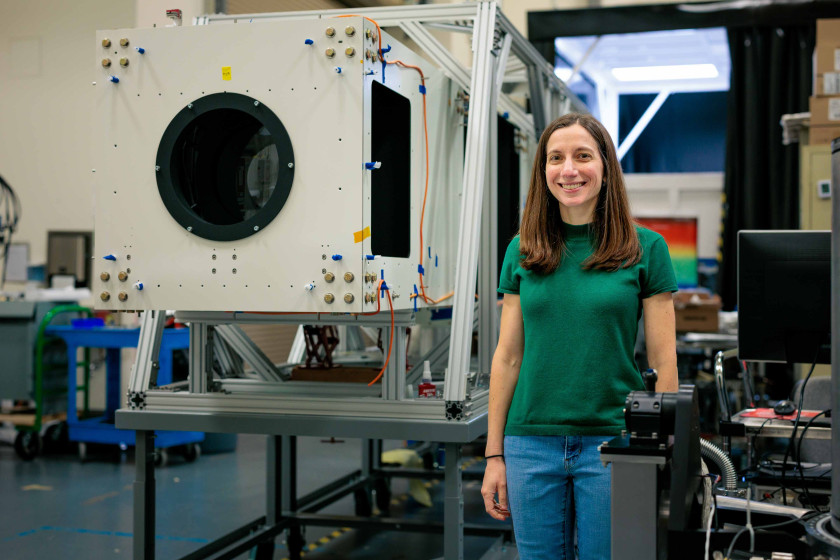
Samra and her 15-person team at the Center for Astrophysics (CfA) have spent the last few weeks in final preparations for the first test flight of CORSAIR, or the Coronal Spectropolarimeter for Airborne Infrared Research. The $5.4 million instrument shipped out of their lab on July 19 and will make its first test flight aboard a NASA-operated balloon in September.
“We’re really making progress by the minute, but we are up against a hard deadline,” Samra explained one recent morning at the Smithsonian Astrophysical Observatory labs, located in Cambridge near Alewife station. “The campaign is in September because that’s when the stratospheric winds allow a flight, so we can’t miss that window.”
The corona is the outermost part of the sun’s atmosphere. It is much hotter than the surface of the sun and much less dense. Its magnetic field causes charged particles to form swirling loops, streamers, and plumes — the distinctive crownlike features that give the corona its name.
Streams of charged particles sometimes escape the sun’s gravity in a phenomenon known as “solar wind” that contributes to aurora (northern and southern lights) at the poles of the Earth. In extreme cases, coronal “mass ejections” can cause geomagnetic storms. In space weather, the former is comparable to a steady breeze and the latter to a hurricane.
The biggest space weather event on record occurred in 1859, when a solar flare was powerful enough to be seen with the naked eye. A mass ejection from the solar corona collided with the Earth’s magnetosphere and ignited a geomagnetic storm known as the Carrington Event. Northern and southern lights flashed in skies across the globe. Utility wires spontaneously burst into flames. Telegraph systems disconnected their batteries, yet still could communicate because the lines remained powered by electrical currents in the atmosphere.
Back in the mid-19th century, communication and electrical networks remained in their infancy. In a modern technological society, such an occurrence could cripple satellites, telephones, radio and television systems, and power grids.
“This beautiful, glowing orb that gives us so much is also a self-sustained thermonuclear explosion that we happen to orbit,” said Chad Madsen, an astrophysicist at the CfA and project scientist for CORSAIR. “The sun has a bit of a violent side, to say the least, which can have some serious effects here on Earth with space weather. The more we understand the fundamental processes of the sun, the better we can predict it and protect ourselves.”
The new device will help do just that.
Scientists believe that the sun’s magnetic field generates the structure and heat of the corona. But these forces are difficult to measure. There is no way to fly a magnetometer through the whole corona at once, so scientists must use the corona’s light to make inferences about its magnetic field.
These challenges have occupied Samra for the last decade. Trained as an electrical engineer, she worked on optical instruments at MIT Lincoln Lab before coming to Harvard to complete a doctorate in applied physics. As a graduate student, she volunteered for a research mission on the corona, which became the subject of her dissertation and the focus of her work ever since.
During solar eclipses in 2017, 2019, and 2024, she and other researchers flew aboard a plane owned by the National Science Foundation and operated by the National Center for Atmospheric Research. It was fitted with a mirror that moved a thousand times per second to constantly reflect the sun into its instruments.
“An eclipse is a high-pressure time — it’s terrifying,” Samra recalled, with a laugh. “You practice a whole lot and you try to just rely on muscle memory to get everything done at the right time. In the moment, it’s so short that it’s really hard to make any decisions that haven’t been preplanned.”
Seeking longer observations, Samra and her colleagues proposed the CORSAIR balloon project in 2020 and were awarded federal funding the following year. Samra designed the optics. Mechanical engineers devised a structure to house it. Electrical engineers figured out how to power it and make the components communicate. Software engineers programmed the information systems to make it all work.
The new CORSAIR device will make its own eclipse, stay aloft for weeks at a time, and pioneer new methods of infrared measurements of the corona.
It combines three instruments in one. A coronagraph blocks the central disk of the sun (which is about a million times brighter than the corona) and admits only light from the outermost ring. A polarimeter measures the polarization of light (which provides information about the magnetic field). Finally, a spectrometer splits the light into a spectrum of colors and allows measurement of the infrared.
All these elements will provide new information about the strength, direction, and variability of the magnetic field. Eventually, researchers will use the data to produce a three-dimensional, 360-degree reconstruction of the corona.
One burning question is why the outer ring of the sun is so much hotter than the central disk.
“As you step further away from a campfire, it gets cooler,” Samra said. “The corona is the opposite — further away from the surface of the sun, it gets hotter, and that’s a bit of a mystery. We know that the magnetic field is what stores the energy to heat the corona. We don’t totally understand how it is dissipated.”
In order to measure infrared light — invisible electromagnetic radiation that we feel as heat — the instrument is cooled with liquid nitrogen at minus 321 degrees Fahrenheit. To prevent condensation (think of a sweaty glass of iced beverage on a hot day), moisture is eliminated by sealing the instrument inside a vacuum chamber.
“It’s about a billion times less than atmospheric pressure,” Samra said.
Such engineering complicates repairs. If the engineers need to make a fix, they must turn off the cooling and vacuum systems and let the instrument slowly return to room temperature and pressure — a cycle that takes several days. After the tweak is complete, the entire process must be reversed.
One night, Samra came into the lab at 10 p.m., and again at 2 a.m., to put liquid nitrogen into the machine. The last few weeks have been a round-the-clock operation of final preparations, adjustments, and tests. “The whole team has been working so hard,” she said.
In July, the instrument was packed into a large wooden shipping container. After leaving Cambridge, CORSAIR traveled to a NASA facility in Virginia to be attached to its balloon gondola and an aiming device called WASP (short for the Wallops Arc Second Pointer). When fully assembled, the device will weigh about 5,000 pounds with dimensions nearly as large as a UPS truck.
CORSAIR soon will continue on to New Mexico for its first flight with the NASA Balloon Program. In September, the instrument will take off on a one-day qualification flight in Fort Sumner. Two years later, it will make another one-day commissioning flight at the same site.
Those test runs are preparations for the ultimate mission: a month-long science flight in Antarctica scheduled for November 2030.
Filled with helium like party balloons, NASA’s giant airships swell up to 460 feet wide and nearly 400 feet tall. With a volume of 40 million cubic feet, they can ascend up to 118,000 feet — about 22 miles — above the Earth and carry payloads up to 8,000 pounds. (Higher altitudes allow scientists to make observations with less interference from the Earth’s atmosphere.) The balloons are made of polyethylene film about as thick as a sandwich wrap and are designed to expand as they rise.
The missions are conducted in Antarctica because the region has clear skies, unpopulated terrain, and constant daylight. The prevailing stratospheric winds circle the pole in a counterclockwise vortex so balloons can fly several weeks. A recent mission stayed airborne for 57 days.
At the end of the flight, the payload descends to the ground by parachute.
After its first test flight this fall, CORSAIR will return to Cambridge and the team will continue to make improvements. For example, future flights will measure five infrared wavelengths, not just one.
“We’ll get some data that tells us how well our instrument worked and allow us to make changes for the next mission,” Samra said. “There’s optical technology that will be improved because we’re pushing the boundaries with the science flight in mind.”
Research described in this story received federal funding from NASA, grants 80NSSC21K0809 and 80NSSC26M0007, as well as the National Science Foundation: grants 1531549, 1822314, 1919809, 2117582, and 2235072.

The incoming professor of English’s fourth novel, “Beginning Middle End,” follows a mother and her 12-year-old daughter as they travel to Sicily, where the duo is figuring out how to reconstruct their lives amid their encounters with the island’s daily life, its winds, waters, and volcanoes.

What happens when a healer, working in a plague-stricken medieval village, falls in love with Death himself? Moviegoers can soon find out when a black-comedy romance, which began as a Harvard College student production, lands on the big screen. “Death Do Us Part,” co-directed by Abigail Ory ’21 and David Chávez-Grant ’21, premieres at the Rhode Island International Film Festival August 9.

FluxBio’s near-term focus is to help biomanufacturers get more out of the reactors they already own.