Kermit Pattison
Harvard Staff Writer
The Harvard Scientist’s pioneering brain research was recognized with the Dirac Medal
/ Read time: 3 minutes
Harvard Staff Writer

Haim Sompolinsky, a Harvard theoretical physicist and neuroscientist, has won the Dirac Medal and Prize, one of the highest honors in physics.
Also announced over the weekend as recipients of the 2026 Dirac Medal were Deepak Dhar of the International Centre for Theoretical Sciences of the Tata Institute of Fundamental Research in India, Bernard Derrida of Collège de France, and Marc Mézard of Italy’s Bocconi University.
“It is especially meaningful to share this recognition with three distinguished colleagues whose work I have admired for many years,” Sompolinsky said. “I am also proud that the prize recognizes a broader intellectual journey: extending the ideas and methods of statistical physics beyond their traditional domain to nonequilibrium systems, biology, neuroscience, and artificial intelligence and, in doing so, reshaping the landscape of these sciences.”
Sompolinsky joined the Harvard faculty in 2022 and serves as professor of molecular and cellular biology and of physics in residence. He also has been a visiting scholar at the Center for Brain Science and professor emeritus of neuroscience and physics at the Hebrew University in Israel.
His research examines the fundamental organization, dynamics, and function of the brain — from molecules to cells to circuits. Sompolinsky has innovated new theoretical approaches to computational neuroscience based on statistical physics and physics of dynamical and stochastic systems. His research involves theoretical and computational investigations of cortical dynamics, sensory processing, motor control, neuronal population coding, long- and short-term memory, and neural learning.
“My central quest has been to uncover the fundamental principles that connect the structure, dynamics, and learning of large neural networks to their cognitive function,” Sompolinsky said. “I am captivated by emergence: how interactions among many relatively simple elements can collectively produce memory, perception, computation, learning, and thought. More recently, I have focused increasingly on the meeting point of neuroscience and artificial intelligence, where biological and artificial neural networks can each help us understand the other.”
First awarded in 1985, the Dirac Medal honors P.A.M. Dirac, a leading physicist of the 20th century, and is announced every year on his birthday, August 8. The award is given by the Abdus Salam International Centre for Theoretical Physics (ICTP) in Trieste, Italy. Past winners have gone on to win major awards such as the Nobel Prize, Fields Medal, and Wolf Prize.
In announcing their 2026 winners, the ICTP selection committee cited the medalists’ “pioneering contributions to equilibrium statistical mechanics and for extending its concepts and methods into non-equilibrium statistical mechanics, optimization problems, theoretical neuroscience, and, finally, artificial intelligence.”
Sompolinsky joins a growing list of Harvard physicists who have won the Dirac Medal, including Subir Sachdev (2018), Andrew Strominger (2014), Cumrun Vafa (2008), Howard Georgi (2000), and Sidney Coleman (1990).
Yet the newest winner did not expect to be added to that list. Sompolinsky had no inkling of the award until receiving an email from the ICTP director a few days before the announcement.
“The news came as a complete surprise,” he recalled. “I was deeply moved, and thrilled to see the names of the three scientists with whom I would share the medal.”
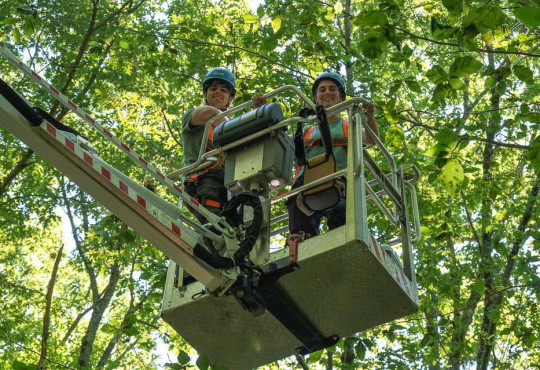
Deep in the woods of Petersham, Mass., the Harvard Forest Summer Research Program in Ecology is cultivating a renewable resource — future generations of scientists.

Forget about the ancient Greek myth of Icarus. For the last 10 years, Jenna Samra, Ph.D. ’18, and her colleagues have been pushing technology to fly closer to the hottest part of the sun. Samra, an astrophysicist at the Center for Astrophysics, an institution jointly run by Harvard and the Smithsonian, leads a scientific quest to study the solar corona.
The incoming professor of English’s fourth novel, “Beginning Middle End,” follows a mother and her 12-year-old daughter as they travel to Sicily, where the duo is figuring out how to reconstruct their lives amid their encounters with the island’s daily life, its winds, waters, and volcanoes.