Scholars turn a critical eye to how Jews and Muslims have misread each other
The all-day conference was split thematically, with a morning focus on Muslim perceptions of Jewish civilization, and an afternoon focus on the opposite.

Number reflects a 15 percent increase from previous year
/ Read time: 2 minutes
Harvard College released data for the Class of 2030 on Tuesday, enrolling 1,648 students from a pool of 55,104 applicants. The number of applicants increased by 15 percent over the previous year. Of the students offered admission, 80.9 percent enrolled, marking a sixth consecutive admissions cycle with a yield above 80 percent.
“A Harvard College education invites students to ask difficult questions, challenge their assumptions, and discover new interests,” said Edgerley Family Dean of the Faculty of Arts and Sciences Hopi Hoekstra. “It is wonderful to see prospective students and their families excited about these opportunities, and I am grateful to the faculty, staff, and students who make the College such a vibrant place to learn.”
In recent years, the FAS and Harvard College have worked to strengthen undergraduate education by putting the classroom at the center of the student experience, encouraging deeper intellectual engagement, and helping students navigate difficult conversations. The Classroom Social Compact reflects these goals, outlining the shared responsibilities of faculty and students in building classrooms grounded in preparation, participation, rigorous inquiry, and open exchange of ideas, including those that challenge one’s own views.
“Each generation has recognized the remarkable opportunities Harvard offers — not only to pursue their own ambitions, but to make a difference in the world,” said William Fitzsimmons, Dean of Admissions and Financial Aid at Harvard College. “The Class of 2030 carries that tradition forward, bringing their own experiences and aspirations to campus.”
The Class of 2030 includes students from all 50 states and 86 countries. Students who applied from outside of the U.S. represent 15.4 percent of the class. Among enrolling students who applied from the U.S., 19 percent of the class are from New England, 23 percent from the Middle Atlantic, 15 percent from the South, 14 percent from the Midwest, and 13 percent from the Pacific region.
First-generation students represent 17 percent of the Class of 2030, and an estimated 21 percent of the class are eligible for federal Pell Grants. The class also includes 12 veterans.
Thirty-nine percent of students receive financial aid that covers their full tuition. More than half of those students qualified for financial aid that covers all their expenses, including tuition, fees, food, and housing.
Of students in the class who self-identified their race or ethnicity, 9.3 percent identified as African American or Black, 43.2 percent as Asian American, 11.4 percent as Hispanic or Latino, and nearly 2 percent as Native American, Native Hawaiian, or Pacific Islander. Students who selected for more than one race are counted in each racial category they identified. Nine percent of the class did not report their race or ethnicity. Racial and ethnic data become available only after the admissions cycle is complete.
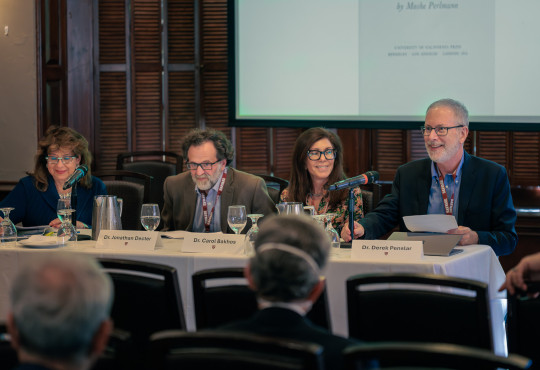
The all-day conference was split thematically, with a morning focus on Muslim perceptions of Jewish civilization, and an afternoon focus on the opposite.

After four years at the University of Michigan, former assistant coach Rob Rassey returns to Harvard as head coach of the men’s ice hockey team. Ahead of his first game on Thursday, he talked about his career journey, how he leads, and what he missed about Cambridge.
The project is unique “because all data, methods, and other procedures are public — something that is not true for any other public forecast we know of,” said co-creator Gary King.