Eileen O’Grady
Harvard Staff Writer
Researchers detail connections between mid-20th-century America’s drug culture and covert CIA experiments
/ Read time: 4 minutes
Harvard Staff Writer
In the 1960s, hippies wanted to free the mind, while the CIA sought to break it.
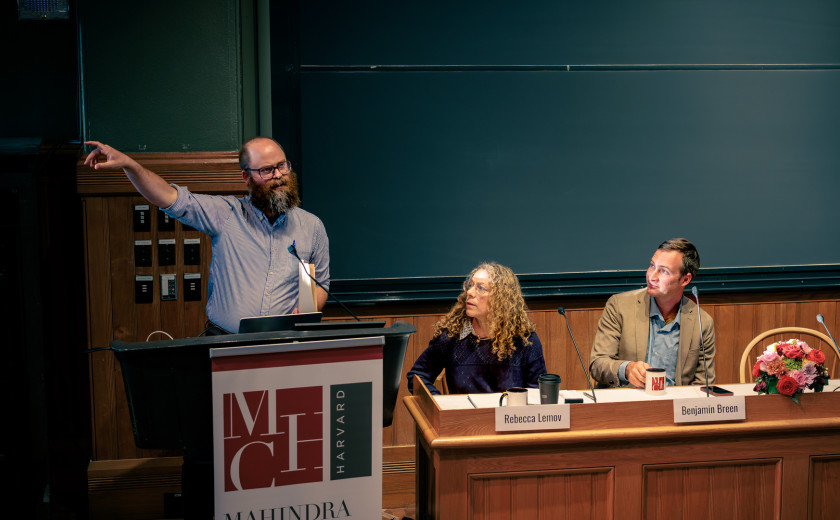
As Rebecca Lemov and J. Christian Greer see it, consciousness-expanding on the streets of San Francisco during the Summer of Love and unethical human experiments in secret government laboratories were anchored on the same premise. At a recent event, the researchers pointed out that members of both groups thought psychedelic drugs could be used to alter the human psyche. The panel conversation, hosted by the Mahindra Humanities Center at Sever Hall, was titled “Psychedelics and the Specter of Mind Control.”
“This dissolution of social condition, this dissolution of a personality, can be coded as both liberation or control,” said Greer, Stanford University lecturer and affiliate professor at the Graduate Theological Union. “It is such a fine line between programming and deprogramming, conditioning and deconditioning, especially when vulnerability is amplified by psychedelics.”
The idea of mind control, that human minds can be “brainwashed” or reprogrammed, gripped the American public after the Korean War, noted Lemov, Professor of the History of Science and author of “The Instability of Truth: Brainwashing, Mind Control, and Hyperpersuasion” (2025).
A group of American prisoners of war were released from Chinese captivity in 1953, with some immediately declaring they did not want to return home. They even publicly voiced support for communism, shocking American news audiences and fueling fears that the POWs’ minds had been altered.
“Brainwashing mushroomed into kind of a cultural and even artistic phenomenon where people were just fascinated by this idea that you could be taken over by something, forces external to yourself, and it would be incorporated as your own will,” Lemov said.
It was this fear that led the CIA in 1953 to start its now-infamous MKUltra program, which sought to understand if “forced behavior change” was possible. Psychiatrists like Louis Jolyon West and Ewen Cameron conducted illegal, top-secret human experiments, combining LSD, hypnosis, sleep deprivation, and sensory manipulation to induce dissociative states.
“[West] claimed in one 1957 article that there was no person who could not be broken through the imposition of these techniques,” Lemov said. “He said you could actually disorient someone to space, time, and self. My point is that LSD was not sufficient, but it was one of several key variables to be combined within a controlled and inescapable environment.”
Outside American laboratories, countercultural groups embraced psychedelic drugs in the 1960s. Except they thought of their experiments as “de-programming” people’s minds from societal norms and expectations, according to Greer.
These groups included the Merry Pranksters, who would distribute LSD-laced Kool-Aid at parties; the Discordian Society, who used drugs to break down reality and sow conspiracy theories; and the Diggers, who provided “social acid” (free food, shelter, and drugs) to people in San Francisco’s Haight-Ashbury neighborhood, with the goal of changing their beliefs about capitalism.
“‘Social acid’ was engineered to blow your mind into new ways of seeing the world, into new ways of being,” Greer said. “The point here, with the free food and the crash pads and the free stores, was conversion. Their program is based on making people see it their way: the world as freedom.”
Some of the era’s thinkers saw dangers in the thin line between mind expansion and mind control. Greer spoke about a theory called “acid fascism,” explored in an influential book from 1972 which suggested that LSD can open the mind to the universe, creating a spiritual hunger and vulnerability which can then be exploited by an authoritarian leader. Charles Manson and his followers, Greer noted, are the oft-cited examples of this dynamic playing out.
Also appearing on the April 6 panel were Benjamin Breen, associate professor of history at the University of California, Santa Cruz, and Tom O’Neill, a journalist who has spent decades researching the question of how Manson managed to quickly develop a following of young hippies so devoted and zealous they would kill at his behest.
O’Neill’s research led him to the two years Manson spent in Haight-Ashbury after being released from prison and assigned to a Bay Area parole officer.
“Manson would come into the [Haight-Ashbury Free Clinic] with the women, who would follow behind him,” O’Neill said. “They weren't allowed to speak unless he spoke to them first. He would order them around. I interviewed lots and lots of people who were there, and they said Manson was like a star there, not because anyone was fond of him but because people were fascinated that this guy had this following and seemed to have all this control.”
In “Chaos: Charles Manson, the CIA, and the Secret History of the Sixties” (2019), O’Neill theorized a link between the U.S. government’s brand of mind control and the influence Manson later wielded over his followers. It was noted that West, the CIA-funded psychiatrist, undertook mysterious research in the Haight-Ashbury neighborhood in 1967. West would lure hippies to his office, set up as a crash pad, to be studied while they used drugs.
O’Neill conceded to being unsure whether he believes the book’s premise. But murmurs coursed through the lecture hall as he described an interview with a psychiatrist and medical doctor who wrote one of the early books on MKUltra.
“I asked him if he thought the Manson murders might have been an experiment gone wrong,” O’Neill said. “He said, ‘Absolutely not. It was an experiment gone right.’”

Could frustration with billionaires and corporate power bring about a resurgence in American democracy? Taeku Lee believes it’s possible.

Joyce Chaplin’s “Rewilding Harvard” is reimagining the Harvard landscape.

The assistant professor of physics and applied math won the grant for cutting-edge neuroscience research.