Clea Simon
Harvard Correspondent

Research led by Christopher Kuzawa, a new arrival in the Department of Human Evolutionary Biology, shows the brain’s energy needs peaking at age five. Now he’s studying the implications for nutrition, society, and public health
/ Read time: 5 minutes
Harvard Correspondent
Childhood is understood as a time to learn and grow. What Christopher Kuzawa’s research shows is that learning and growing are interconnected.
In his first year as professor of human evolutionary biology, Kuzawa has furthered a long-held interest in the brain and its evolution. His research findings help explain why human childhood lasts as long as it does, while also raising new questions for fields like nutrition and public health.
“Many are familiar with the statistic that the brain uses 20 percent of our body’s energy while accounting for only 2 percent of our weight,” Kuzawa said. “I've been motivated to understand how those costs look developmentally, when the brain is even bigger relative to the body and when learning adds additional costs.”
In past work, Kuzawa and his colleagues estimated calories burned by the brain using data from positron emission tomography (PET). The imaging technique can be used to measure the uptake of glucose, the brain’s primary fuel source. Results showed the brain’s share of energy expenditure peaking at age five, when it accounts for two-thirds of the body’s resting energy use.
Interestingly, this is not due to brain growth, which is nearly complete by that stage. Instead, these high energy costs trace to the extra neuronal connections (or synapses) children must maintain to support their rapid pace of learning.
This “excessive energy expenditure has all sorts of fascinating evolutionary consequences,” Kuzawa explained. For example, his group found these costs are met, at least in part, by diverting energy from other uses within the body — especially growth. As humans evolved increasingly costly forms of childhood learning, this slowed the pace of growth and delayed the onset of maturity. That created a longer period of learning prior to adulthood.
The evolutionary implications are clear, but Kuzawa noted that the societal and public health implications “are a completely unwritten book.” Past public health research aimed at improving cognitive outcomes has focused on nutrition during the first few postnatal years, when brain growth is most rapid.
“Our work,” Kuzawa said, “shows that the brain’s energy needs actually peak well after that developmental window, during the preschool years.”
This childhood peak in brain energy needs remains “invisible,” he said, because it traces to the number of neuronal connections rather than to the outwardly visible trait of brain growth. Kuzawa now hopes to assess the impacts of nutrition on the preschool years’ rapidly developing cognitive outcomes, which are known to have lasting effects on educational performance and even future wages.
Collaborating with the Charlestown-based Athinoula A. Martinos Center for Biomedical Imaging — what Kuzawa calls “the world’s premier brain imaging research facility” — has enabled these inquiries into brain energetics. Kuzawa, who arrived at Harvard in January 2025, secured financial support for the partnership via an award from the Star-Friedman Challenge for Promising Scientific Research. The program provides seed funding to Harvard faculty for high-risk, innovative research in the life, physical, and social sciences.
Meanwhile, Kuzawa continues his ongoing work with the Cebu Longitudinal Health and Nutrition Survey, which has followed three generations in the Philippines. The study began by enrolling more than 3,000 pregnant women in 1983. These initial participants are still followed, but so are their children — many now adults, with children of their own. Kuzawa, the study’s lead principal investigator, has been involved since 1998, when he lived in the Philippines and worked in Cebu as part of his doctoral research.
The survey’s decades of data have enabled Kuzawa and his collaborators to pursue numerous questions. For example, cross-sectional studies have compared testosterone levels in fathers and non-fathers. But the Cebu study’s lengthy time span allowed the research team to track hormone levels in men as they became parents for the first time.
Human fathers, Kuzawa explained, are unusual among mammals. “Most mammalian fathers don’t know who their offspring are,” he said.
“In contrast, in 80 percent of bird species, the father helps raise the kids,” he added, noting that avian fathers often help protect the nest, incubate eggs, or feed hatchlings. As a result, birds have evolved an ability to rapidly change their biology as their social roles shift.
“When male birds are mating, their testosterone is really high, but once they become fathers, their testosterone plummets,” Kuzawa explained. This discourages defenses of territory and encourages caring for chicks.
Since humans are among the rare mammals who also exhibit male caregiving, Kuzawa’s team looked into whether fatherhood had the same effect on human testosterone. The inquiry began when study participants were young men, roughly 20 years old, focusing on those who were not yet fathers.
“The ones who had the highest testosterone when the study began were more likely to become fathers five years later. So having high testosterone predicted that they would be more successful at becoming a father,” Kuzawa found.
“But once they did, their testosterone plummeted below the non-fathers,” he continued. “This was really the first demonstration that the changes we see in birds also play out in us.”
The research team’s questions have changed as the Cebu cohort ages. A recent inquiry used newly developed epigenetic “clocks” to understand what experiences and behaviors across the lifecycle accelerate the pace of biological aging — and which have potential slowing effects, with the team also testing models for the evolution of lifespan.
“A lot of the work we do, whether approaching the brain or our work in Cebu, is inspired by evolutionary theory,” Kuzawa said. “When I moved to the Department of Human Evolutionary Biology at Harvard, I had the thrill of joining a group of top-notch scientists dedicated to understanding humans and our evolution.”
“My new colleagues approach human evolution from the perspectives of genetics, physiology, brain evolution, cultural evolution, through comparisons with our primate relatives and by reconstructing the environments that humans adapted to in the past,” he continued. “All my interests really converge here.”
Research described in this report was funded by the National Science Foundation and National Institutes of Health.
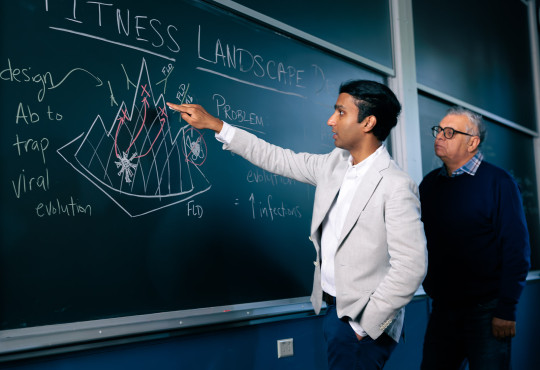
Two Harvard scientists describe a way to engineer the evolutionary landscape that viruses experience, pushing them away from dangerous variants and into evolutionary dead ends.

Amid the rhythms of the back-to-campus bustle, new faculty find themselves experiencing the same first-day excitement — and jitters. We dropped in on three, on the first day of their first classes.

As the sun sinks below the horizon, two scientists perch quietly beside a darkening field and wait for flashes of light. They have traveled far outside the city in search of research sites, because they study a group of creatures that have been driven to the margins of human settlements: fireflies.