Eric Moskowitz
Harvard Staff Writer
“I don’t think there’s a precedent for a program with the breadth of ambition this one has.”
Harvard Staff Writer
UPDATE — April 14, 2026: At a recent Meeting of the Faculty, the Energy, Climate and the Environment (ENCE) concentration was approved by a vote of 215-3.
At burrito nights and coffee chats, the students who gave feedback on a proposed multidisciplinary Energy, Climate, and the Environment (ENCE) concentration frequently said the same thing — “I wish this had been there for me already,” and “How soon can we start?”
If approved at April’s faculty meeting, ENCE would become the first new concentration for Harvard College students since the addition of Environmental Science and Engineering (ESE) in 2018, while bringing the number of defined concentrations to 50, not counting customized concentrations.
An interdisciplinary offering, ENCE would span departments, divisions, and the Harvard School of Engineering and Applied Sciences (SEAS), preparing students with both the broad understanding and the specific expertise to pursue careers addressing humanity’s spiraling energy consumption and confronting climate change, pollution, and biodiversity loss.
“I don’t think there’s a precedent for a program with the breadth of ambition this one has,” said Robin Kelsey, Shirley Carter Burden Professor of Photography in the Department of History of Art and Architecture, one of three coordinators on the 28-member planning committee behind the proposal (itself a reflection of the “deep bench” of faculty eager to meet that student interest). “On the other hand, the problems we face in the world today require that breadth of perspective.”
Other interdisciplinary concentrations typically sit in one primary department. ENCE would draw ladder faculty across divisions while offering four tracks under four different deans:
Within those four tracks, students could further specialize by pursuing different “braids,” or customizable pathways, such as history or art and media within the Nature, Ethics and the Human Imagination track, or energy systems or sustainable computing within the Science and Engineering track.
In that way, the 41-page proposal reads like a “choose your own adventure” book — if all the outcomes conferred specialized knowledge while winding toward a shared resolution. All students would start in a foundational ENCE course team-taught by professors from different disciplines, and they would reconvene as seniors in a capstone project-based class. There they would draw on the perspectives and expertise from their respective educations to tackle a real-world problem together.
That reflects two guiding principles for ENCE — that “it’s very hard to solve problems if you don’t have field depth in something,” and that addressing the climate crisis requires a symphony of coordination by experts across disciplines, said Lene Hau, Mallinckrodt Professor of Physics and of Applied Physics, who coordinated the proposal with Kelsey and Jason Beckfield, the Robert G. Stone Jr. Professor of Sociology
“I might be in the lab with my team and we find a fantastic new material — ‘Oh, my God! We can use this to create the world's best battery! We will change the world!’” Hau said. But not so fast: the technology must be scalable (enter the engineers), and the economics must work. Even then, the project will fail if consumers don’t embrace it, requiring an understanding of sociology and psychology — as well as arts and humanities, from the aesthetics of design to the need for effective communication.
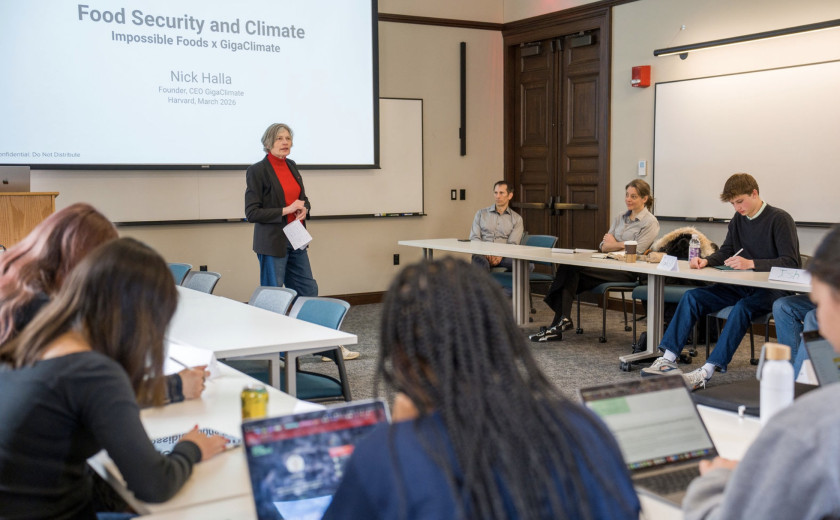
This spring, the foundational course, Gateway to Energy, Climate and Environment, is being taught as a pilot — a “stress test” for the multi-division, multi-school approach, Hau said — to 16 students who signed up in hopes of picking the concentration, pending approval. Their interests span the divisions and SEAS and include a poet from Paraguay who aspires to work for an energy-tech startup, motivated by extreme droughts that have caused conflict between Paraguayan farmers and fishers over water usage.
The class is case-based, with frequent guest speakers, including Nick Halla, “Employee No. 1” at Impossible Foods and founder of climate-tech venture firm GigaClimate; and Bo Cerup-Simonsen, CEO of the Mærsk McKinney Møller Center in Copenhagen, who is working to decarbonize the maritime transportation industry.
The individual lessons are part of a coherent tapestry. Where Hau taught a hands-on lesson about energy and the quantum mechanics of solar cells — wielding atomic structural models, shimmering silicon wafers, handheld flashlights, and military-surplus infrared cameras — Joyce Chaplin, James Duncan Phillips Professor of Early American History, traced the history of harnessed power, including the ways that new energy sources have repeatedly disrupted and transformed human existence.
Hau was fascinated to learn how Art Deco helped drive rural electrification in 1930s America by associating electricity with progress and prosperity — and wondered how that might affect the adoption of more efficient technologies today. Indeed, “heat pumps lack a style,” added Kelsey, quoting a curator friend. “Electricity had a style.”
The planning committee sees ENCE as “additive and complementary to existing concentrations in this broad area,” namely ESE, Environmental Science and Public Policy (ESPP), Integrative Biology (IB), and Earth and Planetary Sciences (EPS). “These problems are enormous, and there’s not one silver-bullet approach,” Hau said.
The proposal arose from years of hearing from students who sought this field of study, and via collaboration within FAS and SEAS and across the University, including the Salata Institute for Climate and Sustainability. “All of us who teach undergrads, and also the faculty deans in the houses, see that they have so much climate anxiety, and at the same time they feel they have no agency,” Hau said. “They really want to be part of the solutions, and this is very much what we’re trying to do.”

The Harvard theoretical physicist and neuroscientist has won the Dirac Medal and Prize, one of the highest honors in physics.
Deep in the woods of Petersham, Mass., the Harvard Forest Summer Research Program in Ecology is cultivating a renewable resource — future generations of scientists.

Forget about the ancient Greek myth of Icarus. For the last 10 years, Jenna Samra, Ph.D. ’18, and her colleagues have been pushing technology to fly closer to the hottest part of the sun. Samra, an astrophysicist at the Center for Astrophysics, an institution jointly run by Harvard and the Smithsonian, leads a scientific quest to study the solar corona.