Eileen O’Grady
Harvard Staff Writer
At Harvard, drummer Raghav Mehrotra ’26 built knowledge about the music industry — and a sizable social media following
Harvard Staff Writer

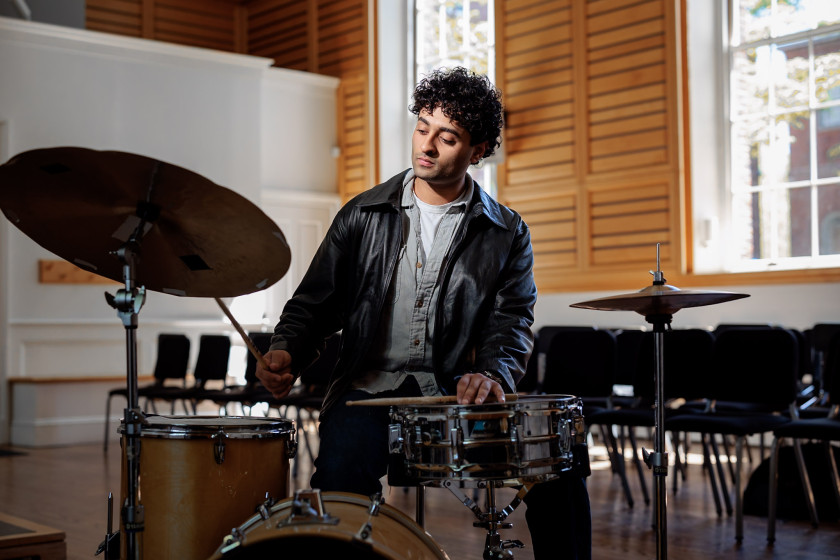
At the start of his first semester, Raghav Mehrotra wasn’t sitting in class. He was sitting in as a guest drummer with the 8G Band for four episode tapings of “Late Night with Seth Meyers” in New York City.
The talk show host couldn’t resist ribbing the 18-year-old about missing his first week at Harvard College.
“Back to school on Monday, right?” Meyers joked. “I’m not writing you a second letter to the Dean!”
Mehrotra, now a senior, is enrolled in the Harvard-Berklee Joint Studies Program, with a double concentration in music and economics and a secondary in philosophy. No matter the discipline, he said, a lifelong passion for music has guided his studies. The drummer and composer found economics helped him better understand the music industry; philosophy shaped his thinking on art; and Berklee refined his performance skills.
“Regardless of what econ class I took, I was able to find a way to put a music spin on it,” Mehrotra said. “And with the music classes, my professors gave me the flexibility to write about music business. In my class about the economics of digitization, for example, I was able to write about consumer risk and ‘genre conformity’ within the music streaming market.”
Growing up in New Jersey, Mehrotra started playing drums at age 3 and was performing by age 4. As a preteen, he kept the beat as Freddy in Andrew Lloyd Webber’s musical adaptation of “School of Rock” on Broadway, which brought him to venues like Madison Square Garden, the Macy’s Thanksgiving Day Parade, and the 2016 Tony Awards.
These days, Mehrotra’s favorite venues are intimate clubs like New York City’s Village Vanguard and the Bitter End, where he plays with jazz trios or other small ensembles.
“Every single movement that the audience makes, directly or indirectly, informs how I play, and the other musicians on stage as well,” Mehrotra said. “The musical conversation on stage turns into a collective conversation between musicians and between the musicians and the audience members. It becomes like a game of ping-pong with 80 balls and 79 rackets.”
An average week for the Cabot House resident involves balancing classes, practice, and sometimes travel for gigs or recording sessions. He might spend the morning in an econ course, take the bus or just bike across the river to Berklee for a midday ensemble, then return to Cambridge for an evening seminar.
“Raghav often carried extraordinarily demanding course loads, sometimes six courses and even seven during his final semester, while also performing professionally with multiple musical groups,” said Cabot House Resident Dean Ken Thomas. “At the same time, he was a real presence in Cabot House. You would see him in the dining hall talking with friends, spending time with his suitemates, or checking in with people.”
Mehrotra has performed on campus with the Harvard Jazz Orchestra and Hasty Pudding Theatricals. He recently appeared at Arts Fest with the Yard Bops cover band.
“He has consistently demonstrated seriousness, talent, and a remarkable work ethic — always going out of his way to seek knowledge and new experiences,” said Yosvany Terry, senior lecturer on music and director of Harvard Jazz Orchestra. “He asks thoughtful questions and is always ready to help his peers and classmates. I truly believe his voice and talent will be deeply missed in the Harvard Jazz Orchestra and the Department of Music.”
As a junior, Mehrotra co-founded the Harvard Undergraduate Music Business Association with his classmate Matteo Wakeman ’26. The idea came from Mehrotra noticing how many students enjoy performing music but don’t see it as a viable career path.
“I hate the trope of ‘starving artist’ because there’s so many ways in which you don’t have to be a star, but you can be an artist and be very successful,” Mehrotra said.
Practicing happens whenever he can find a moment alone with the drum sets in Holden Chapel, Memorial Hall, the SOCH Studio, or in one of the houses. He carries a small drum pad just in case no sets are available.
“Whenever I have the opportunity to be with a set of drums, I try to treat the time like gold, because it’s very valuable,” Mehrotra said.
He started posting videos from his practice sessions on social media, initially just for friends. But his following quickly skyrocketed. Today, he has more than 76,000 followers on Instagram.
He still keeps the videos casual, recording himself with little more than a phone propped on a music stand. Mehrotra finds the platform helps build rapport with live audiences. “What better way to connect with a musician than to show yourself practicing?” he said. “Every musician does.”
Mehrotra completed a creative thesis in the Department of Music, a series of pieces reflecting on being diagnosed with Type 1 Diabetes at age 7.
“Raghav found a way to turn something deeply personal into work that feels thoughtful, vulnerable, and genuinely human,” Thomas said. “Type 1 diabetes has never defined Raghav, but I do think it has refined him — deepening his empathy, sharpening his sense of purpose, and shaping the honesty that comes through so clearly in both his relationships and his music.”
Now Mehrotra is developing an interactive sound art project that allows people with diabetes to “hear” their glucose levels. Users will be able to upload data from a continuous glucose monitor to a program Mehrotra created, which transforms the readings into original compositions and creates a sonic map of the day’s fluctuations.
“My relationship with how I played drums changed a lot,” Mehrotra recalled of his diagnosis. “My relationship with how I toured and performed and thought about music and my body’s relationship to how I produce art, all completely changed.”
Following Commencement, Mehrotra plans to seek grant funding to expand his project. He hopes to exhibit the work as an installation in hospital or museum settings.
“Being a diabetic almost feels like you’re at a table for one, where you’re able to engage with the community around you, but everybody is not able to fully understand or engage with you on every level,” he said. “This will maybe help create awareness in a small way.”

The Harvard theoretical physicist and neuroscientist has won the Dirac Medal and Prize, one of the highest honors in physics.
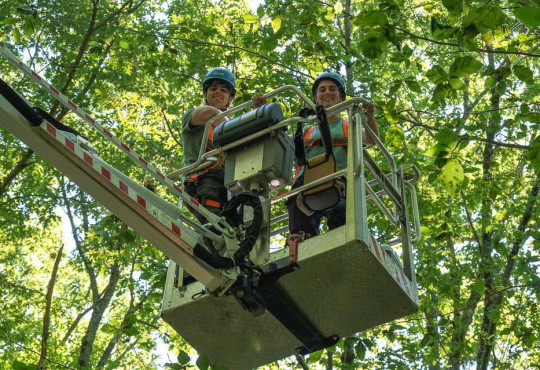
Deep in the woods of Petersham, Mass., the Harvard Forest Summer Research Program in Ecology is cultivating a renewable resource — future generations of scientists.

Forget about the ancient Greek myth of Icarus. For the last 10 years, Jenna Samra, Ph.D. ’18, and her colleagues have been pushing technology to fly closer to the hottest part of the sun. Samra, an astrophysicist at the Center for Astrophysics, an institution jointly run by Harvard and the Smithsonian, leads a scientific quest to study the solar corona.