Eileen O’Grady
Harvard Staff Writer
The instrument was handpicked by composer, pianist, and professor Vijay Iyer with help from FAS staff
| 4 minutes
Harvard Staff Writer
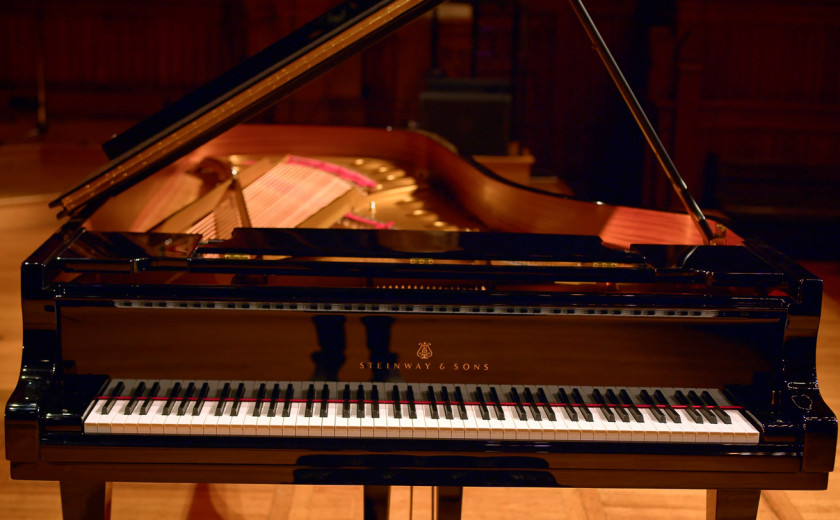
As Harmony Zhu ’28 laid her hands on the keys, Frédéric Chopin’s Prelude Op. 28, No. 19 in E flat major began to flow from the belly of the grand piano. It filled the Sanders Theatre stage, where audience members sat eager to hear the instrument’s first notes.
Zhu, a psychology concentrator enrolled in the Harvard–New England Conservatory Dual Degree Program, performed at the official unveiling of Sanders Theatre’s new piano this month. The Office for the Arts-hosted event was organized to honor the 150th anniversary of the historic performance and lecture space.
The piano, a Steinway & Sons Model D Concert Grand, was purchased with funding provided by Harvard College. “This is an investment in the next 150 years of great performances, great experiences, and great conversations,” David Deming, Danoff Dean of Harvard College, told the audience. “This will pay off so many times over. This place makes meaning for all of us here, over and over again, in all kinds of ways.”
Piano Technical Services and the Office for the Arts worked with Vijay Iyer, Franklin D. and Florence Rosenblatt Professor of the Arts and Professor of African and African American Studies, to choose the instrument. Iyer went to the selection room in the Steinway & Sons New York City factory with Piano Technical Services Manager Mariana Quinn and Senior Concert Technician Paul Rattigan to test out various options.
It didn’t take long before everyone agreed they had found an “unusually strong” instrument, according to Iyer.
“It took a lot of pairs of ears, but we all felt it,” he said. “This is a pretty special instrument that is somehow that ‘unicorn’ that can do everything.”
Iyer said his main goal during the selection process was to find something versatile, knowing it would be used for events ranging from student ensembles to celebrity recitals. It needed to be powerful enough to fill the 1,000-seat theater while maintaining an even sound across both low and high registers. It also needed enough depth, character, and nuance to accommodate the expressiveness of a professional pianist playing a solo concert.
“This one has this rare combination of attributes: It can work very well for all those cases,” Iyer explained. “It has this bite that can work if you’re playing Rachmaninoff in front of an orchestra. It can really dominate if it has to. It can sing if it has to. It can support if it has to. It’s a pretty special instrument.”
The piano, which measures almost 9 feet long and close to 1,000 pounds, was delivered this summer to Harvard’s Piano Shop, where Rattigan spent hours tuning the strings, regulating the tone, and making sure all moving parts functioned correctly.
Unlike a new car, which is road-ready when it leaves the factory, Rattigan said a piano can require a year or two of follow-up work.
“It’s helping the pianist realize their creative vision,” Rattigan said. “Little details: the alignment of the hammers to the strings. On every key there’s probably at least 10 different adjustments, and they all have to be consistent — note-to-note for all 88 notes. Then there’s the mechanical side of things. Then there’s the sound side of things. All the notes have to get along well with their neighbors.”
One morning in early August, a crew transported the instrument from Harvard’s Francis Avenue Piano Shop down the street to Memorial Hall. The team moved with choreographed precision, tilting the piano on its side, removing the legs and wrapping each piece in protective blankets for its brief journey inside a truck. Once inside Sanders, the team used a metal ramp to roll the piano from the main floor to the stage.
Andrew Gitchel, director of Memorial Hall, said having a high-quality performance piano in the building is “critical” for supporting all the community rehearsals and concerts happening on that stage.
“Everyone that comes into Sanders expects the best,” Gitchel said. “That includes the service from our team that supports these events, and the resources that we provide. When we have these high expectations, we want to meet them. Having this beautiful Steinway really lets everyone know that we are a professional organization. It says, ‘We have the equipment, and we’re here to meet the expectations of all our constituents.’”
The theater’s former piano, now around 30 years old, is still in good working order but no longer performs at concert level, according to Quinn and Gitchel. It has been retired from the main stage to a rehearsal room.
Rattigan, who will continue to visit Memorial Hall to tune and maintain the piano as needed, said he looked forward to observing people’s reactions as they hear or play the instrument for the first time.
“This is probably the finest sounding piano I’ve ever been personally involved with in my long career here, and in the business in general,” Rattigan said. “I’m so excited to hear it on stage, and confident that anyone who comes in is going to find it more than adequate for their needs.”
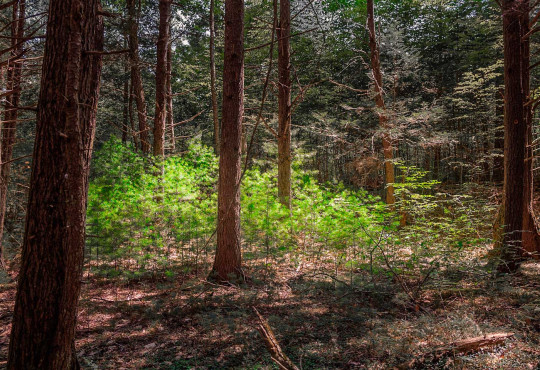
Sixteen years ago, an invasive pest called the woolly adelgid arrived at Harvard Forest and slowly began to devastate its the eastern hemlocks — as they had done in forcce elsewhere. Since then, Harvard Forest scientists have begun to study how to manage the demise of its so-called foundation species.
The John L. Loeb Associate Professor of the Humanities and associate professor of African and African American Studies is one of eight U.S. visual arts writers to receive the award this year.

Professor Sarah Lewis’s curated exhibition, “If Emmett Till Lived: Freedom on American Ground,” opened September 10 at the Museum of Contemporary Photography in Chicago.