Kermit Pattison
Harvard Staff Writer
Research offers new insights on managing forests devastated by invasive pests
/ Read time: 8 minutes
Harvard Staff Writer
This is a story about doomed trees, deadwood, and new life.
Sixteen years ago, an invasive pest called the woolly adelgid arrived at Harvard Forest and slowly began to kill the eastern hemlocks emblematic of the 4,000-acre research site.
After witnessing the devastation to hemlock forests elsewhere, Harvard Forest scientists braced for a wholesale ecological turnover and began to study how to manage the demise of its so-called foundation species.
That research now has yielded a surprising insight: The remains of dead trees have helped nurture saplings of the same species. A recent paper in Science Advances described how the Harvard Forest hemlocks and other foundation species across the plant and animal kingdoms continue to shape their environments long after death. This new realm of research is poised to become increasingly relevant amid climate change and other human-induced changes to the planet.
“Even when these foundation species die, they still have these profound influences on the ecosystem,” said co-author Audrey Barker Plotkin, senior researcher and site manager at Harvard Forest in Petersham, Mass. “That’s the new concept here — when they die, these material legacies have really interesting effects on what happens next.”
The roots of the hemlock saga run deep.
In 1907, Harvard Forest was founded as a student laboratory, research center, and forestry demonstration site. Located roughly 65 miles west of the University’s Cambridge campus, the site is a palimpsest of centuries of ecological change.
The evolution of the landscape is captured in a series of dioramas, on view at Harvard Forest’s Fisher Museum, that depict the major stages: the old-growth hemlock forest populated by the indigenous Nipmuc, small farms cleared by European homesteaders in the 1700s, an open landscape of farms and pastures peaking in the 1800s, the abandonment of farms, and regrowth of white pines and hardwood forests.
Gradually, the slow-growing hemlocks reasserted themselves as one of the dominant tree species. These coniferous evergreens shape the forest ecosystem because they produce cool, shady conditions and thickly carpet the ground with their needles. Hemlocks can live up to 500 years.
Today, ecologists are braced for yet another change at the site. The hemlock woolly adelgid — an aphid-like insect from Asia — has gradually been spreading and destroying the forest’s majestic giants.
In 1951, the insects arrived in Virginia via an imported Japanese hemlock. Over the following decades, these poppy-seed-sized insects gradually infested millions of hemlocks across the eastern United States. Although they rarely fly, adelgids spread easily via birds, animal fur, or human activities such as transporting firewood.
The insects sustain themselves by inserting feeding tubes into the tree’s twigs to suck out sap. It remains unclear if the woolly adelgids kill hemlocks by starvation, toxic saliva, inducing cell death in the trees, or some combination of those factors.
But there is no question about the result. Ancient trees drop their needles, wither, and die. Saplings never mature into adulthood. Shady hemlock forests give way to open sunny patches.
Researchers are still searching for ways to combat the pest. As former Harvard Forest Director David R. Foster lamented in the book “Hemlock: A Forest Giant on the Edge” (2014), “We remain helpless in slowing the spread of the adelgid or constraining its impact in the region’s forests … Unimpeded, the insect progresses in its relentless spread, and the hemlocks in our woods continue to disintegrate.”
In 2003, the forest began an experiment to prepare for the devastation.
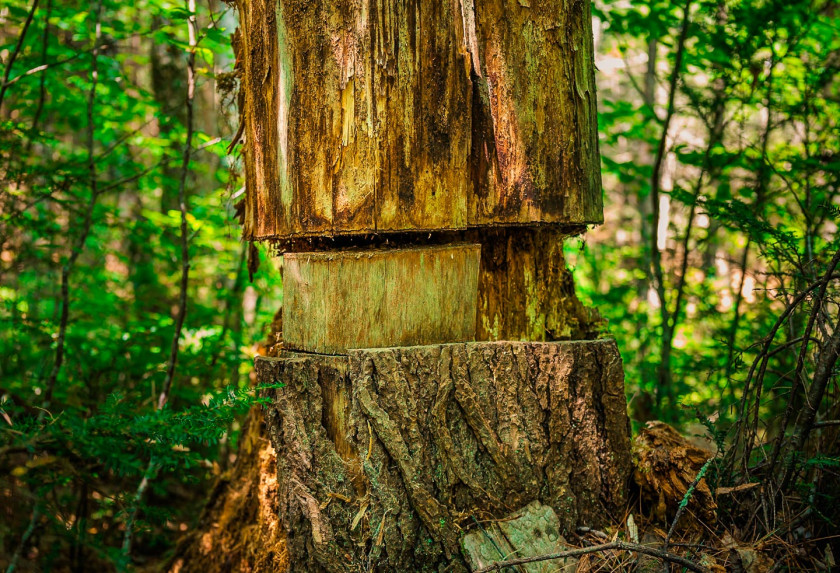
In some test plots, hemlocks were killed by “girdling” — a technique in which the bark and outer trunk were cut — but left standing to simulate trees killed by the pests. In other tracts, the hemlocks were logged, a simulation of a timber harvest.
Both techniques stripped away about 70 percent of the overstory and unleashed major changes to the ecosystem. But when the dead hemlocks were left in place, the changes were slower — a less dramatic increase in sunlight exposure, fewer changes in the mix of species, and less disruption to the ecosystem.
In both cases, black birch — a fast-growing species that thrives in full sun — became the most abundant tree species. But when hemlock trunks were left in place, their saplings retained a toehold in the ecosystem.
The findings joined a larger body of research on how the remains of foundation species continue to shape ecosystems long after death.
Foundation species are those that dominate ecosystems in numbers or biomass, sit near the base of the food chain, and strongly influence other species by creating habitat or dominating nutrient cycles. Due to their abundance, foundation species leave behind substantial physical remains — their so-called material legacies.
The Science Advances paper constitutes the first continental-wide examination of how the remains of foundation species influence their living descendants. It examined a variety of ecosystems on land and sea, including kelp forests, tallgrass prairies, oyster beds, Everglades mangroves, coastal marshes, and varied types of forests.
In nine of 10 ecosystems studied, the remains of foundation species significantly influenced the demography of their living survivors — sometimes promoting their growth and other times inhibiting it.
In oyster reefs, larger amounts of dead shells supported higher density of new shellfish colonies. In boreal forests, the remains of burned black spruce trees promoted higher seed density in the soils.
In some ecosystems, however, the remains had a negative effect. In tropical coral reefs, dead coral skeletons left after a marine heat wave accelerated the decline of living corals. In tallgrass prairies, the accumulation of litter limited regrowth — at least until a burn.
“Material legacies rarely serve as passive debris,” the authors observed, “but instead routinely shape population dynamics of foundation species and, by extension, the structures of communities and processes of ecosystems.”
Lead author Kai Kopecky, an ecologist at the University of Colorado Boulder, added: “The Harvard Forest hemlock example was one of the strongest effects we found across all the ecosystems we looked at.”
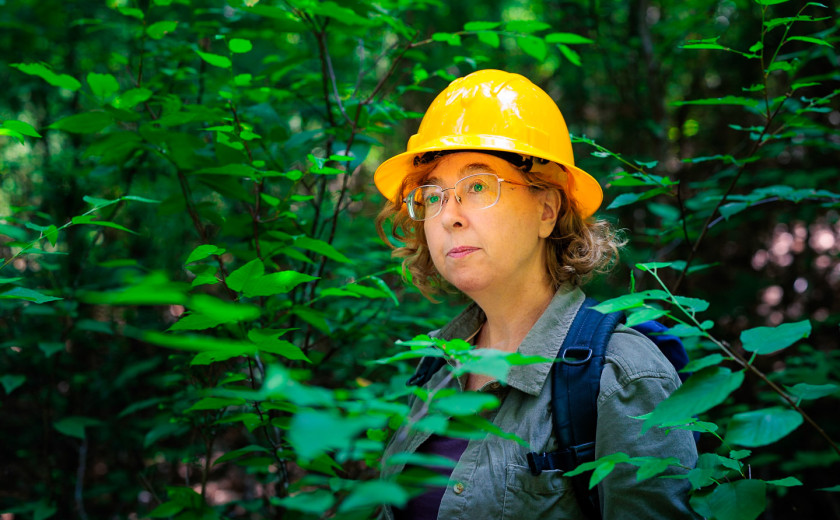
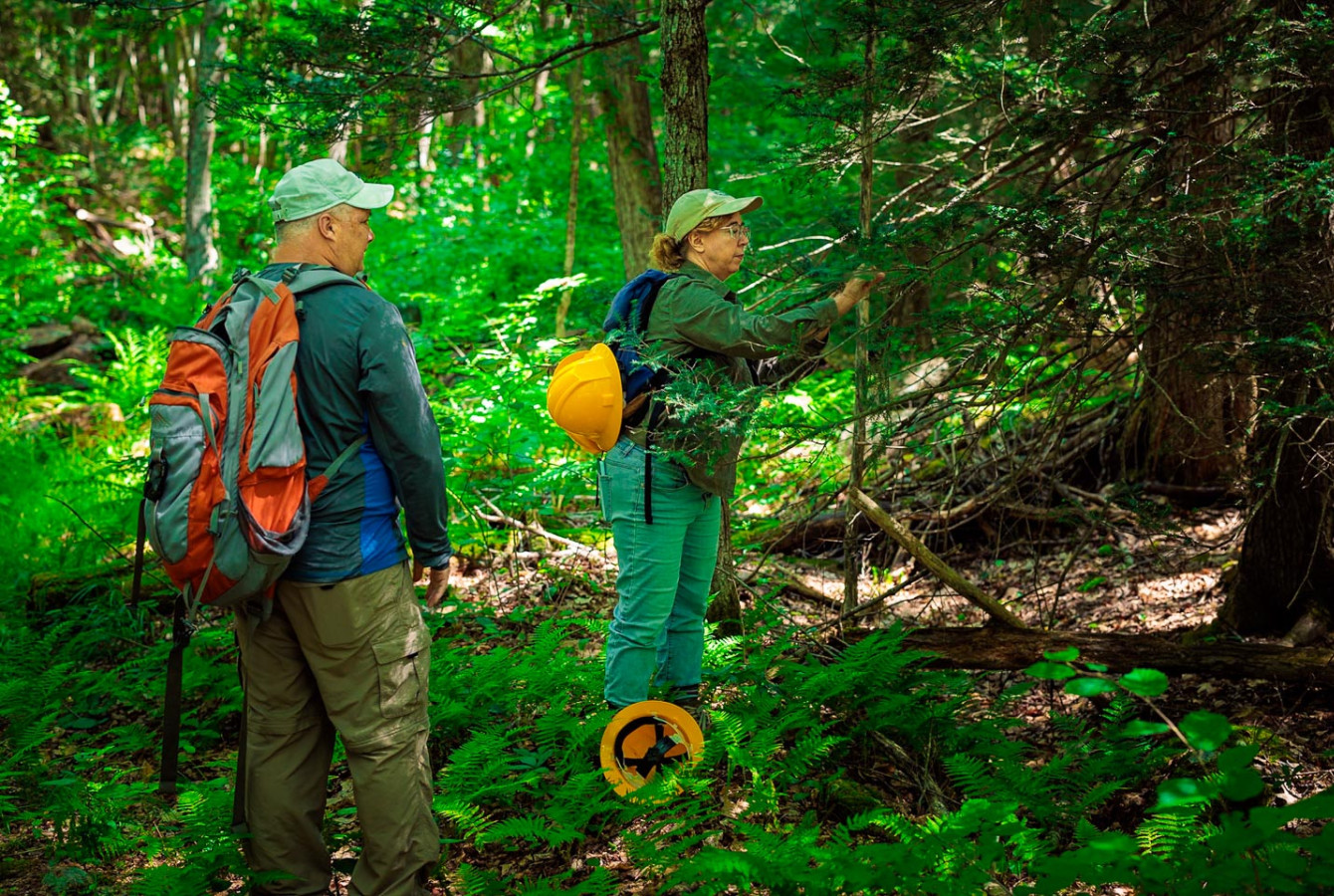
One summer morning, Barker Plotkin and Harvard Forest senior ecologist David Orwig donned hard hats and hiked into Harvard Forest toward their research plots. Overhead, the 100-foot canopy rustled in the breeze as they walked along a shaded lane bordered by stone walls — remnants of bygone pastures, cleared by farmers centuries ago, that have been reclaimed by the forest.
They passed through a classic hemlock forest with a towering canopy and cool, shaded floor mostly clear of undergrowth. But portents of mortality were everywhere. Again and again, they found skeletal trunks of dead hemlocks or ailing ones with bare branches and discolored needles.
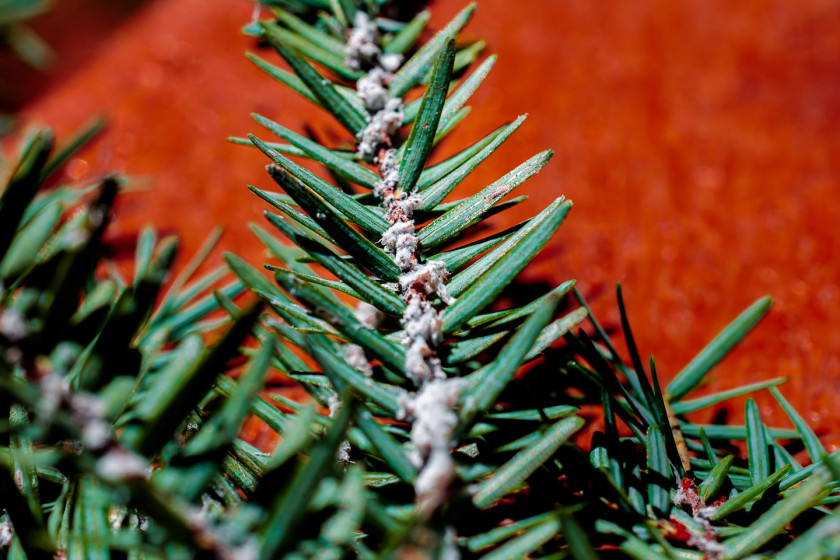
Orwig gazed at one hemlock, turned over a branch, and pulled a magnifying glass from his pocket. “If you look at the base of each needle, you’ll see a black speck — each one of those is an adelgid,” he said.
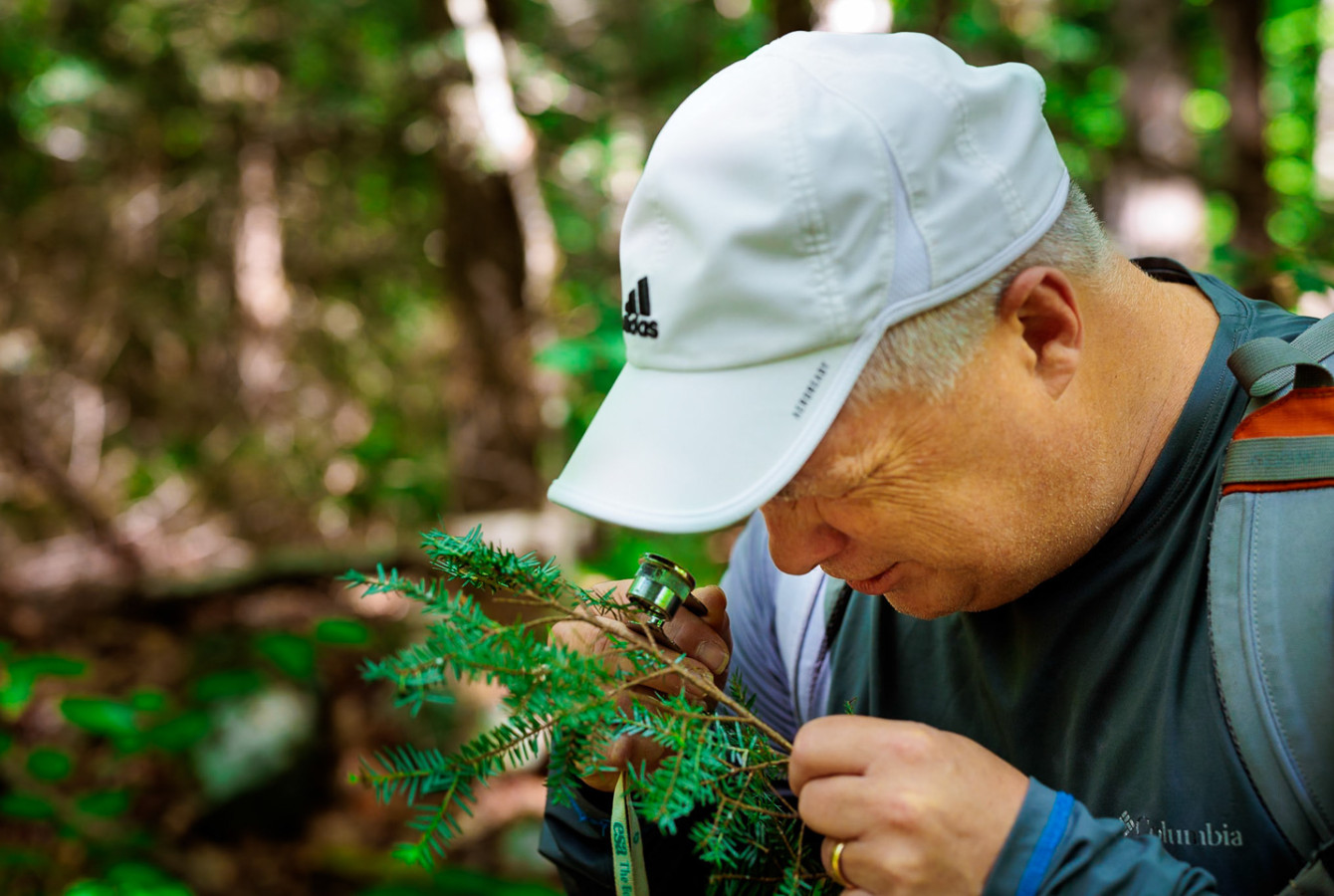
Indeed, every needle contained a female that could lay up to 150 eggs. The herringbone pattern of green needles was dotted by a waxy, cottonlike substance — the protective cases that inspired the name woolly adelgid.
In North America, the population consists entirely of females who reproduce via a form of asexual reproduction called parthenogenesis. They produce two generations every year. In two years, 10 insects can beget 30 million descendants.
Orwig began monitoring woolly adelgids at forest plots in Connecticut 30 years ago and routinely saw hemlocks wiped out within five years. He expected the same devastation at Harvard Forest, as the invasive pests soon made their way north. But many hemlocks at the research station have continued to limp along, with some surviving upwards of 20 years after infestation.
“We don’t know how long they can survive that,” he said. “I’ve seen the first tree now in my career that I know has had adelgid for 30 years, and it’s still alive. They don’t look good, but they have lived longer than I ever thought they would.”
The scientists continued trekking, and soon the shaded canopy thinned into sunny clearings with thickets of pale green leaves of fast-growing black birch. These were the experimental plots that yielded new surprises.
They stepped past moose droppings and eyed chest-high hemlock saplings that had been browsed by big herbivores. “When the forest opens up and the shrubs are coming in, it’s like a magnet for deer and moose,” Barker Plotkin said. “They love to browse young forests.”
They picked their way through the plot where the dead hemlocks had been left in place and stepped over fallen trunks. Barker Plotkin believes that the hemlock deadwood preserved a shady environment friendly to new generations of the species.
“Birch is winning, but hemlock is still in the mix,” Barker Plotkin said. “It’s not as tall as the birch, but because it’s so shade-tolerant it should be fine. The thing that might make it not fine is that the adelgid is still here.”
Over nearly two decades of monitoring, areas where dead hemlocks remained in place produced far more hemlock saplings. For example, in 2023, only 106 hemlock saplings per hectare grew in the plots that had been cleared, but 1,384 sprouted in the areas where the deadwood of the species remained.
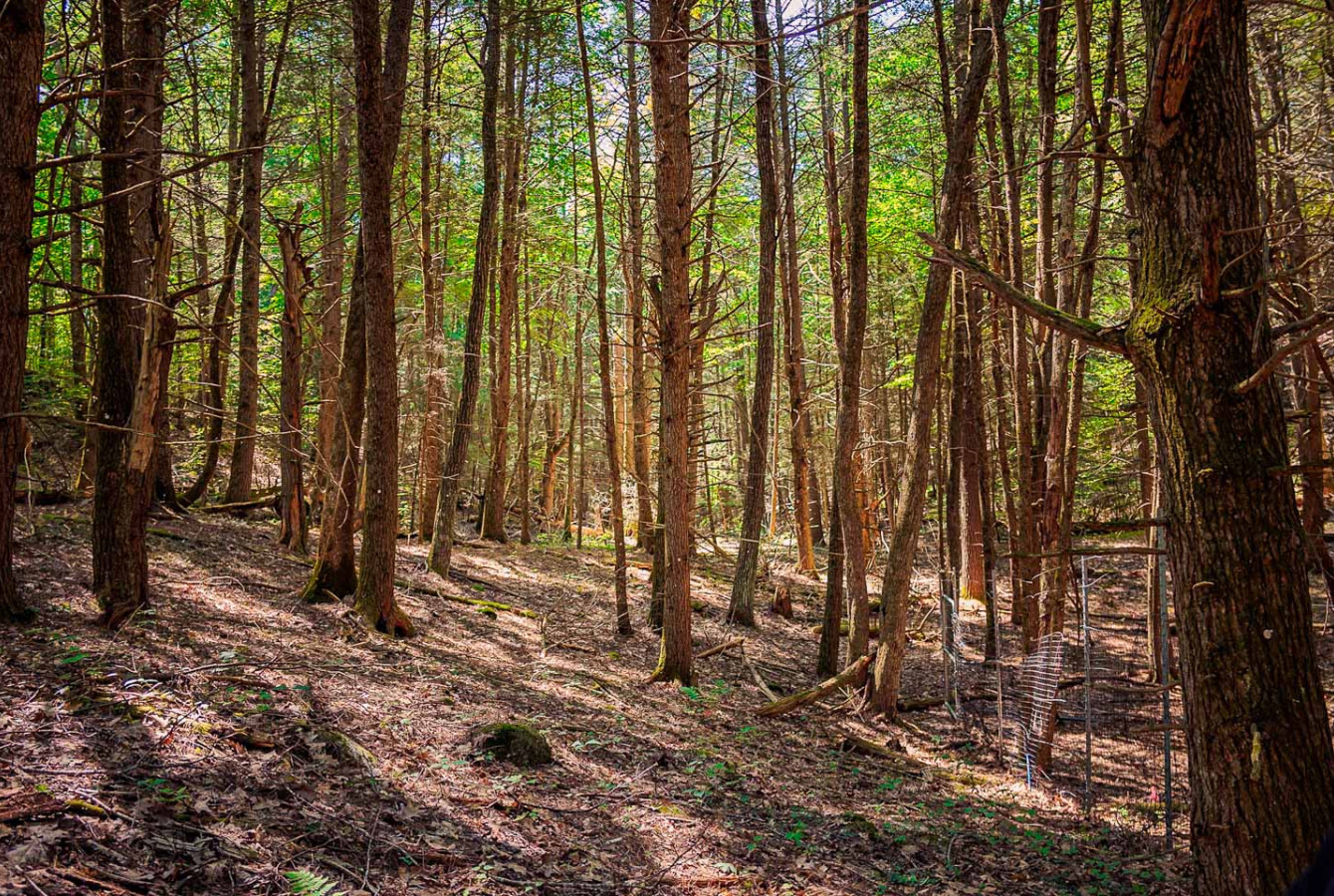
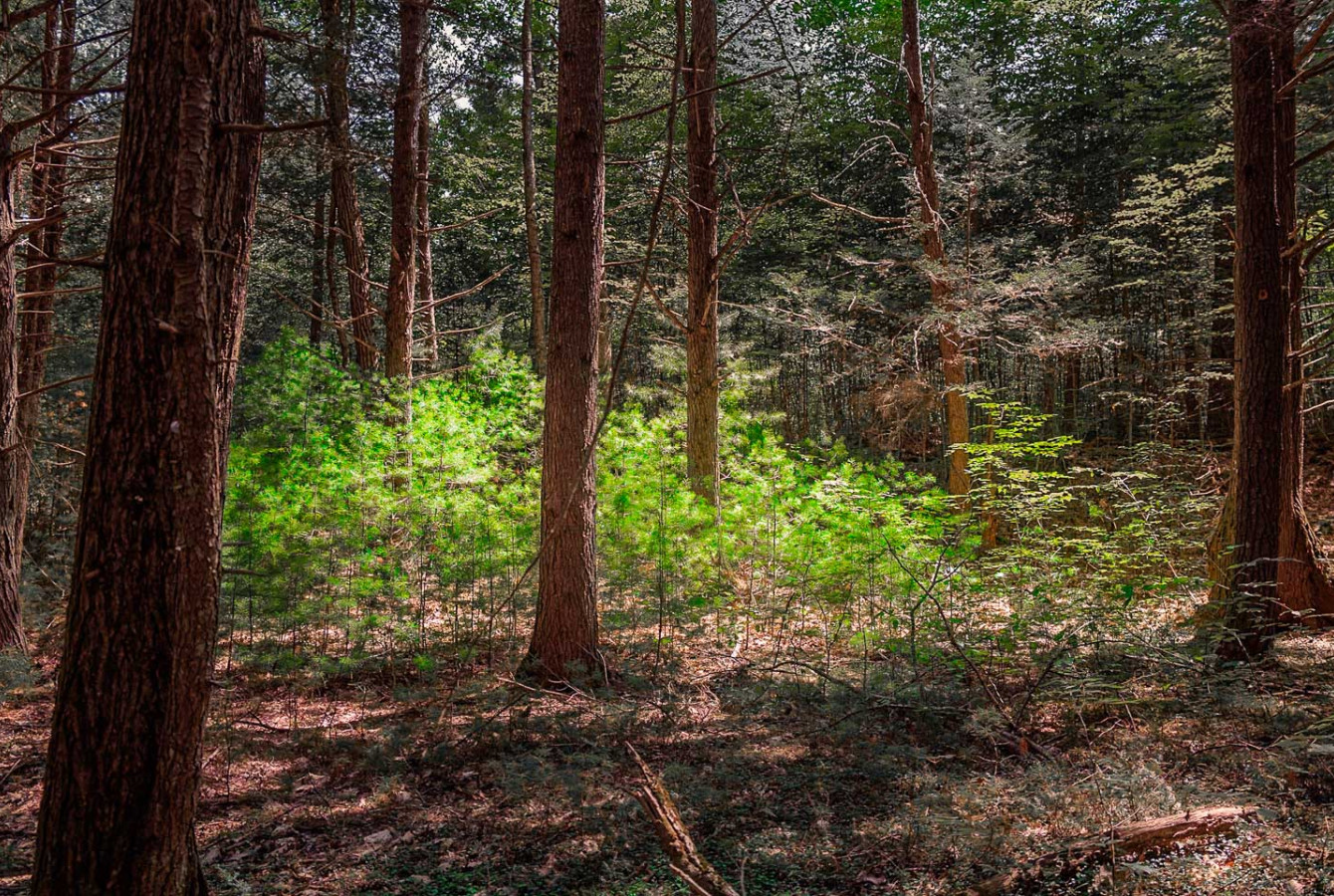
These findings offer insights for managing the forest after an infestation. Sometimes, it seems, it is better to leave the deadwood in place. In other words, the best hemlock conservation strategy might be doing nothing and letting nature take its course.
“There’s lots more here,” said Orwig as he brushed past the hemlock saplings. “They’re getting fed on — and they’re still hanging in!”
“You can see hopeful things on these, because these light green needles are from this year,” Barker Plotkin added. “So they’re doing well enough to put on new needles. A declining hemlock is not going to put on new needles.”
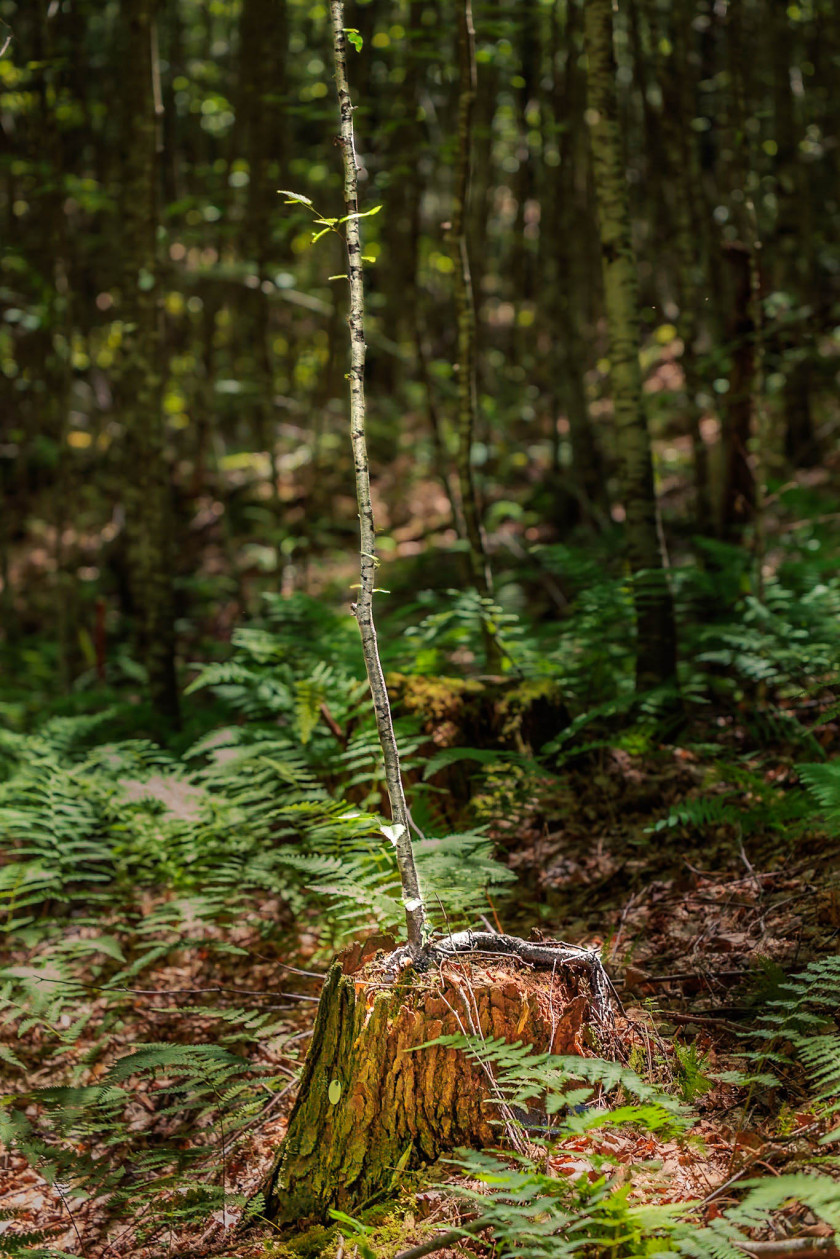
As they waded through the thicket, they came across a hemlock stump where a black birch had sprouted. It was the perfect anecdote for the future forest: Deadwood of the foundation species had become a flowerpot for its replacement.
“That,” Barker Plotkin said ruefully, “is pretty emblematic.”

The John L. Loeb Associate Professor of the Humanities and associate professor of African and African American Studies is one of eight U.S. visual arts writers to receive the award this year.

Piano Technical Services and the Office for the Arts worked with Vijay Iyer, Franklin D. and Florence Rosenblatt Professor of the Arts and Professor of African and African American Studies, to select the “unusually strong” instrument.

Professor Sarah Lewis’s curated exhibition, “If Emmett Till Lived: Freedom on American Ground,” opened September 10 at the Museum of Contemporary Photography in Chicago.