Kermit Pattison
Harvard Staff Writer

Evolutionary biologist Daniel L. Lieberman airs his concerns about the revolutionary new class of weight-loss drugs.
/ Read time: 8 minutes
Harvard Staff Writer
Why take a walk or a run when you can just take a pill? These are burning questions in the new era of revolutionary weight loss drugs.
Daniel Lieberman, Edwin M. Lerner II Professor of Biological Sciences and Professor of Human Evolutionary Biology (HEB), studies the evolution of the human body — and how our prehistoric adaptations sometimes are ill-matched to modern lifestyles. In a new perspective piece for the Journal of the American Medical Association (JAMA), he and coauthors Daniel H. Aslan (a postdoctoral fellow in HEB) and Steven B. Heymsfield (a researcher at Louisiana State University) explain why physical activity — particularly strength training — is still important for dieters, especially those on glucagon-like peptide (GLP-1) receptor agonists.
GLP-1s mimic a gut hormone that regulates blood sugar, signals satiety, and reduces hunger. Originally developed for Type 2 diabetes, these drugs (under brands such as Ozempic and Wegovy) have proved highly effective for reducing weight and have surged in popularity. By last year, one in eight American adults used GLP-1s for weight loss.
In an interview, edited for length and clarity, Lieberman explored the benefits and potential concerns surrounding these powerful drugs. He also explained why exercise remains potent medicine for anyone trying to manage their weight.
What prompted you to write the JAMA piece?
I'm interested in the effects of physical activity on health and weight, and just about everybody is now interested in GLP-1s because they’ve been transformative for many people.
The other reason I am interested in GLP-1s is that my lab is studying sarcopenia, which is age-related muscle loss. We’re doing research on this topic both in Rwanda and here in the United States, trying to understand the evolutionary basis for how, when, why, and to what extent different people lose muscle mass as they age. Concerningly, now there's evidence that that GLP-1s may be putting a large number of Americans at risk of this condition.
The obvious antidote to this problem is exercise, but many physicians struggle with the issue of prescribing exercise to their patients. Everyone knows that exercise is good for helping prevent age-related muscle loss, but a lot of physicians are frustrated by the knowledge that their patients don’t exercise; in fact, only about one-fifth of physicians even ask their patients if they exercise regularly.
Why is an evolutionary perspective useful for physicians as they consider prescribing weight loss drugs to patients?
An evolutionary perspective is necessary to explain why we are the way we are. We weren’t engineered or designed — we evolved! Thus, an evolutionary perspective explains why we tend to gain weight and keep it, why we evolved to be physically active, why physical activity helps us age more slowly and be less vulnerable to disease, and why we tend to avoid exercise.
For decades, people imagined a futuristic alternative to exercise — you could just take a pill. Well, now a pill is here. How is today’s reality different from what was previously imagined?
GLP-1s are a game changer for many. They can be extraordinary, as close as you can get to magic in medicine. But there's no such thing as a magic pill. Everything comes with trade-offs. Although GLP-1s are helping a lot of people, they also come with some costs and some limitations.
Most importantly, from my perspective, they don’t substitute for exercise. Exercise has manifold benefits. Studies have shown that something like a thousand genes can be turned on by exercise, affecting countless repair and maintenance processes throughout your body. You’ll never be able to replicate that bonanza of benefits with a pill. You would need an entire truck worth of pharmaceuticals, and then you’d have side effects from all those drugs.
One of the benefits of exercise — and there are many — is that it helps you grow muscle. There are some pills which may help you grow muscle a little bit, but I think we can agree that exercising is a better way to grow muscle than taking a pill.
And why does that matter? Well, a big problem is that while people on GLP-1s typically lose a lot of body fat, which is great, they also lose a lot of muscle. According to some studies, as much as one-third of the weight some GLP-1 users can lose isn’t fat but instead muscle.
In addition, more than half of GLP-1 users quit taking the medication — and when they regain weight, they typically gain mostly fat, not muscle. A big concern is what will happen to these individuals when they get to be in their 70s, 80s or 90s. How much will they suffer from frailty?
Are the long-term health effects of GLP-1s still an open question?
Yes. We’re conducting an enormous experiment on millions of people without having done the randomized controlled studies beforehand.
One key part of your argument is the distinction between efficacy and effectiveness. Briefly, what is the difference and how is it important for understanding GLP-1s and exercise?
Efficacy is how well something works in ideal conditions — when you have a supervised study that ensures everybody is getting the appropriate dose. Effectiveness is how well something works in the real world — when you're not in a doctor’s office, in a controlled experiment, or whatever.
This difference is important, because some people look at the data on how much exercise affects weight, and conclude, “Oh, it's not very effective.” But when you look at these studies, the reason they are not effective is often because either the dose was too small to have an effect, and/or the adherence to the dose was poor.
In your JAMA perspective, you conclude by saying, “disinclination to exercise is often a normal instinct.” But in earlier research, you described how humans evolved to remain active for several decades past reproductive age. How do you reconcile those two observations?
Our hunter-gatherer ancestors were physically active. The average 70-year-old hunter-gatherer is 10 times more active than the average American. According to published studies, the average 70-year-old hunter-gatherer gets about 150 minutes of moderate to vigorous physical activity a day, and we’re struggling to get people to do that in a week.
But hunter-gatherers aren’t physically active because a doctor told them to exercise; they are physically active because it’s how they survive and how they get their food. Like us, sometimes they play, dance, and engage in sports, but they don’t go to the gym to get on a treadmill or lift weights. Instead, they are physically active for only two reasons: when it’s necessary or rewarding, and otherwise they sensibly take it easy.
For many Americans today, physical activity is no longer necessary and for many people it’s unrewarding. As a result, about half of Americans never exercise.
You cite figures that GLP-1s typically reduce caloric intake by 16 to 39 percent, but 150 minutes of brisk walking per week only represents 3 to 4 percent of energy expenditure for the typical person. Is it hard to make the case for exercise if energy is the sole criteria?
People often ask me, what’s better for losing weight, diet or exercise? I think it’s a terrible question. Why is it a trade-off? For most people, it should be diet and exercise.
If you want to lose weight and maintain your weight, there’s no question that diet is more efficacious because its calorie effect on energy balance is much larger. But there is good evidence for supplementing every diet with exercise. One of my favorite studies — just one of many — was done here in Boston. Researchers recruited some Boston police who were obese or overweight and put them on a low-calorie diet. Half the police on this diet also exercised. Everyone lost a lot of weight, but the ones who also exercised lost a little more weight. But here’s the big difference — the ones who continued to exercise after the diet was over kept the weight off, but almost all the ones who didn’t exercise regained the lost weight.
That’s a significant effect because most diets don’t last forever, and once they end the body often tries to regain lost weight through increased appetite. And that’s exactly what happens with GLP-1s — when people go off them, their hunger and weight comes roaring back. What’s more, much of the weight they regain is not muscle, it’s fat. So they end up with a higher percentage of body fat, which is not good.
So, yes, you will lose more weight if you diet than if you exercise, but dieting with exercise helps you lose slightly more weight, helps you maintain the weight loss, helps you maintain your muscle mass, and benefits your cardiovascular system, your metabolism, your brain, and much more.

Being born a few days on either side of the school-enrollment cutoff date might seem like an arbitrary difference. But new research finds boys born just after the cutoff, who start kindergarten relatively old for their grade, enjoy far more advantages than previously known.
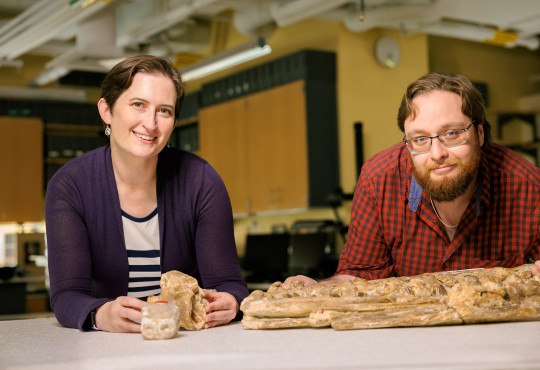
After 80 million years, a giant fossil jaw has quite a story to tell. Back in the age of the dinosaurs, Tylosaurus proriger was a fearsome predator — a bus-sized aquatic reptile with a crushing snout, daggerlike teeth, and knack for swallowing prey whole. How its bones wound up at Harvard is a tangled yarn involving a Wild West stagecoach station, the early western railroads, the infamous “Bone Wars” between rival fossil hunters, and a founding scholar of natural history.

New research by economist Rebecca Diamond found an increase in marriage among single women and an increase in employment rates among unemployed women after they started taking GLP-1 drugs for weight loss. Diamond says the pattern suggests that at least part of the female obesity penalty — the social and financial costs women bear due to their body size — is linked to first impressions.